Clear Sky Science · en
Forced changes in Atlantic overturning are distinctly fingerprinted by South Atlantic western boundary transports
Why the Atlantic’s Slow-Motion Engine Matters
The Atlantic Ocean hides a gigantic, slow-moving conveyor belt of water that helps set the climate for much of the planet. This circulation, known as the Atlantic Meridional Overturning Circulation (AMOC), redistributes heat, carbon, and nutrients between the tropics and the polar regions. Scientists fear that human-driven warming could weaken this system, with far‑reaching consequences. This study asks a crucial question: if the AMOC changes, where in the ocean do we see the clearest and most reliable signs? The answer, it turns out, lies not in the stormy North Atlantic where deep waters form, but thousands of kilometers away along the western edge of the South Atlantic.
Tracing a Hidden Climate Conveyor
The AMOC can be pictured as a three‑dimensional loop. Near the surface, warm salty waters flow northward, release heat to the atmosphere, and then cool and sink in the northern North Atlantic. These colder deep waters then creep southward at depth before eventually rising and returning north again in other ocean basins. Because this overturning connects distant regions, a slowdown in northern deep‑water formation should, in principle, send a coherent signal along the whole Atlantic. Yet what we can actually measure at any given place is not the full conveyor, but local currents and flows. The challenge is to identify which of these local motions best reflect slow, externally forced shifts in the AMOC, and which are mostly noisy, short‑term wiggles driven by winds and internal variability.
Peering 22,000 Years into the Past
To tackle this, the authors used two large climate simulations that track the evolution of Earth’s climate from the height of the last ice age, 22,000 years ago, to the pre‑industrial era. These simulations include changes in incoming sunlight, greenhouse gases, ice sheets, and meltwater entering the North Atlantic. By carefully separating slow, long‑term trends from faster, short‑term fluctuations, the team examined how AMOC changes propagated through the Atlantic and how they showed up in the horizontal currents we can, in principle, observe. They compared patterns of circulation in the North and South Atlantic, looking in particular at strong currents that hug the continents—the western boundary currents—and how tightly their strength tracked that of the AMOC over many different time scales.
South Atlantic: A Clear Signal, North Atlantic: Mostly Noise
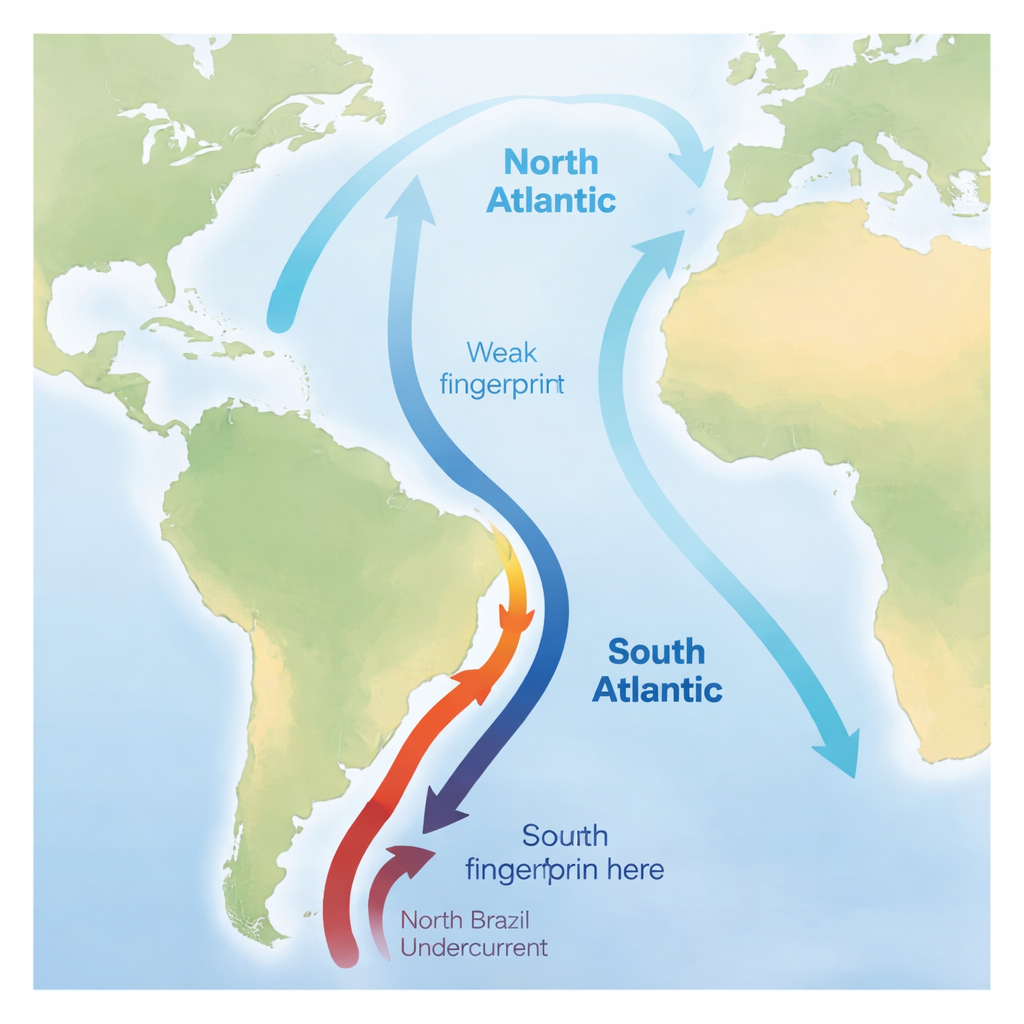
The analysis reveals a striking contrast between hemispheres. When the AMOC strengthens or weakens over centuries to millennia, the resulting changes in flow are spread unevenly across the basin. In the North Atlantic, much of the adjustment is taken up by broad interior currents and flows along the eastern boundary near Europe and Africa. The Florida Current and Gulf Stream, famous surface currents along North America, respond strongly to short‑term, wind‑driven variations but only weakly and inconsistently to long‑term shifts in the AMOC. In other words, they are good at reflecting the AMOC’s “weather” but not its “climate.” In the South Atlantic, by contrast, the response concentrates along the western boundary off Brazil, where the northward‑flowing North Brazil Undercurrent and southward‑flowing Brazil Current act together as a sensitive gauge of slow changes in the overturning.
The Brazilian Coast as a Fingerprint of Change
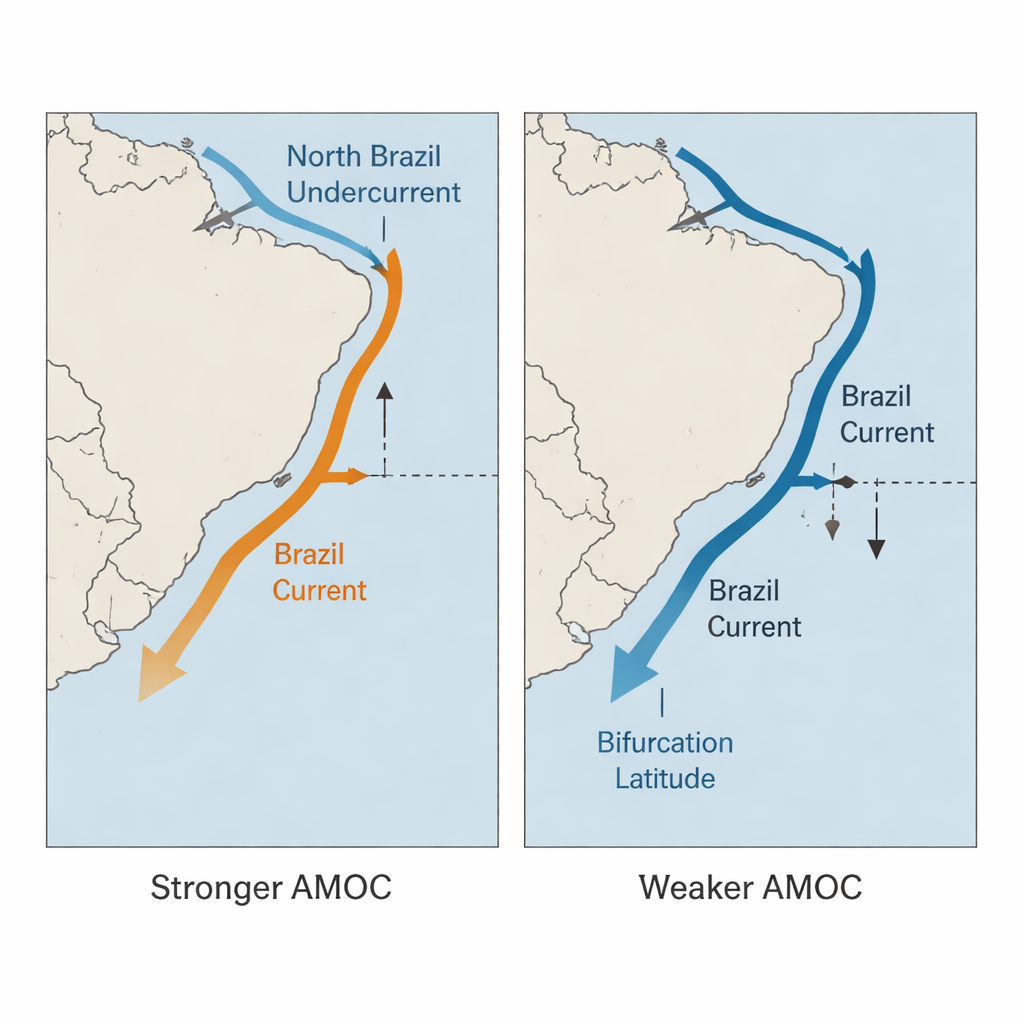
Along the Brazilian margin, the study finds that nearly all of the long‑term, AMOC‑driven redistribution of mass is handled by a tight interplay between the North Brazil Undercurrent, the Brazil Current, and the latitude where the southern South Equatorial Current splits to feed them both. When the AMOC weakens, less water flows northward in the undercurrent and more turns south into the Brazil Current; the point where the flow splits shifts toward the Equator. When the AMOC strengthens, the pattern reverses. Crucially, these South Atlantic boundary currents are only weakly disturbed by long‑term wind changes. In fact, on long time scales, the winds tend to reinforce rather than obscure the AMOC‑driven signals. As a result, the strength of these currents, and the position of the splitting point, track the AMOC remarkably closely over the entire 22,000‑year period.
What This Means for a Warming World
The study concludes that the western boundary currents of the South Atlantic provide a uniquely clear “fingerprint” of externally forced changes in the AMOC, such as those driven by greenhouse gases and ice‑sheet melt. While the North Atlantic’s famous currents are heavily influenced by short‑term wind patterns and internal variability, the Brazilian boundary currents faithfully mirror slow, basin‑wide adjustments in the overturning circulation. This suggests that as human activities push the climate system toward a weaker AMOC, careful monitoring of currents along the South American coast—rather than relying only on northern observations—could offer an early and robust readout of how one of Earth’s great climate engines is responding.
Citation: Marcello, F., Wainer, I., de Mahiques, M.M. et al. Forced changes in Atlantic overturning are distinctly fingerprinted by South Atlantic western boundary transports. Commun Earth Environ 7, 184 (2026). https://doi.org/10.1038/s43247-026-03282-9
Keywords: Atlantic overturning circulation, South Atlantic currents, ocean climate change, paleoclimate simulations, Brazil Current