Clear Sky Science · en
Increased contributions of climate-driven wildfires to nitrogen deposition in the United States
Why Western Wildfires Matter for Everyone
In recent years, images of giant wildfires raging across the American West have become painfully familiar. We usually focus on the smoke we can see and breathe, but this new study asks a deeper question: what happens to all the nitrogen in that smoke after the flames die down? The answer matters for forests, grasslands, lakes, and even our air quality across the United States. Using two decades of detailed computer reconstructions, the authors show that climate-driven wildfires are quietly reshaping how nitrogen moves through the atmosphere and where it lands on the ground, with growing consequences for sensitive ecosystems.
Fire, Heat, and a Drying Atmosphere
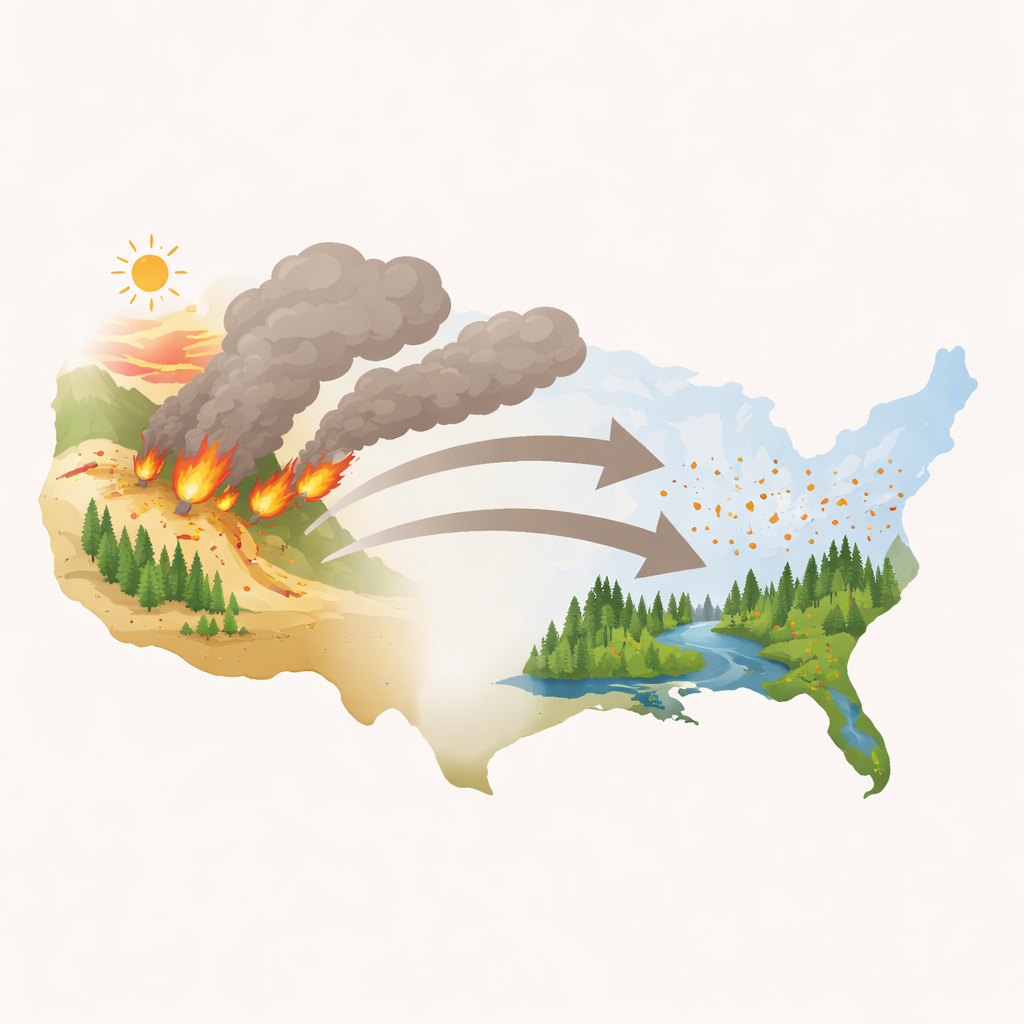
The researchers start by linking fire behavior to a warming, drying climate. They analyze 20 years (2002–2021) of data for the contiguous United States, focusing on temperature and a measure called vapor pressure deficit, which describes how thirsty the air is for moisture. In western regions, especially the West and Northwest, years with hotter temperatures and drier air strongly line up with years when many more acres burn. After about 2011, the western states see a clear shift toward more frequent years with unusually large burned areas, peaking around 2020. In contrast, in the eastern U.S., wildfire sizes have generally declined, influenced by wetter conditions and different vegetation and landscapes.
Smoke as a Moving Source of Nitrogen
Wildfire smoke is not just a haze; it is packed with reactive nitrogen compounds that can travel long distances. The study examines nitrogen released as nitrogen oxides and ammonia, together called reactive nitrogen. Nationally, pollution from vehicles, power plants, and industry has dropped sharply over the past two decades thanks to clean-air regulations. But wildfire emissions have not followed the same downward path. In some western regions, wildfires now contribute around 10–20% of nitrogen oxides and 20–30% of ammonia emissions. The authors find that as the air becomes drier—another sign of climate change—wildfire nitrogen emissions tend to increase, especially in the western mountain and coastal regions.
Where the Nitrogen Finally Lands
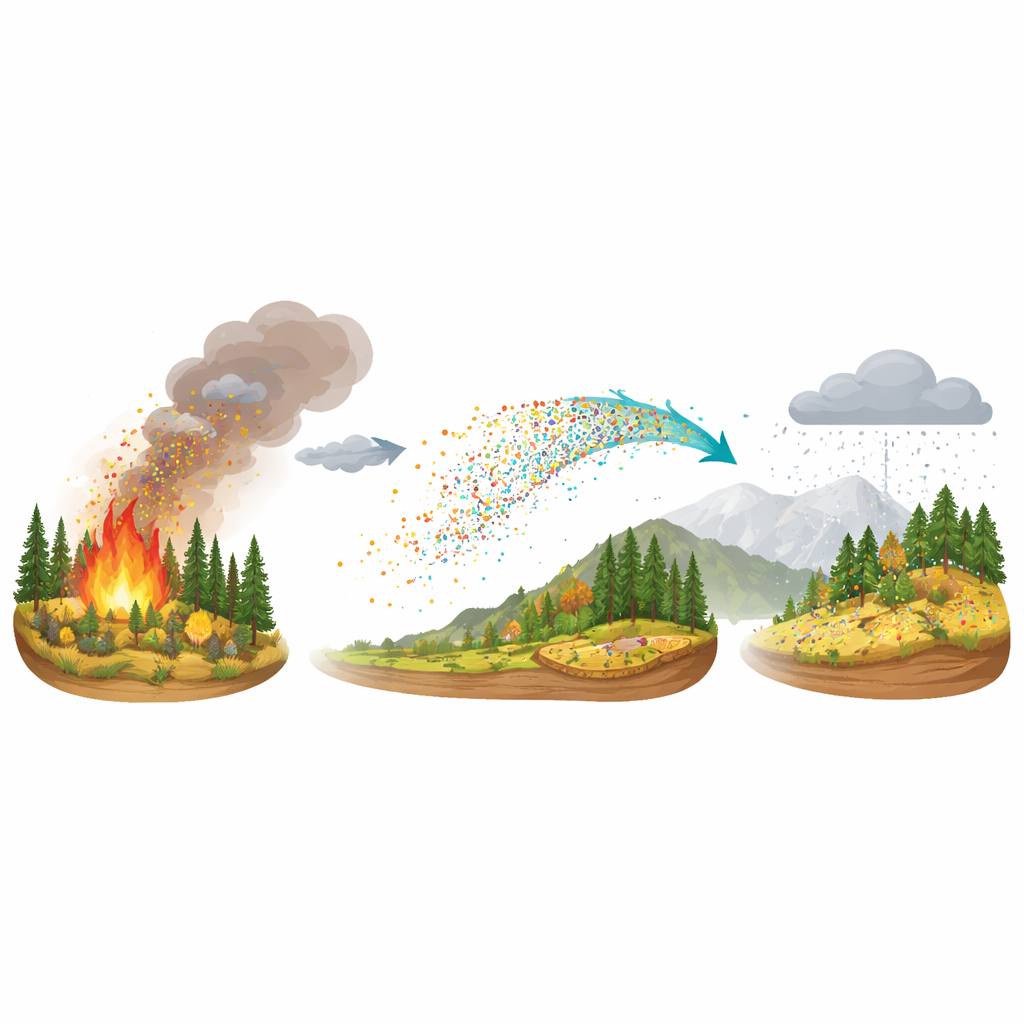
To see how this nitrogen affects the land, the team runs two massive, harmonized simulations: one that includes all fire emissions and one that removes them. Comparing these “with-fire” and “without-fire” worlds reveals how much extra nitrogen ends up on ecosystems because of burning. Across the country, stricter pollution rules have pushed overall nitrogen deposition downward. Yet fires are bending that curve back up in key places. In the West and Northwest, fires increase local nitrogen deposition by as much as 76% in some grid cells, and across these regions the contribution from fires grows by roughly 0.5–1% per year. By 2020, fire-related nitrogen can account for about 20% of total deposition in the West and up to 40% in the Northwest. Much of this extra nitrogen arrives as ammonia-based compounds that tend to fall out of the air directly onto leaves and soil in dry form rather than being washed out by rain.
Stress on Forests and Grasslands
Ecologists use the idea of a “critical load” to describe how much nitrogen an ecosystem can receive each year before it starts to suffer—through loss of sensitive lichens, shifts in plant communities, soil acidification, or water quality problems. The authors compare their modeled nitrogen deposition to two conservative thresholds for western U.S. forests and herbaceous plant communities. While total nitrogen loads have generally declined since 2002, adding in wildfire emissions flattens that downward trend and, in some cases, pushes ecosystems back toward or above the point of concern. In the West and Northwest climate regions, wildfires raise the ratio of nitrogen deposition to critical load by up to 20–40%, nudging vulnerable forests and grasslands closer to levels associated with biodiversity loss and other long-term damage.
What This Means for the Future
For a layperson, the takeaway is that cleaner cars and power plants have reduced many traditional forms of air pollution, but climate-driven wildfires are becoming a growing, harder-to-control source of nitrogen pollution. In western states, larger and more frequent fires are increasingly dominating how much nitrogen falls on ecosystems, especially as dry conditions favor direct deposition of ammonia-rich compounds onto land. Even as human-made emissions decline, fire-related nitrogen is slowing or reversing environmental gains and raising the risk that sensitive forests and grasslands will cross damaging thresholds. The study’s long-term, continental-scale view suggests that adapting to climate change will require not only managing smoke for human health, but also rethinking fire and land management to protect the hidden nitrogen balance that underpins ecosystem health.
Citation: Campbell, P.C., Tong, D.Q., Chang, S. et al. Increased contributions of climate-driven wildfires to nitrogen deposition in the United States. Commun Earth Environ 7, 254 (2026). https://doi.org/10.1038/s43247-026-03279-4
Keywords: wildfires, nitrogen deposition, climate change, air pollution, ecosystem health