Clear Sky Science · en
Higher, but more variable, annual CO2 emissions from lakes in drier Arctic landscapes
Why Arctic Lakes Matter for Our Climate
The Arctic is warming faster than the rest of the planet, and its soils hold vast amounts of frozen carbon. Much of that carbon ultimately passes through lakes before reaching the atmosphere. This study asks a deceptively simple question with big implications: do lakes in wetter Arctic regions release more carbon dioxide (CO2) than lakes in drier regions, or is the reverse true? By stitching together data from more than 200 lakes across Alaska, Canada, Greenland, Siberia and Scandinavia, the authors reveal that some of the strongest and most unpredictable CO2 emissions are actually coming from drier Arctic landscapes, challenging long‑held assumptions about how water and carbon move in the far North.
Where the Lakes Are and How Wet They Are
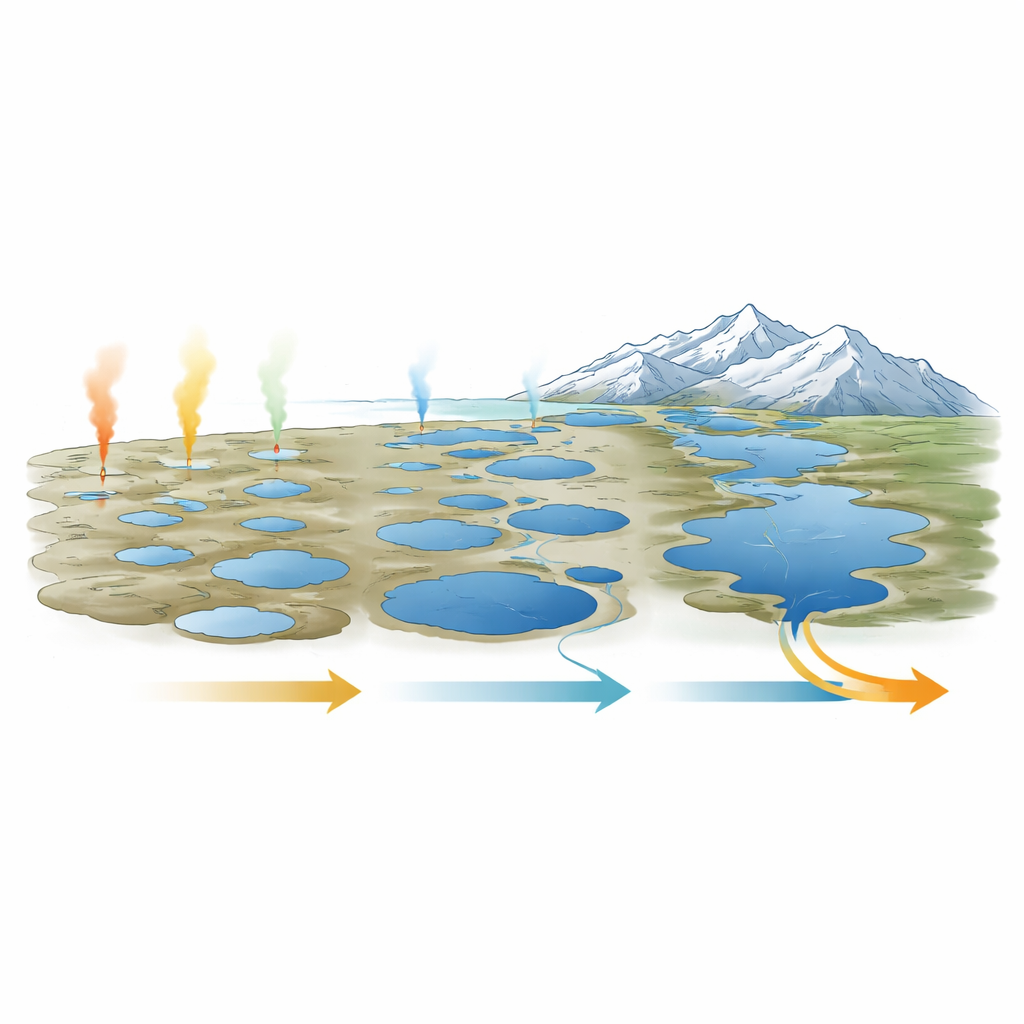
The researchers began by mapping Arctic lakes against a simple climate measure: summer water balance, defined as rainfall minus the amount of water that could evaporate. Regions where losses exceed inputs were tagged as “drier,” and those with a surplus as “wetter.” Surprisingly, nearly 60% of the northern permafrost zone falls into the drier category, and these drylands contain about 2.7 times more lakes than wetter regions. Using long‑term climate records and high‑resolution elevation maps, the team also characterized each lake’s surrounding terrain—how steep or flat it is, how much soil carbon it holds, and whether wetlands are present.
More CO2 from Drier Places, and Much Less Predictability
Contrary to the idea that wetter regions, with more runoff, should feed lakes with more carbon and thus more CO2 emissions, the data showed the opposite pattern. Over 80% of all lakes were net sources of CO2 to the atmosphere, but lakes in drier regions emitted more CO2 on average and with far greater lake‑to‑lake variation. Both the lowest and the highest annual CO2 fluxes in the entire dataset came from these dryland lakes. When emissions were scaled to the size of each lake’s catchment, drier regions again stood out, with more than an order of magnitude higher emissions than wetter regions. This suggests that in dry landscapes, lakes act as concentrated “hotspots” where carbon is transformed and released rather than simply passed along.
How Water Pathways Shape Carbon Fate
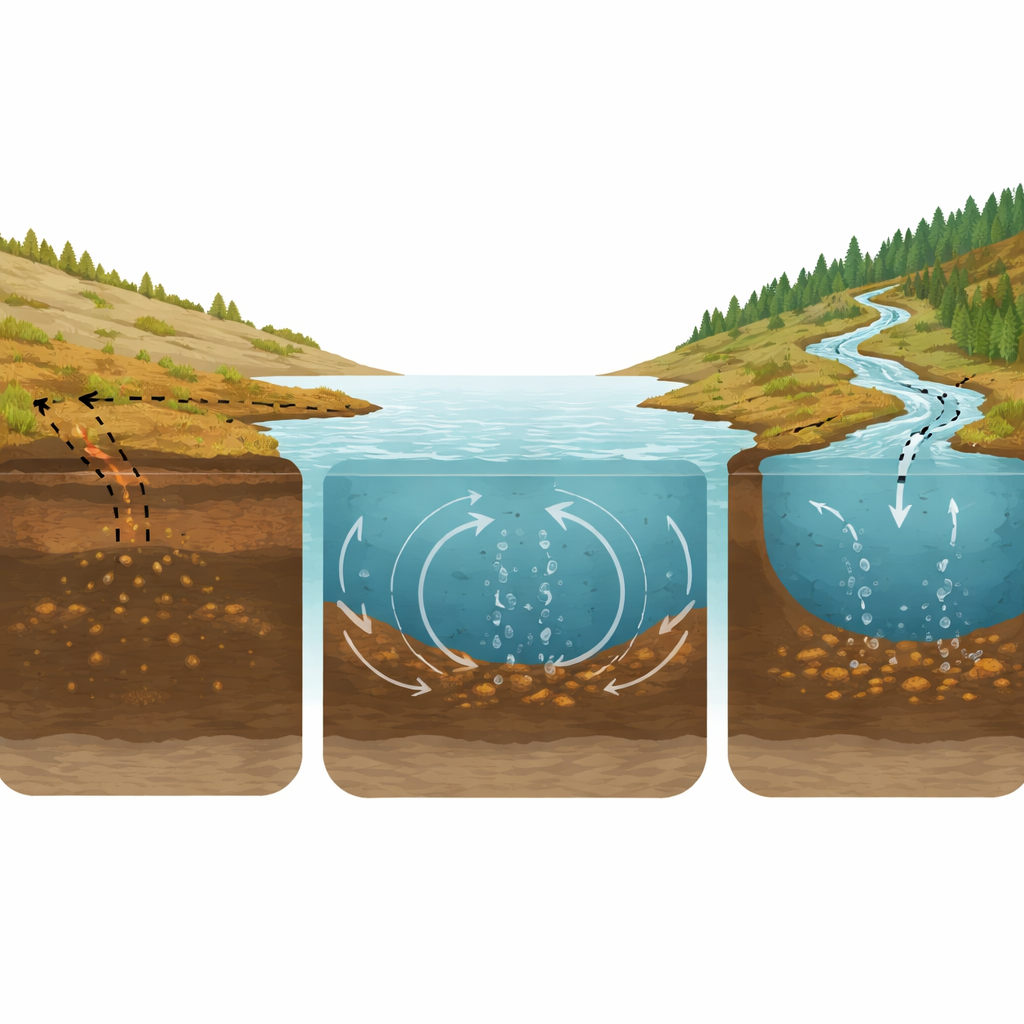
To explain this contrast, the authors focus on how water moves. In wetter, often more mountainous regions, ample rainfall and steeper slopes create strong connections between soils, streams and lakes. Carbon washed off the land tends to be carried rapidly through small rivers, with relatively short pauses in lakes. In this “pipe‑like” setting, water does not linger, so lakes export much of the incoming carbon downstream instead of emitting it on site. In drier, flatter areas, by contrast, streams are sparse or episodic, and many lakes have little or no surface outflow. Water that does reach them can stay for long periods, allowing organic matter to accumulate, break down slowly in the water and sediments, and release CO2 over extended times. This “reactor‑like” behavior helps explain both higher average emissions and the striking variability from one lake to another.
Wetlands and Hidden Carbon Stores
Wetlands add another twist. Roughly 40% of the lakes in the study had wetlands in their catchments, which act like sponges for both water and organic matter. In wetter regions, lakes draining wetlands did emit more CO2 than lakes without wetlands, but only by about a factor of two. In drier regions, however, the presence of wetlands was associated with an eight‑fold jump in emissions. Flat, low‑lying peatlands in places like the Russian Lowlands can store huge volumes of water and carbon; when conditions are right, they leak carbon‑rich water into connected lakes, feeding high CO2 release. Across the Arctic, drier catchments also tend to have thicker, more carbon‑rich soils, providing a large but unevenly tapped stock of material that can be mobilized by rain, snowmelt or permafrost thaw.
Looking Ahead in a Changing Arctic
The study concludes that as the Arctic’s water cycle intensifies—with shifts in rainfall, evaporation, and permafrost stability—changes in lake CO2 emissions will depend not just on how wet a region becomes, but also on its topography, soil carbon stores and wetland extent. Because drier regions currently dominate the Arctic landscape and host many of its lakes, their highly variable emissions could strongly influence the region’s overall carbon balance and make future behavior harder to predict. For non‑specialists, the takeaway is clear: Arctic lakes in dry landscapes are not quiet backwaters, but dynamic reactors where stored carbon can be efficiently turned into CO2. Understanding when they act as strong sources, modest sources, or even temporary sinks will be essential for building accurate climate forecasts in a rapidly changing North.
Citation: Hazuková, V., Alriksson, F., Gudasz, C. et al. Higher, but more variable, annual CO2 emissions from lakes in drier Arctic landscapes. Commun Earth Environ 7, 238 (2026). https://doi.org/10.1038/s43247-026-03275-8
Keywords: Arctic lakes, carbon dioxide emissions, hydrological connectivity, permafrost carbon, wetlands