Clear Sky Science · en
River temperature response to atmospheric heatwaves is modulated by discharge and meltwater
Why mountain rivers matter in a warming world
Across the European Alps, rivers are lifelines for wildlife, drinking water, farming, and energy production. But when the air bakes during heatwaves, these rivers can also overheat, triggering fish kills, water-quality problems, and power-plant shutdowns. This study asks a deceptively simple question with big consequences: when the atmosphere swelters, do Alpine rivers always follow suit, or are there hidden factors that can keep river waters cooler for longer?

When hot air does not guarantee hot rivers
By analysing data from 275 river catchments in Switzerland and Austria between 2011 and 2021, the researchers compared “atmospheric heatwaves” in the air with “riverine heatwaves” in the water. Both were defined as periods of at least five days when local temperatures pushed into the hottest 10 percent for that time of year. Surprisingly, only about 47 percent of the atmospheric heatwaves led to heatwaves in the rivers. The timing and strength of the link depended strongly on where and when the event occurred: low‑lying rivers in spring and summer were most likely to heat up with the air, while high‑elevation rivers tended to respond more in autumn and often stayed relatively cool in summer.
Hidden helpers: extra water and melting snow
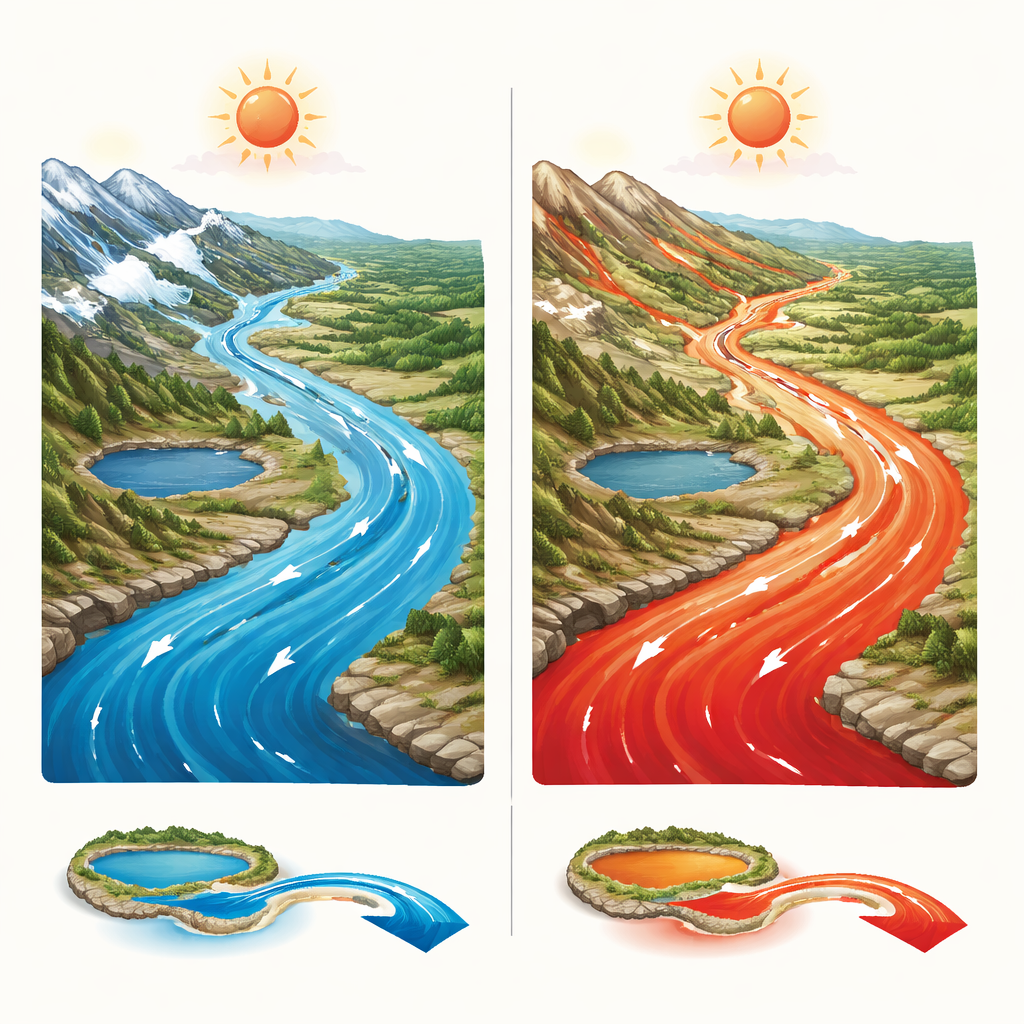
To understand why some rivers resisted heating, the team looked beyond air temperature to a suite of other conditions: river flow, meltwater from snow and glaciers, soil moisture, rainfall minus evaporation, humidity, and sunlight reaching the surface. They converted all of these into a common scale of how “unusual” the conditions were. The clearest pattern emerged for how much water was moving through the river and how much of that water came from melting snow and ice. During many heatwaves, rivers experiencing higher‑than‑usual flows and strong contributions from cold meltwater stayed cooler, even when the surrounding air was exceptionally hot. In contrast, when flows were lower than normal, rivers were much more likely to experience their own heatwaves.
When low flow and lakes tip the balance
Low flow during dry spells turned out to be a key troublemaker. With less water in the channel, rivers have a smaller “heat capacity,” so the same amount of incoming heat raises their temperature more quickly. These lean‑flow periods also go hand‑in‑hand with reduced groundwater and melt inputs, removing important natural cooling sources. The study’s case examples make this concrete: two early‑summer heatwaves along Austria’s Drau River had similar air temperatures, but one year had abundant meltwater and high flow and produced no river heatwave, whereas two years later, with little remaining snow and lower flow, all monitored stations experienced river heatwaves. Large lakes added a further twist. In winter and spring, water leaving Alpine lakes tended to be cooler than upstream rivers, tempering downstream warming. In mid‑ and late‑summer, however, sun‑warmed lake surface water could actually amplify downstream river heating.
Changing seasons in the age of climate change
The findings suggest that future river warming will be shaped not just by hotter air but by shifting water regimes. Climate change is expected to bring more frequent and intense heatwaves and longer dry spells, both of which favour riverine heatwaves. At the same time, Alpine snowpacks and glaciers are shrinking and melting earlier in the year. That means less cold meltwater reaching rivers during late spring and summer, when it currently offers crucial protection. In many basins, flow patterns are projected to shift from being dominated by snowmelt to rainfall, leading to lower summer flows and further reducing rivers’ ability to buffer heat.
What this means for rivers, fish, and people
For non‑specialists, the main takeaway is that mountain rivers are not passive thermometers of the air above them. Their temperature during heatwaves depends strongly on how much water they carry, when snow and ice melt, how lakes mix and release water, and whether catchments are wet or dry. Today, these factors sometimes prevent dangerous river warming even when the air is scorching. But as meltwater declines and summer flows drop in the Alps, that natural protection is likely to weaken. Without careful management of water use, reservoir operations, and ecosystem needs, riverine heatwaves may become more frequent and severe, with far‑reaching impacts on aquatic life, drinking water quality, and hydropower production.
Citation: van Hamel, A., Janzing, J. & Brunner, M.I. River temperature response to atmospheric heatwaves is modulated by discharge and meltwater. Commun Earth Environ 7, 296 (2026). https://doi.org/10.1038/s43247-026-03269-6
Keywords: river heatwaves, Alpine rivers, meltwater, streamflow drought, climate change impacts