Clear Sky Science · en
Stochastic poromechanical analysis forecasts a notable exceedance probability for the 2017 Pohang, South Korea, Mw 5.5 earthquake
Why a Man‑Made Earthquake Matters
In 2017, a magnitude 5.5 earthquake shook the city of Pohang in South Korea, damaging buildings and surprising scientists because it was linked to a geothermal energy project rather than a natural fault shift. Understanding how human activities like deep fluid injection can trigger such strong quakes is crucial if we want to expand low‑carbon energy without putting nearby communities at risk. This study uses a physics‑based, probability‑driven approach to ask a simple question with big implications: given what we (don’t) know about the rocks and stresses underground, how likely was an earthquake as large as Pohang to occur?
How Energy Projects Can Awaken Hidden Faults
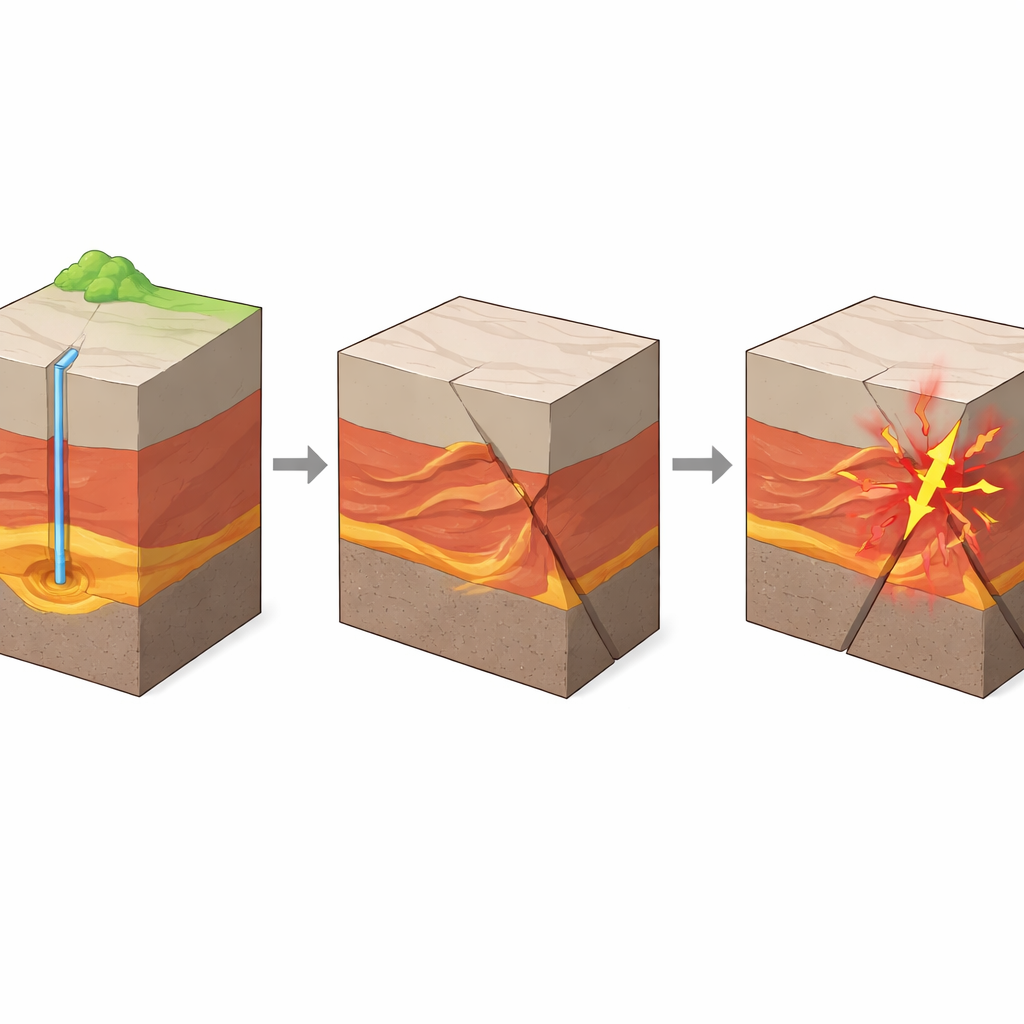
Enhanced Geothermal Systems produce heat by injecting high‑pressure water deep underground to open existing fractures and improve water circulation. At Pohang, this injection occurred into granitic rock about 4.2 kilometers down, near a pre‑existing fault that did not break the surface. When pressurized water enters the rocks, it raises the pressure in the tiny pores between mineral grains and slightly changes how the rock mass carries stress. These subtle shifts can reduce the frictional resistance on a fault, allowing it to slip. In Pohang, several lines of evidence show that the main earthquake happened near the injection well, along a mature fault plane whose precise orientation and stress state were, and still are, poorly constrained.
Turning Uncertainty Into a Probability Forecast
Most earlier analyses of the Pohang earthquake tried to reconstruct a single “best” underground model, assuming the fault was already extremely close to failure so that even tiny stress changes could set it off. But field measurements and earthquake data suggest this fault was more stable than that simple picture allows. Instead of betting on one scenario, the authors treat key underground properties—such as the direction and strength of the stresses, the angle of the fault, and the friction of the fault surface—as uncertain quantities. They then use a technique called Monte Carlo simulation: thousands of slightly different, but physically plausible, underground worlds are generated, and for each one they calculate how fluid pressure spreads, how the rocks respond mechanically, and whether the fault would slip, and by how much.
Simulating How Faults Respond to Injection
To keep this huge number of trials computationally manageable, the team uses analytical formulas, rather than heavy numerical models, to describe how injection raises pore pressure around the well and how that change feeds into the surrounding stress field. They explore two realistic ways the fault might move, both involving an oblique mixture of vertical and sideways slip. In their base case, with average rock and stress properties, the fault actually remains stable despite injection—clearly at odds with the real earthquake. When they allow the uncertain parameters to vary within ranges supported by measurements and laboratory tests, some realizations produce only tiny, undetectable quakes, while others generate much larger events. By converting the size of the slipping fault area in each realization into an earthquake magnitude, they build a full probability distribution of possible outcomes.
How Likely Was the Pohang Earthquake?
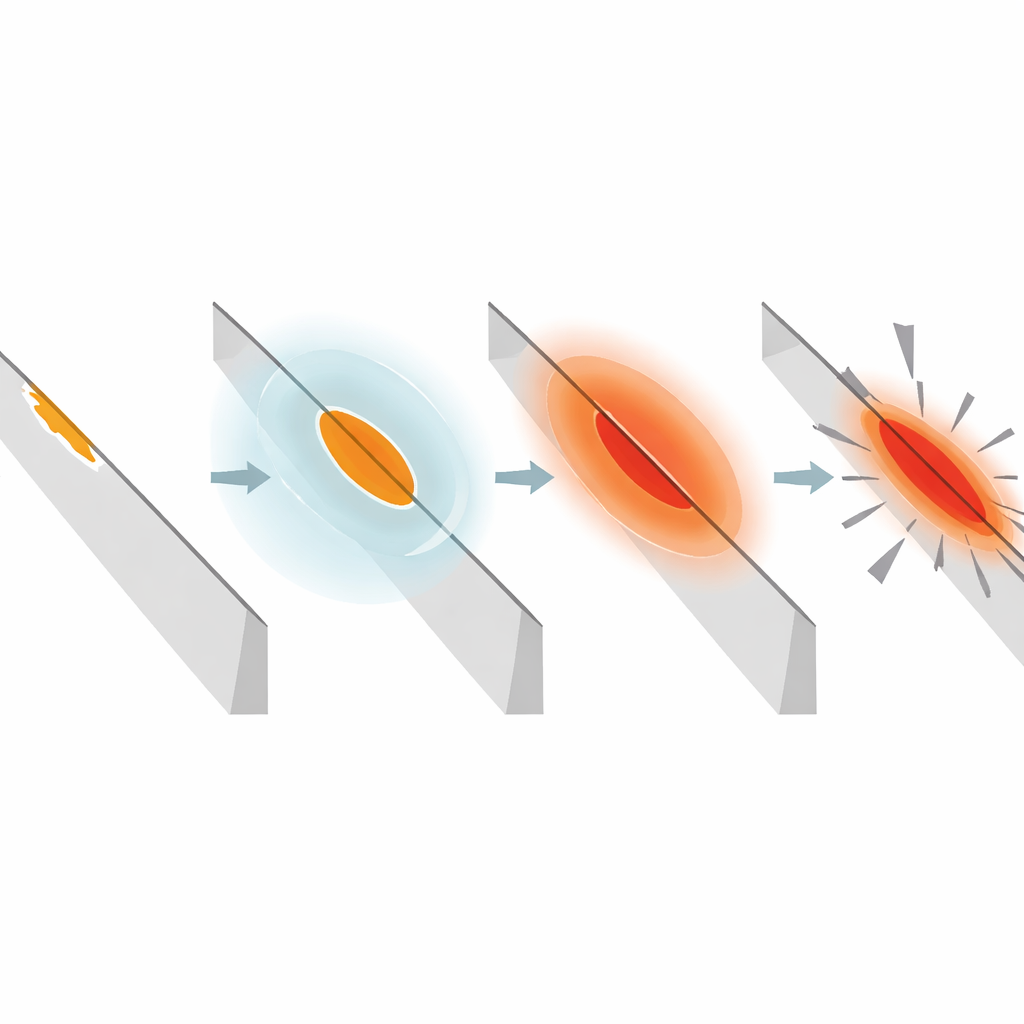
The simulations show that, under the conditions relevant to Pohang, the largest possible induced earthquake could in principle approach magnitude 7, but such events are very unlikely. Much more telling is the estimated chance of exceeding particular magnitudes. For earthquakes as large as the actual 2017 event (Mw 5.5), the model forecasts an exceedance probability between about 7% and 15%, depending on which slip pattern is assumed. This range closely matches the likelihood inferred independently from the observed sequence of smaller earthquakes at the site. The analysis also reveals a clear link between how close a fault is to failure before injection and the size of the earthquake that follows. At Pohang, once the initial “safety margin” on the fault drops below roughly 0.1–0.2 megapascals, even modest poromechanical disturbances can tip it into a damaging rupture.
What This Means for Future Geo‑Energy Projects
For a layperson, the key takeaway is that the Pohang earthquake was not a freak accident, nor an inevitable outcome of geothermal development, but a quantifiable risk that depends on how critically stressed nearby faults are, and on how much we know about them. This study shows that by combining physics‑based models with systematic uncertainty analysis, it is possible to estimate in advance the probability that injection will trigger quakes of a given size. It warns that faults already close to failure can produce damaging earthquakes from relatively small pressure changes, and suggests that traditional “traffic light” systems based only on monitoring small events may not be enough. Instead, careful site characterization and adaptive, model‑informed risk assessment—of the kind demonstrated here—will be essential if we are to use deep subsurface resources safely and responsibly.
Citation: Wu, H., Vilarrasa, V., Parisio, F. et al. Stochastic poromechanical analysis forecasts a notable exceedance probability for the 2017 Pohang, South Korea, Mw 5.5 earthquake. Commun Earth Environ 7, 236 (2026). https://doi.org/10.1038/s43247-026-03268-7
Keywords: induced seismicity, geothermal energy, fault stability, fluid injection, earthquake risk