Clear Sky Science · en
Declining Δ17O of nitrate in the northeastern Tibetan Plateau reveals changing atmospheric oxidative capacity
Why the Roof of the World Matters for Our Air
The Tibetan Plateau, sometimes called Earth’s “Third Pole,” is not just a remote highland of ice and rock. It acts like a giant switchboard that helps control weather, water, and even the chemistry of the air across Asia and beyond. This study uses a finely sampled ice core from the northeastern Tibetan Plateau to reveal how a warming, wetter climate is quietly boosting the air’s ability to cleanse itself, with consequences for greenhouse gases and regional pollution.
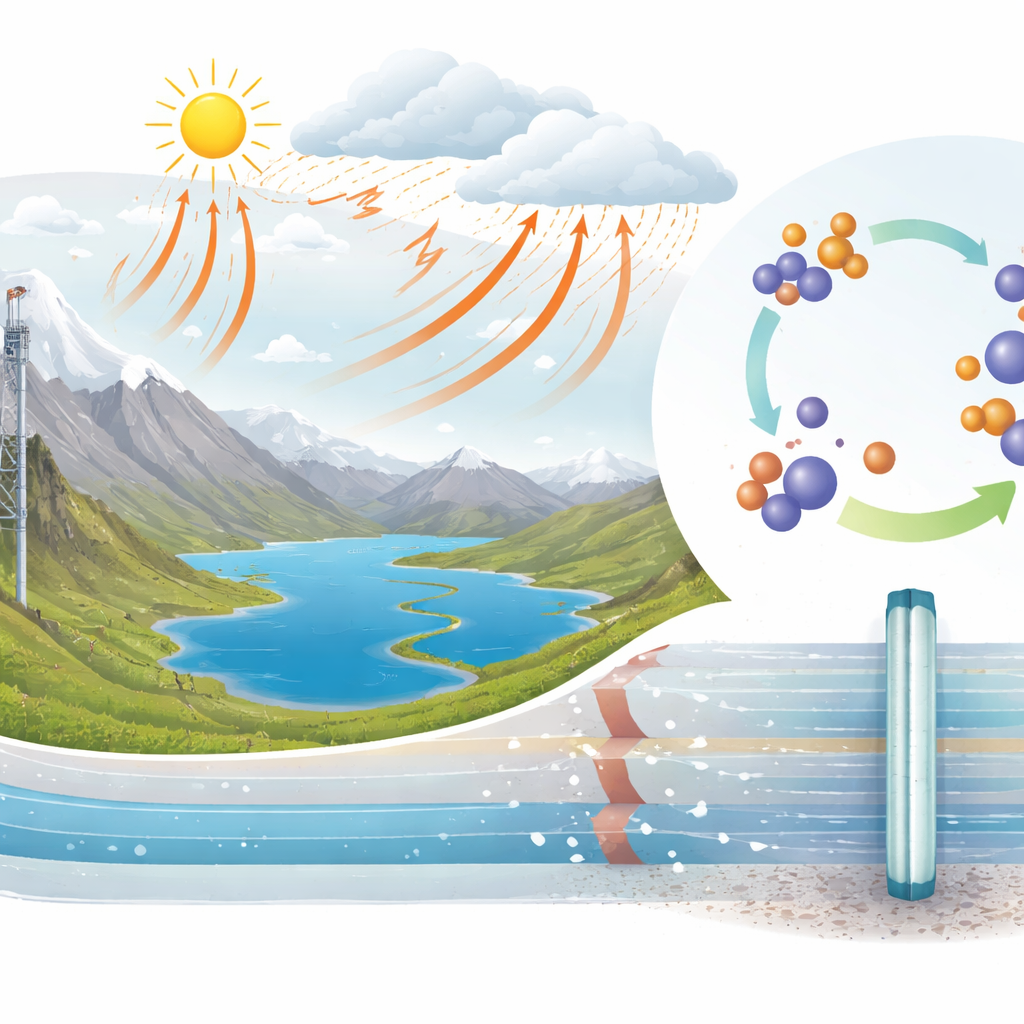
Reading Climate Clues Locked in Mountain Ice
To track subtle shifts in the atmosphere, the researchers drilled a 20‑meter ice core from the Anemaqen summit, a high mountain in the Yellow River headwaters. Each annual layer in this core captures particles and molecules that once floated in the air, then fell as snow. By measuring common dissolved salts and the detailed isotopic “fingerprints” of nitrate (a form of nitrogen that ends up in snow and ice), the team could reconstruct changes in both the hydrological cycle and the chemistry of the air from 2002 to 2023. They combined these ice records with a state‑of‑the‑art atmospheric chemistry model to understand how climate‑driven changes in moisture, lakes, and soils feed back on the atmosphere above the Plateau.
Growing Lakes and a Faster Water Cycle
The chemical mix frozen into the ice reveals that the Tibetan Plateau’s water cycle has been speeding up. Concentrations and deposition of sodium and sulfate—key components of the region’s natural salt lakes—rose in step with rapid lake expansion over the past two decades. At the same time, dust‑related ions such as calcium and magnesium declined, consistent with more frequent wet conditions that suppress dust emissions and wash particles out of the air. Back‑trajectory analyses show that winds carry aerosols mainly from the interior of the Plateau itself, linking the changing chemistry at Anemaqen directly to local lakes and recycled moisture rather than distant oceans. Together these lines of evidence indicate that a warmer, wetter climate is enhancing local evaporation, cloud formation, and precipitation, and that expanding saline lakes are now major sources of airborne particles.
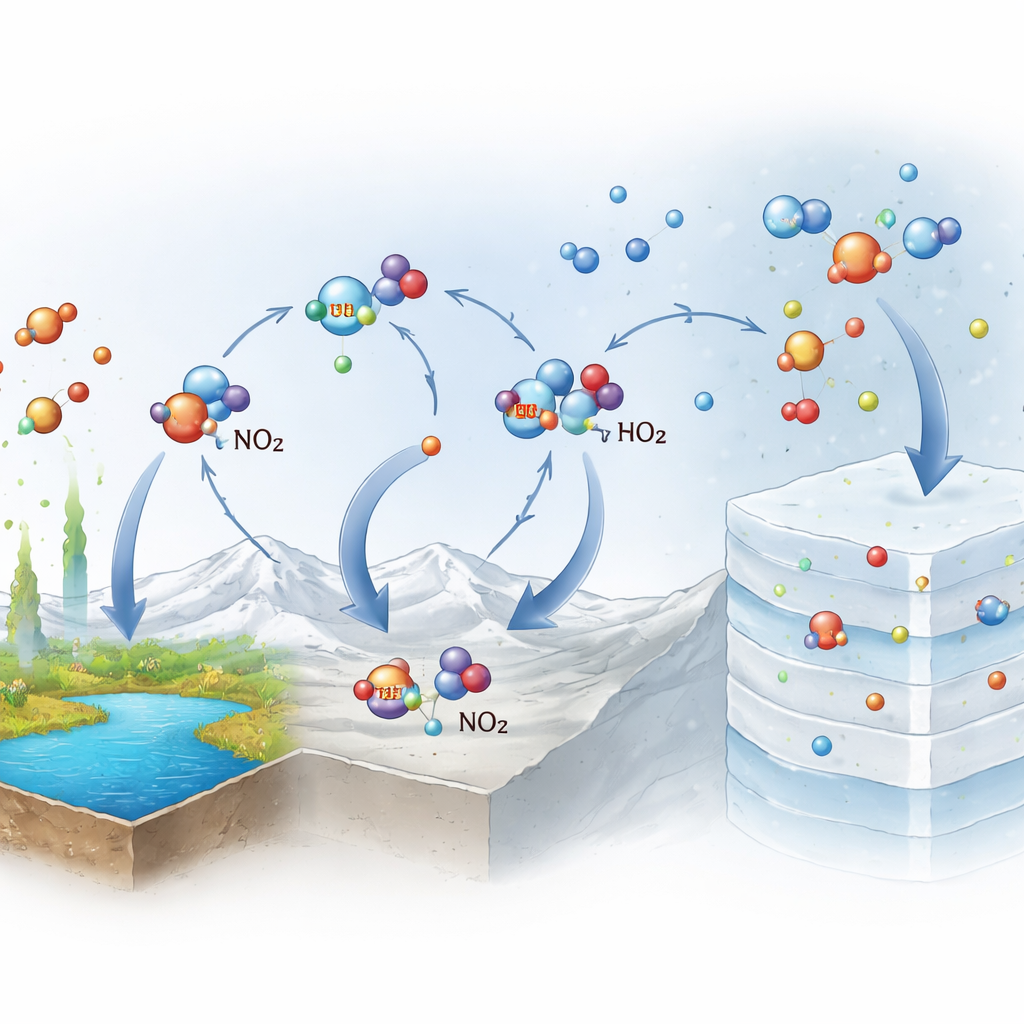
Soils Breathing Out More Reactive Nitrogen
The nitrogen isotopes of nitrate in the ice core point to an important biological response to this new climate. The values of nitrogen‑15 in nitrate have steadily shifted toward more negative numbers, a signature characteristic of nitrogen oxides released by soil microbes rather than by fossil fuel burning or lightning. This trend is strongly linked to rising soil moisture across the Plateau, while showing little sensitivity to temperature changes. The result implies that wetter soils and more frequent freeze–thaw cycles are stimulating microbial processes that generate nitrogen oxides in both soils and lakes. Even as China’s pollution controls have cut industrial emissions elsewhere, the ice record and model simulations indicate that these natural microbial sources of nitrogen oxides over the Plateau have been increasing, adding more reactive nitrogen to the regional atmosphere.
A Stronger Atmospheric “Cleaning Crew”
The most striking signal comes from the oxygen isotopes in nitrate, which trace how it formed in the air. Over roughly the last 15 years, the unusual oxygen‑17 signal in nitrate has declined, indicating a growing role for reactions driven by hydroxyl radicals and related short‑lived oxidants. These highly reactive molecules act as the atmosphere’s “cleaning crew,” breaking down gases like methane, carbon monoxide, and many organic vapors. Rising humidity over the Plateau, combined with more nitrogen oxides and plant‑derived organic gases, boosts the production of these oxidants. The ice‑core isotope trends and independent model calculations both show an increasing share of nitrate being produced through hydroxyl‑driven pathways, consistent with a long‑term strengthening of the atmosphere’s oxidative capacity above the northern Tibetan Plateau.
What This Means for Climate and the Future
For non‑specialists, the key takeaway is that the Tibetan Plateau is not just reacting to climate change; it is helping to reshape it. A warmer, wetter Plateau is expanding its lakes, moistening its soils, and waking up its microbes, which in turn release more reactive nitrogen into the air. This fuels a more powerful atmospheric cleaning system that can shorten the lifetime of gases like methane, slightly offsetting some warming, even as thawing permafrost and other changes release additional greenhouse gases. The study shows that to predict future climate, models must better capture these intertwined water, soil, and atmospheric processes in high mountain regions. Ignoring them risks underestimating both how quickly the Plateau is changing and how strongly it can influence the chemistry of the air far beyond its snowy peaks.
Citation: Yan, X., Shi, G., Li, R. et al. Declining Δ17O of nitrate in the northeastern Tibetan Plateau reveals changing atmospheric oxidative capacity. Commun Earth Environ 7, 231 (2026). https://doi.org/10.1038/s43247-026-03266-9
Keywords: Tibetan Plateau, atmospheric oxidation, ice core, nitrate isotopes, climate change