Clear Sky Science · en
Iron supply to the Amundsen Sea, Antarctica is dominated by circumpolar deepwater and continental subglacial sources
Why Melting Antarctic Ice Matters for Ocean Life
Far from being a lifeless white desert, the seas around Antarctica are a crucial engine for the planet’s climate and marine food webs. Tiny drifting plants, or phytoplankton, soak up carbon dioxide from the air and feed everything from krill to whales—but they can only thrive if they get enough of a key micronutrient: iron. This study asks a deceptively simple question with big implications: as West Antarctic ice melts faster in a warming world, where does the iron that fuels nearby ocean life actually come from?
Hidden Highways Beneath the Ice
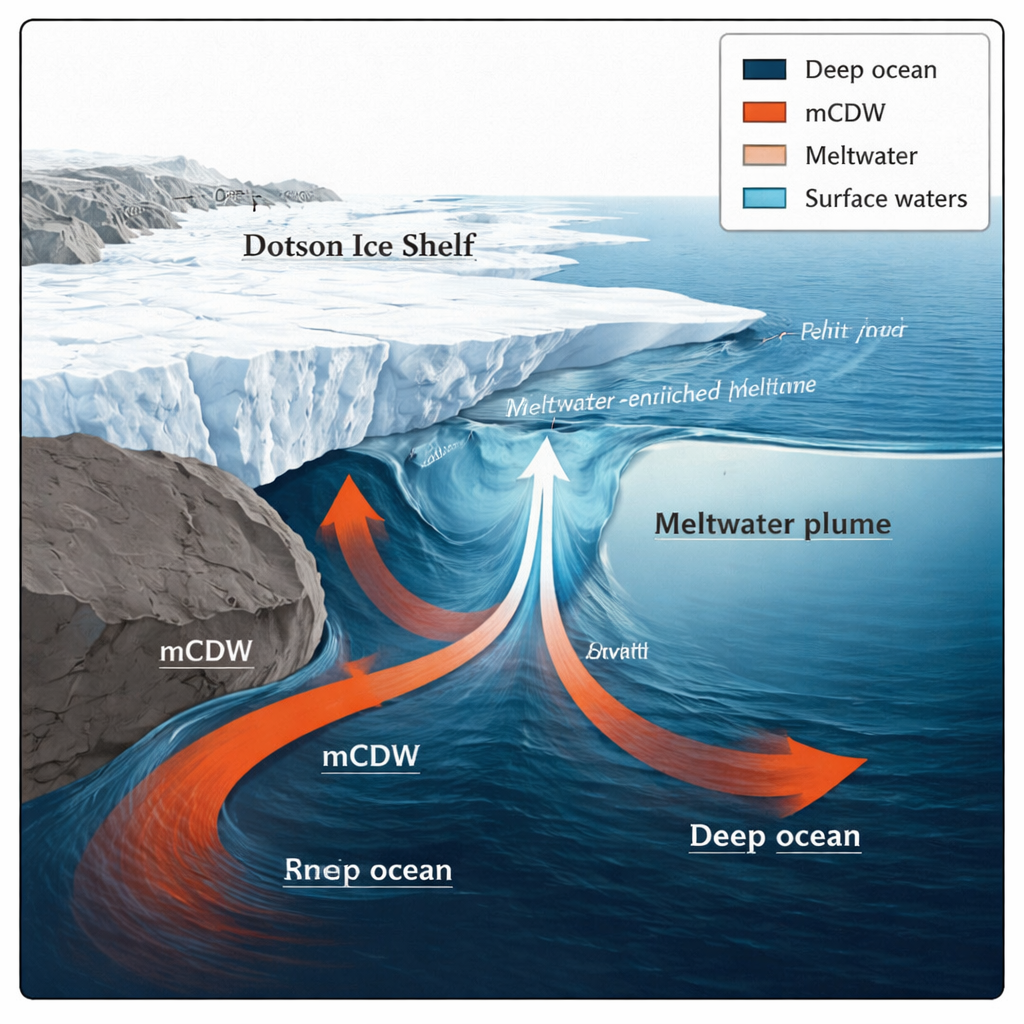
The research focuses on the Dotson Ice Shelf in the Amundsen Sea, one of the fastest-melting regions of West Antarctica. Warm, salty water called modified Circumpolar Deep Water (mCDW) creeps onto the continental shelf along the seafloor and slips into the cavity beneath the floating ice. There it melts the ice from below, picks up fresh meltwater, and flows back out toward the open sea in a buoyant “meltwater pump.” Using ship-based instruments, the team precisely mapped where this deep inflow enters the cavity and where the lighter, melt-enriched water exits, allowing them to compare the chemistry of water going in and coming out.
Tracking Iron with Chemical Fingerprints
To understand iron’s journey, the scientists measured both dissolved iron—tiny ions and nanoparticles that organisms can readily use—and iron locked in suspended particles. They also analyzed the isotopic “fingerprint” of dissolved iron, subtle shifts in the ratio of light to heavy iron atoms that reveal how the iron was produced. By averaging measurements across the inflow and outflow layers, they could see how much iron was added inside the cavity and which processes were responsible.
Deep Ocean and Hidden Subglacial Sources Dominate
The results overturn a common assumption. Only about one-tenth of the dissolved iron leaving the Dotson Ice Shelf cavity in 2022 could be attributed to glacial meltwater itself. Most dissolved iron—roughly two-thirds—was already present in the incoming deep water, with nearly another third added from seafloor sediments as that water crossed the continental shelf. Yet the chemistry of the dissolved iron in the outflow carried a distinct isotopic signal: it was isotopically “lighter” than the inflow, a hallmark of iron released in oxygen-poor environments by microbes that chemically reduce iron minerals.
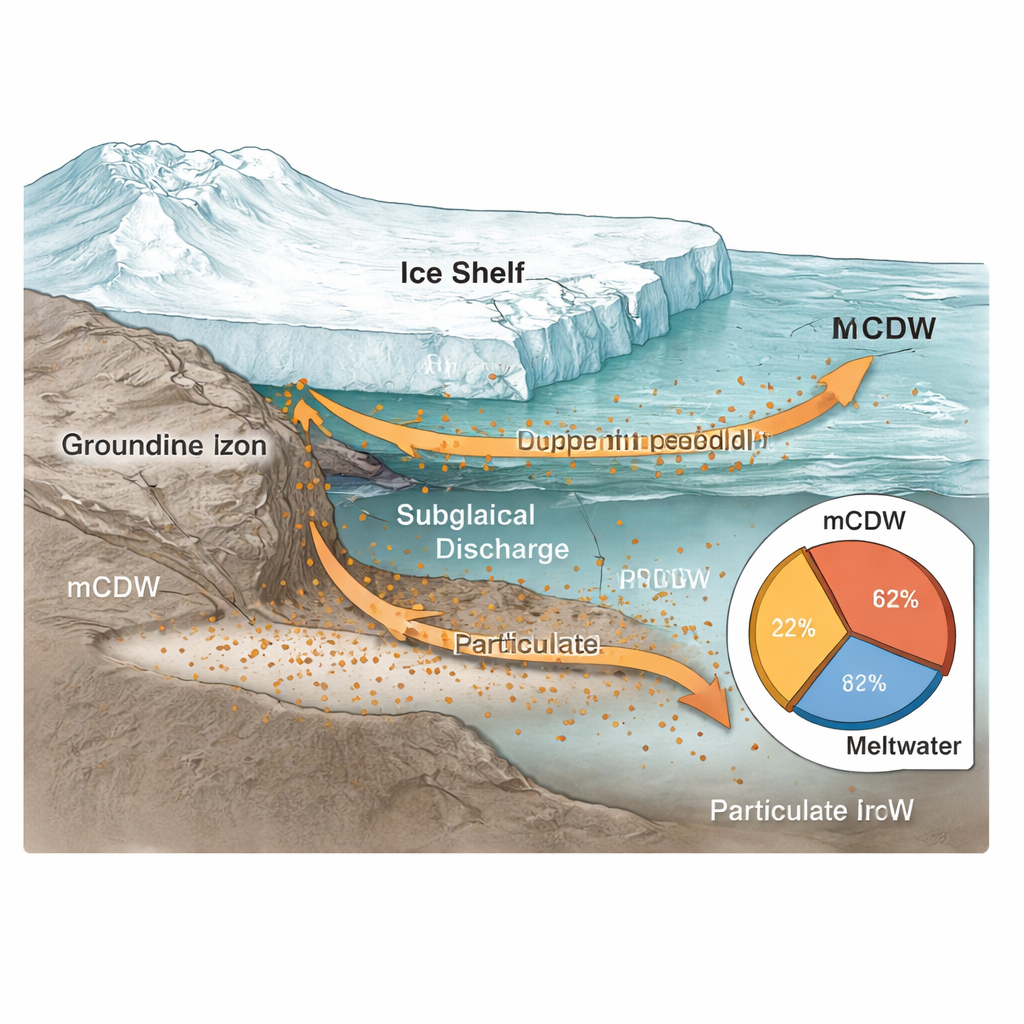
This signature points to a surprising main contributor to meltwater-derived iron: not the ice shelf’s own melting, but liquid water flowing beneath the grounded ice upstream. In this buried subglacial plumbing system, where water can linger for long periods with little oxygen, microbial communities can generate large amounts of reduced iron with a light isotopic fingerprint. Even though this subglacial discharge makes up only a tiny fraction of the total water volume, its iron content is so high that it overwhelms the contribution from ice melting within the cavity.
Particles as a Slow-Release Iron Supply
While dissolved iron from meltwater is relatively modest, the story is very different for particulate iron. The outflowing water contained nearly 50% more particulate iron than the inflow, including a sizeable “labile” fraction that is chemically reactive and can gradually dissolve. These particles come from several processes: sediments stirred up near the grounding zone, minerals released from ice at the base of the shelf, and iron that re-precipitates after being oxidized in the cavity. Because these grains sink slowly, they can be carried out of the cavity and spread across the nearby open waters, where they may act as a slow-release fertilizer for phytoplankton over weeks to months.
What This Means for a Warming World
For non-specialists, the core message is that melting ice shelves do not simply “pour out” iron into the ocean. Instead, their main role is to act like a pump, using the buoyancy of fresh meltwater to lift iron-rich deep waters—and iron from hidden subglacial reservoirs—toward the surface ocean where life needs it. As climate change continues to warm the Southern Ocean and speed up ice loss, this pump is likely to strengthen, increasing the delivery of bioavailable iron to nearby waters. Predicting future productivity and carbon uptake in the Southern Ocean will therefore require models that capture not just melting rates, but also the properties of incoming deep water, sediment–water interactions on the seafloor, and the poorly explored subglacial waterways beneath Antarctica’s ice sheet.
Citation: Chinni, V., Steffen, J.M., Stammerjohn, S.E. et al. Iron supply to the Amundsen Sea, Antarctica is dominated by circumpolar deepwater and continental subglacial sources. Commun Earth Environ 7, 162 (2026). https://doi.org/10.1038/s43247-026-03264-x
Keywords: Southern Ocean iron, Antarctic ice shelves, subglacial meltwater, Amundsen Sea, phytoplankton productivity