Clear Sky Science · en
Tracking jet streams as Lagrangian objects
Why high‑altitude winds matter to everyday life
Far above our heads, narrow rivers of fast air circle the globe. These jet streams steer storms, shape regional climates, and influence everything from heat waves to airline routes. Yet, despite their importance, scientists still debate how these powerful winds are changing as the planet warms. This article introduces a new way to track jet streams that follows the actual motion of air, promising clearer pictures of past trends and future risks. 
Rethinking how we see the jet stream
Traditionally, meteorologists have treated jets as places where the wind happens to be strongest at a given moment. This “snapshot” view can break the jet into scattered segments, called jet streaks, that jump around from one time step to the next. It tends to highlight the loudest, fastest gusts while ignoring quieter but more persistent bands of flow that actually guide long‑range transport of air. As a result, different studies—and even different computer models—often disagree on where the jet is, how much it wanders, and how it is responding to global warming.
Following air parcels instead of chasing wind peaks
The authors propose a different perspective: instead of asking, “Where is the wind strongest right now?”, they ask, “Along which paths do air parcels travel the farthest while staying together?” In this view, jets are not just speed zones; they are moving barriers that separate air masses with different histories. To capture this, the team introduces an algorithm they call JetLag, which follows idealized air parcels along surfaces of nearly constant temperature in the upper atmosphere. By tracking how far these parcels travel over a few days, the method identifies winding ridges of maximum displacement where air flows far along a coherent path but does not easily cross from one side to the other. These ridges mark the jet streams as material features of the flow, rather than artifacts of a particular wind snapshot.
Testing a new map of the sky’s highways
To see how JetLag performs, the authors apply it to more than 80 years of global atmospheric data from the ERA5 reanalysis. They focus on two key jets: the subtropical jet, which lies closer to the tropics, and the polar‑front (or eddy‑driven) jet at higher latitudes. They compare JetLag’s results with two widely used “Eulerian” approaches that rely on wind speed and temperature patterns near the tropopause, the boundary between the lower and upper atmosphere. The comparison shows that while all methods broadly agree on where jets tend to sit on average, JetLag delivers a much smoother and more continuous jet path in space and time. 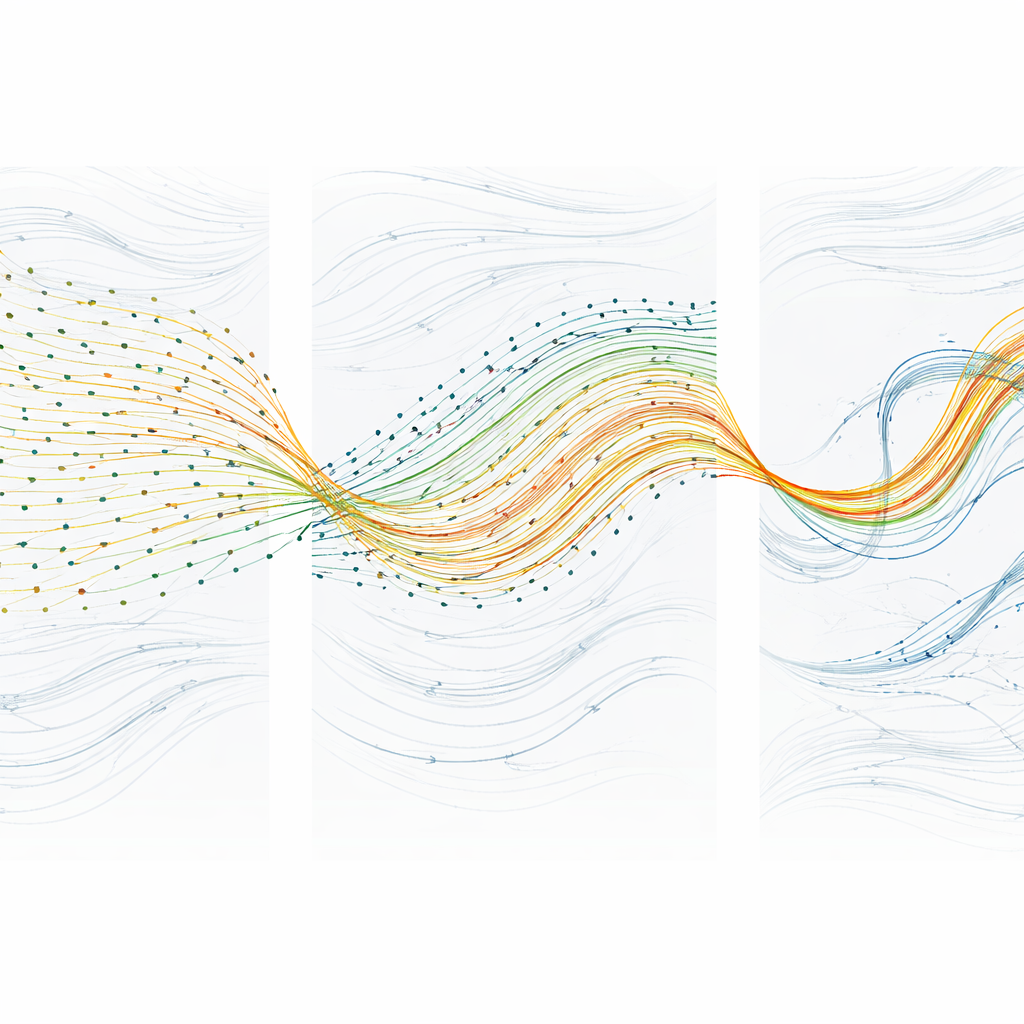
Stable paths, fewer tuning knobs
Conventional jet‑finding tools depend on several hand‑picked thresholds, such as a minimum wind speed needed to declare that a jet exists. Changing these numbers even modestly can shift the diagnosed jet by hundreds of kilometers and alter how much long‑term variability is seen. JetLag, by contrast, relies on just two parameters that are set from basic wave physics rather than trial and error. The authors show that its identified jet positions hardly move when these parameters are adjusted within reasonable bounds. JetLag is also better at “filling in” gaps where winds temporarily weaken or break up, such as regions of frequent wave breaking over the Pacific and Atlantic, revealing persistent transport pathways that wind‑based methods miss.
New clues about long‑term changes in jets
Because JetLag traces the continuous meandering of the jet, it captures slower swings in jet latitude more clearly than traditional methods. In their analysis, power on decade‑to‑multidecade time scales is about three times larger with JetLag than with a common wind‑based metric, suggesting that the jets may undergo more gradual shifts than previously recognized. At the same time, the method avoids some artificial variability that arises when older algorithms jump abruptly between disconnected jet segments. By providing a unified, physics‑based description of jets across different regions and seasons, JetLag offers a cleaner baseline for comparing models, diagnosing trends, and even extending jet studies to other planets.
What this means for weather and climate understanding
In plain terms, this work argues that to understand jet streams we should watch the actual journeys of air, not just where the wind speed spikes. JetLag turns the jet from a patchwork of fleeting streaks into a single, winding highway that shapes how heat, moisture, and pollutants move around the globe. Because it is less sensitive to arbitrary choices and more tightly tied to the physics of wave motions, the method is well suited for tracking how jets respond to global warming and other long‑term influences. While refinements are still needed—for example, to handle split jets or evolving atmospheric layers—the approach marks a significant step toward more reliable, comparable jet‑stream diagnostics for both present‑day weather and future climate projections.
Citation: Rivoire, L., Curbelo, J. & Linz, M. Tracking jet streams as Lagrangian objects. Commun Earth Environ 7, 267 (2026). https://doi.org/10.1038/s43247-026-03262-z
Keywords: jet stream, atmospheric circulation, climate variability, Lagrangian analysis, Rossby waves