Clear Sky Science · en
Local human disturbances on coral reefs negate potential climate refugia
Why these reefs matter to all of us
Coral reefs are often described as the rainforests of the sea. They protect coasts from storms, feed hundreds of millions of people, and support a dazzling array of life. Yet rising ocean temperatures are triggering intense marine heatwaves that bleach and kill corals. This study asks a pressing question with real-world consequences: where on Earth can reefs still find some shelter from climate change, and how are our local actions on land helping or hurting their chances?
Heat in the ocean, trouble on the shore
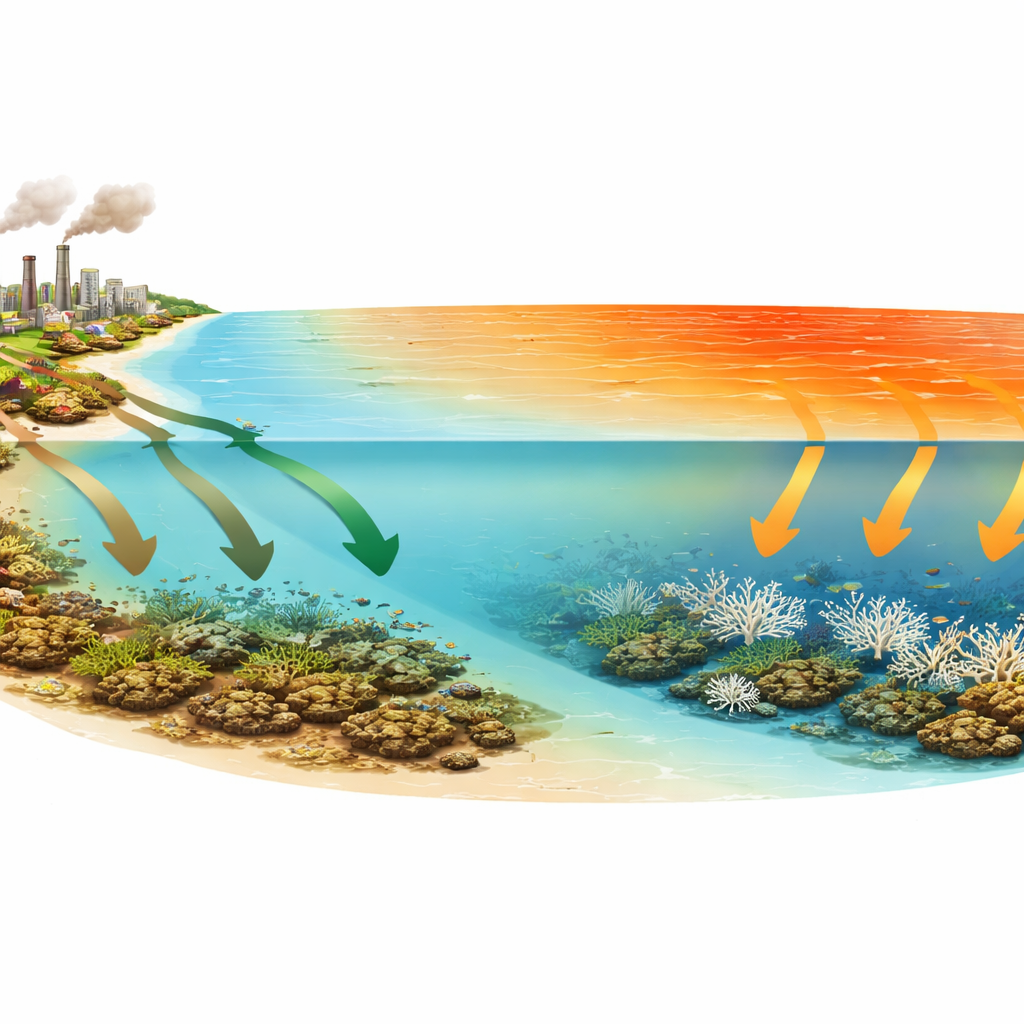
Marine heatwaves—periods when ocean temperatures spike well above normal—have become longer, hotter, and more frequent. Using nearly 33,000 coral surveys from 1969 to 2023 across the Atlantic, Indian, and Pacific Oceans, the authors tracked how coral cover has changed over time and how it responds to both heat and human activity. They found that reef-building corals have declined sharply in the Atlantic, while the Indian and Pacific Oceans have, on average, held relatively steady despite strong ups and downs. Across the globe, the maximum intensity and frequency of heatwaves were clearly linked to lower coral cover, confirming that extreme ocean warming is a major driver of reef damage.
Hidden costs of life near people
Reefs are not only stressed from above by hot water; they are also battered from the shore. The study combined global data on urbanization, agriculture, human population, and access by boat with environmental records for each reef site. Nearby cities, farming, and large coastal populations all coincided with reduced coral cover. These pressures send nutrients, sediments, and pollutants into the sea, promoting fleshy seaweeds and disrupting food webs. In contrast, reefs near intact forests, far from dense populations, or inside large, long-established marine protected areas tended to have more coral, suggesting that healthy watersheds and thoughtful management can soften some of the blows reefs receive.
Where refuges from climate stress can still exist
Scientists often talk about "climate refuges": places where conditions allow species to survive even as the world warms. The authors distinguished between two kinds. Geographical refuges are areas that have so far escaped the worst marine heatwaves. Environmental refuges are reefs whose local conditions make them less vulnerable to heat, even when it strikes. By mapping the combined impact of heatwaves and local human pressures, the study shows that some reefs—such as parts of the Galápagos, the Spratly Islands, and sections of the Great Barrier Reef and Red Sea—currently experience relatively low stress from both sources. Many more reefs, especially in the Coral Triangle, eastern Pacific, and Caribbean, would likely qualify as refuges if local pollution and overuse were reduced. Today, they are "suppressed refuges": places with gentle heat stress but heavy human impact.
The surprising power of cloudy water
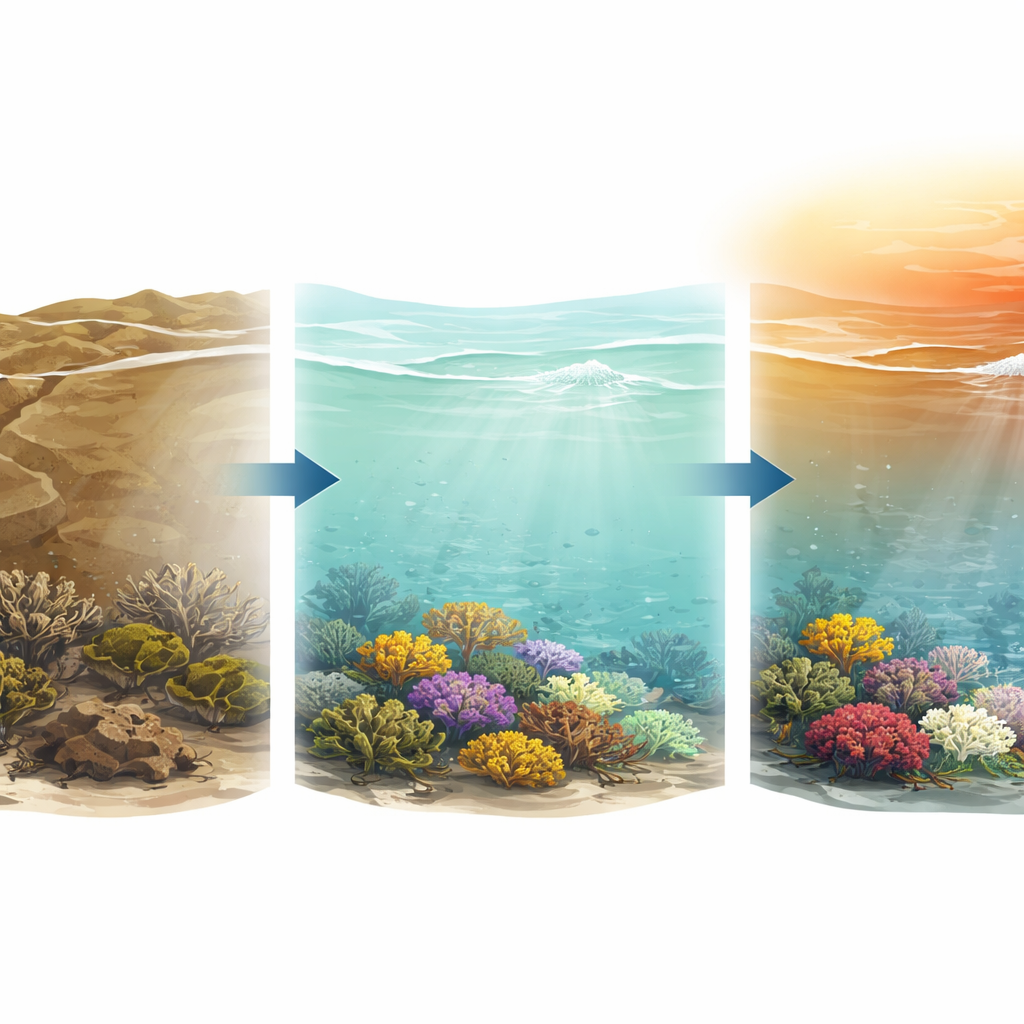
The team tested four popular ideas about what kinds of reefs might act as natural safe havens: high-latitude (cooler) reefs, remote offshore reefs, deep mesophotic reefs, and naturally turbid, or murky, nearshore reefs. The data offered little support for the first three. High-latitude and remote reefs showed no strong protection from coral loss, and deep reefs did not consistently fare better than shallow ones. In contrast, moderately turbid reefs stood out. Where the water was a bit cloudy—often because of natural sediment stirred by waves and tides—corals tended to maintain higher cover and decline less over recent decades. The dimmer light in these habitats seems to shield corals from the worst combined effects of high temperature and intense sunlight. However, when turbidity became extreme, or when human pollution was layered on top, corals again suffered and recovery slowed.
What this means for saving reefs
For a general reader, the central message is both sobering and hopeful. Climate change is a global force that no reef can completely escape, and marine heatwaves are already reshaping coral ecosystems. Yet the study shows that our local choices—how we manage land use, pollution, fishing, and protected areas—strongly influence which reefs can function as climate refuges. By curbing runoff from farms and cities, protecting coastal forests, and designing marine reserves with water quality in mind, we can transform many currently degraded, especially moderately turbid inshore reefs, into working shelters for corals. Paired with worldwide cuts in greenhouse-gas emissions, this two-pronged strategy offers one of the clearest paths to keeping coral reefs, and the benefits they provide to people, alive through this century.
Citation: Walker, A.S., van Woesik, R. Local human disturbances on coral reefs negate potential climate refugia. Commun Earth Environ 7, 232 (2026). https://doi.org/10.1038/s43247-026-03261-0
Keywords: coral reefs, marine heatwaves, climate refugia, coastal pollution, turbid reefs