Clear Sky Science · en
Ecosystem diversity in southern African savannas is fueled by pyrodiversity
Why Fire Patterns Matter for Wildlife and People
Across southern Africa’s savannas, wildfires are changing. In many places, there is now less land burning each year and fires are becoming more uniform. This might sound like good news, but fire is a natural force that has shaped these grass‑and‑tree landscapes for millennia. This study explores how the variety of fire patterns across the land – what scientists call “pyrodiversity” – helps support rich plant life, healthy soils, and carbon storage. Understanding this balance is crucial for conserving wildlife, sustaining grazing, and tackling climate change.
A Living Mosaic Shaped by Fire
Rather than treating fire as purely destructive, the researchers view it as an artist that paints the savanna in patches: some burned often, some rarely, some left unburned for decades. Each patch looks and functions differently. To study this living mosaic, they used one of the world’s longest fire experiments in South Africa’s Kruger National Park, where some plots have been burned every one, two or three years, and others have been protected from fire for more than 70 years. They focused on three types of savanna along a rainfall gradient – dry, intermediate, and wet – and combined real field measurements into “virtual landscapes” to see how different mixes of fire histories affect the overall diversity of the ecosystem. 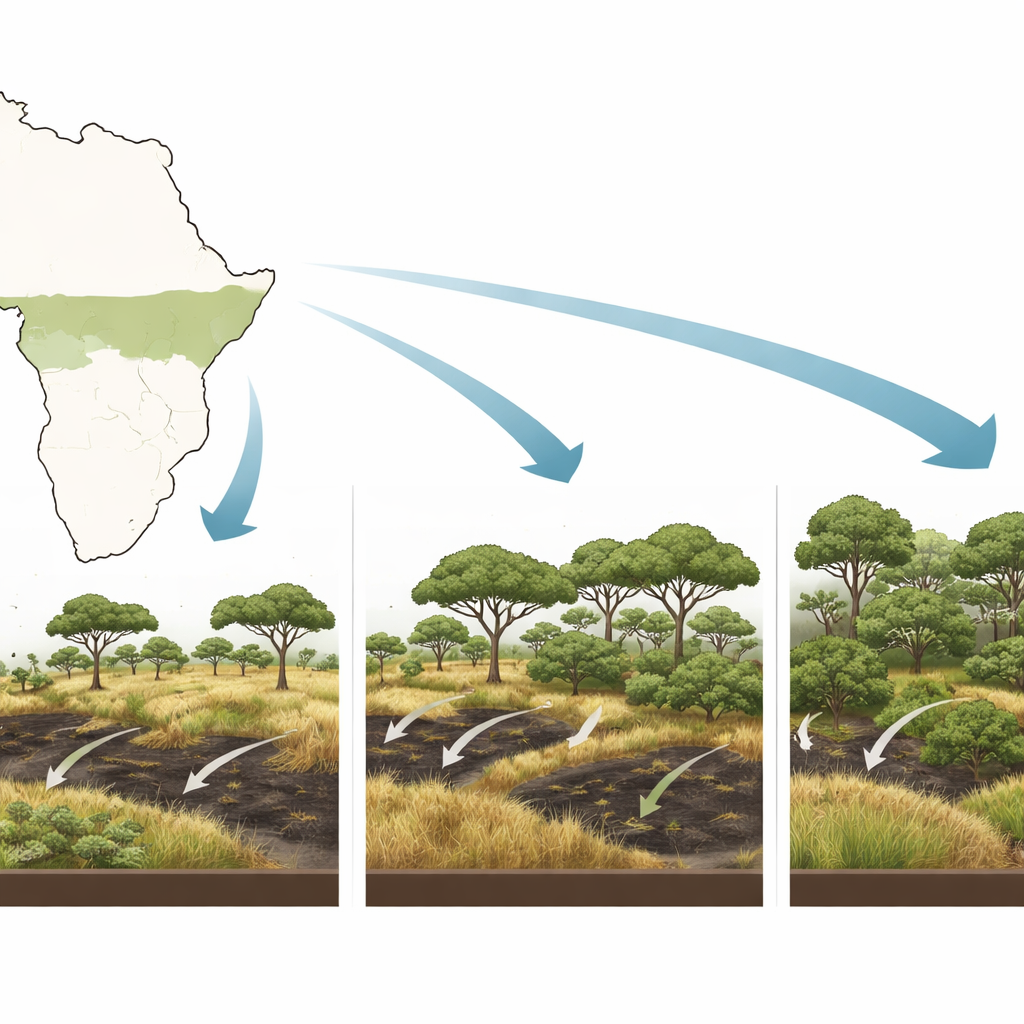
How Different Fire Histories Change the Land
In plots that burned frequently over many decades, the landscape stayed open: grasses dominated, shrubs and trees remained small and sparse, and the ground carried only a thin layer of leaves and twigs. In contrast, where fire was excluded, woody plants thickened, canopies closed, and shrubs and trees stored much more carbon aboveground and in the soil. These differences were especially strong in wetter savannas, where more rain and deeper soils allow vegetation – and thus fuel – to build up, making fires hotter and their effects stronger. The result is that a landscape with both often‑burned and long‑unburned patches contains a wide range of structures, from open grazing lawns to dense thickets, rather than a single uniform look.
Trade‑offs Between Grasses, Trees, and Soil Health
Fire patterns also reshaped how the savannas function. Frequent fires tended to reduce total carbon storage and soil nitrogen because repeated burning removes woody biomass and litter, and combustion releases nutrients to the air. At the same time, in some wetter and intermediate areas, repeated burns encouraged more belowground carbon in roots and improved the availability of certain nutrients like phosphorus, which can boost productivity. There were clear trade‑offs: low‑fire patches stored more carbon, had richer soils, and supported a greater variety of woody plant species; high‑fire patches favored diverse ground‑layer plants, particularly herbs and grasses important for grazing animals. No single fire frequency maximized all benefits at once.
More Fire Variety, More Life
When the team looked across their virtual landscapes, a clear pattern emerged: landscapes with higher pyrodiversity – that is, a wider spread of fire frequencies from patch to patch – also had higher diversity in plant structure, ecosystem processes, and plant species. This was true for diversity within individual patches, differences between patches, and the total number of species across the whole landscape. The effect was strongest in wetter savannas, where differences in fire history translated into more distinct habitats. These varied conditions likely ripple up the food web, helping birds, mammals, insects, and other animals that depend on specific combinations of grass, shrubs, and trees. 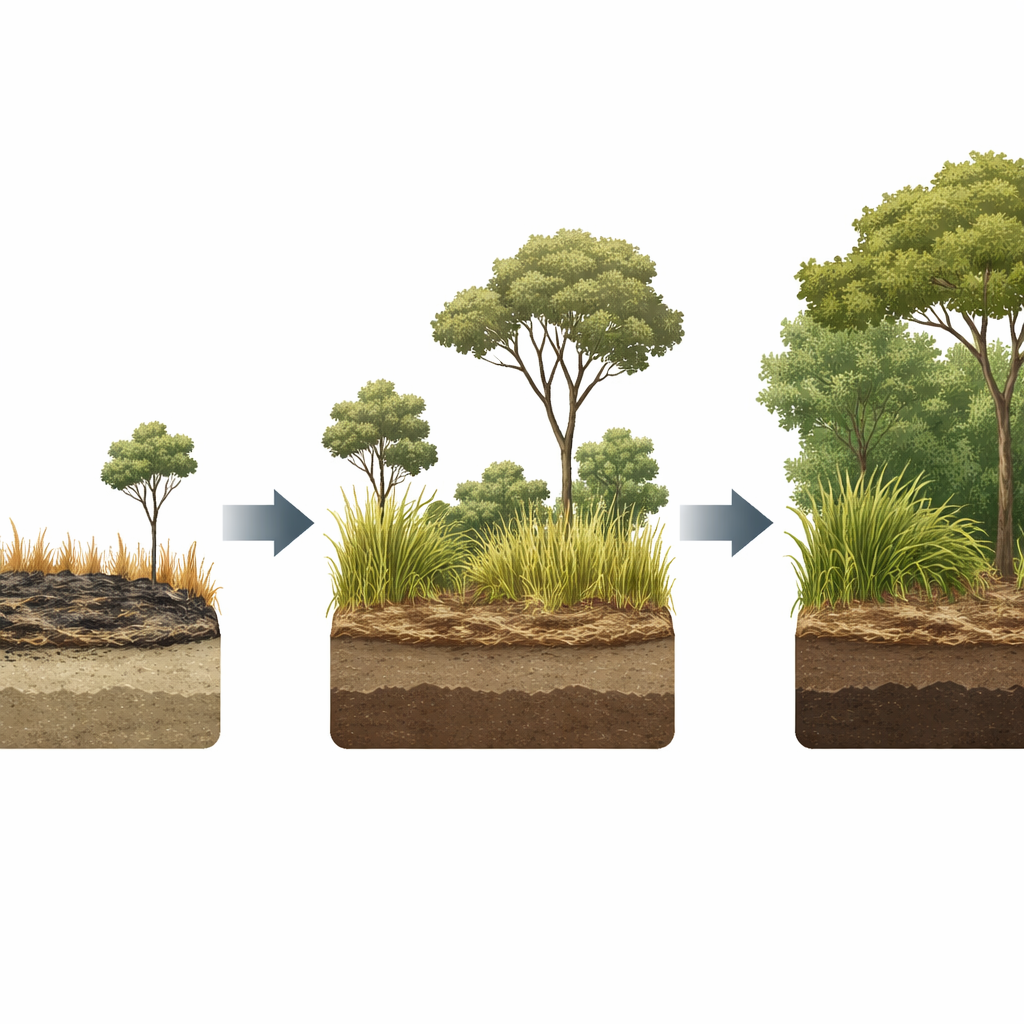
Rethinking Fire Management in a Changing World
To a lay reader, the core message is straightforward: making fire regimes more uniform – whether by widespread fire suppression or by burning everything on the same schedule – risks flattening the savanna into a simpler, less resilient system. This study shows that a patchwork of fire histories supports more kinds of plants, more ways for the land to store carbon and cycle nutrients, and a richer set of habitats for wildlife, especially in wetter savannas. Instead of chasing a single “best” fire interval, land managers can aim to maintain a mosaic of patches burned at different times. In a future of changing climate and human pressures, embracing this complexity – and managing for pyrodiversity – may be key to keeping southern African savannas vibrant, productive, and robust.
Citation: Fernández-García, V., Strydom, T., Thompson, D.I. et al. Ecosystem diversity in southern African savannas is fueled by pyrodiversity. Commun Earth Environ 7, 226 (2026). https://doi.org/10.1038/s43247-026-03260-1
Keywords: savanna fires, biodiversity, pyrodiversity, African ecosystems, fire management