Clear Sky Science · en
Cropland concentration powers sustainable intensification of agriculture in China
Why this matters for dinner tables and clean rivers
Feeding a large population without exhausting the land and water it depends on is one of the biggest challenges of this century. In China, which grows food for nearly one fifth of humanity, farms have been reshaped by rapid urban growth, aging rural communities, and changing policies. This study asks a simple but powerful question: can bringing scattered fields together into larger, more connected cropland help China grow more food with fewer chemicals, less machinery, and less water—and so move toward a cleaner, safer form of agriculture?
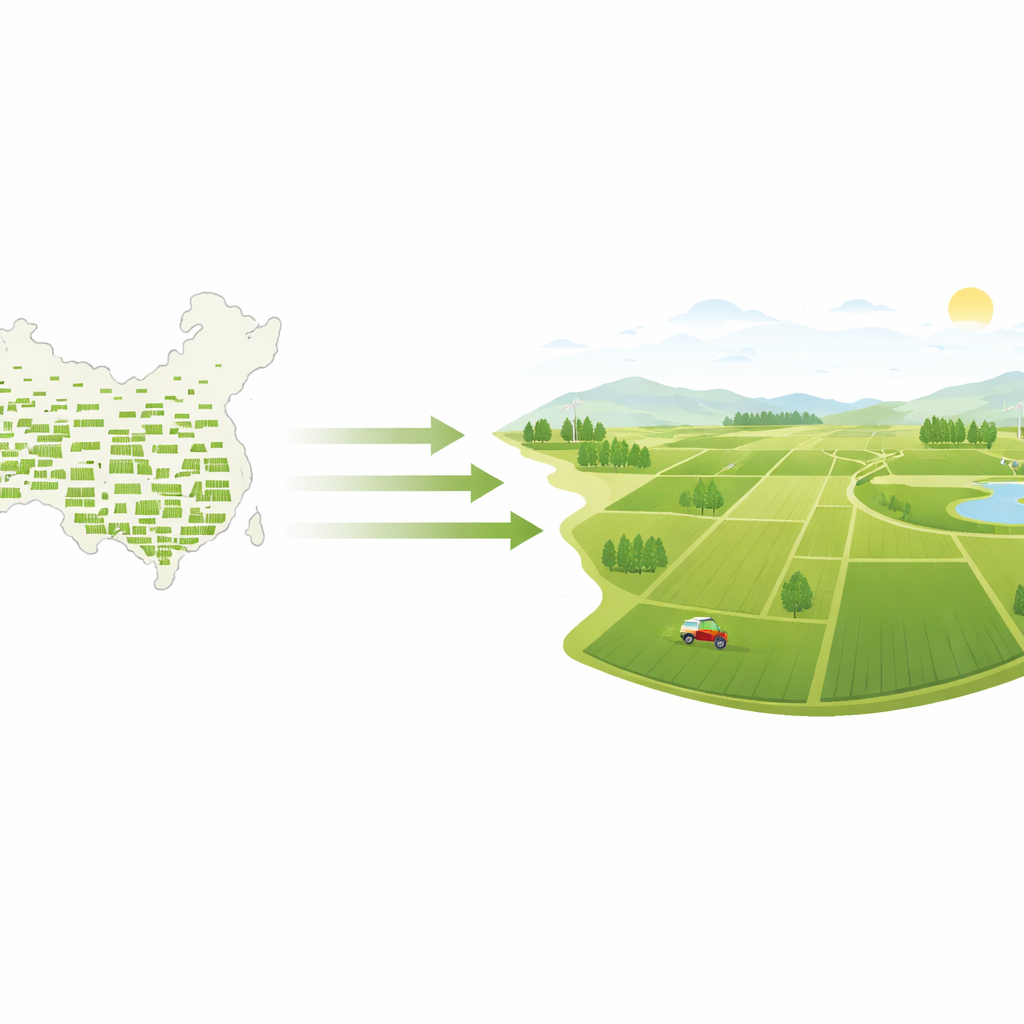
From scattered fields to connected farmland
For decades, most of rural China has been a patchwork of tiny family plots, broken up by houses, roads, and streams. Using over 230,000 satellite images between 2000 and 2020, the researchers mapped where crops are actually grown at a fine scale across the country. They found that China’s cropland followed a two-stage story. From 2000 to 2015, total cropland shrank as cities sprawled, big infrastructure projects advanced, and conservation programs turned marginal fields back into forest and grassland. After 2015, that trend reversed: cropland area began to recover, and fields in many regions became more continuous and less fragmented.
More grain, but at what cost?
Over the same twenty years, China’s harvests of major food crops kept climbing, which is good news for food security. But the way this was first achieved came with a hidden bill. During the initial contraction period, higher yields mostly depended on pouring in more chemical fertilizers and expanding the power of farm machinery. Fertilizer use per hectare rose until about 2015, and machinery power per hectare also climbed, even as many small fields were being lost or broken into smaller pieces. This combination—more inputs on increasingly choppy land—boosted production but also increased pollution, greenhouse gas emissions, and pressure on soils and waterways.
A turning point toward smarter growth
After 2015, the pattern changed. Fertilizer use and machinery power per hectare began to fall in most regions, while harvests continued to rise. At the same time, satellite-based measures showed that cropland patches were getting larger and more tightly grouped together. The study links these trends to a suite of national policies: tighter protection of cropland, encouragement of land transfer so that scattered plots could be farmed as larger units, strong efforts to curb fertilizer overuse, promotion of organic fertilizers, and big investments in water-saving irrigation. When the authors compared provinces, they found that in this later period the areas with more concentrated cropland tended to use less fertilizer and machinery per ton of grain produced, suggesting that better field layout made it easier to farm efficiently.
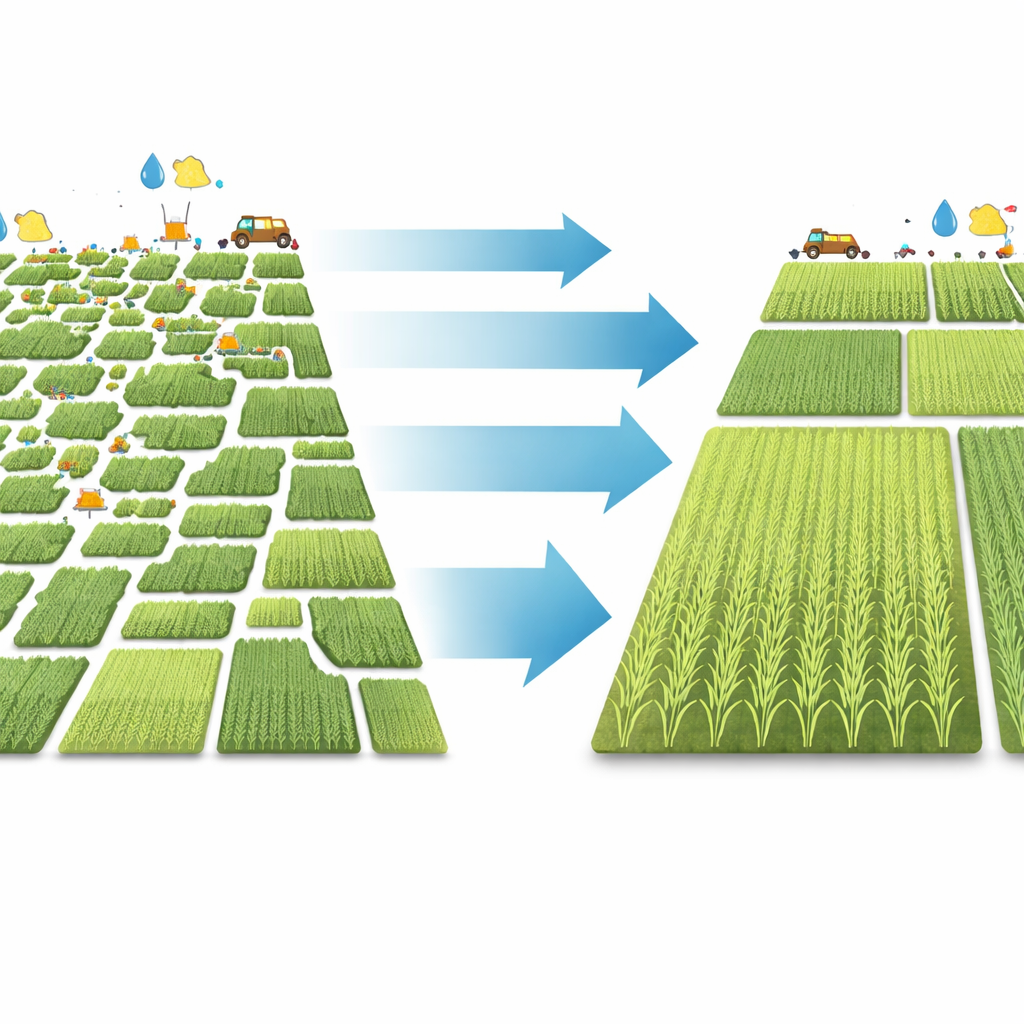
China’s own path to sustainable farming
Unlike many Western countries, where large commercial farms were already common and progress has focused on high-tech gadgets and precision tools, China’s path to more sustainable farming begins with the land pattern itself. The study shows that most cropland is still operated by very small farms, yet a large share of land already exists in big, continuous blocks on the ground. This gap between physical field size and actual farm size points to a huge opportunity: more integrated management of existing large patches could cut waste without needing to clear new land. At the same time, the authors stress that consolidation must be guided carefully to avoid harming rural livelihoods, eroding traditional cultures, or damaging local wildlife and soil life.
What this means for the future of food
In everyday terms, the paper concludes that carefully knitting small fields into larger, better connected farmland can help China grow more grain with fewer chemical and energy inputs. As cropland becomes more continuous, farms can use fertilizers, machinery, and water more precisely and sparingly, easing pressure on rivers, soils, and the climate. This shift—from squeezing the land with ever more inputs to organizing it more wisely—offers a practical roadmap not only for China but also for other countries dominated by smallholders that are searching for ways to secure food supplies while protecting the environment.
Citation: Liu, S., Ling, L., He, F. et al. Cropland concentration powers sustainable intensification of agriculture in China. Commun Earth Environ 7, 225 (2026). https://doi.org/10.1038/s43247-026-03259-8
Keywords: sustainable agriculture, cropland consolidation, China food security, remote sensing farming, fertilizer reduction