Clear Sky Science · en
Physicochemical controls on ancient carbon assimilation into ecosystem biomass in shallow-water hydrothermal systems
Hidden Carbon Factories on the Seafloor
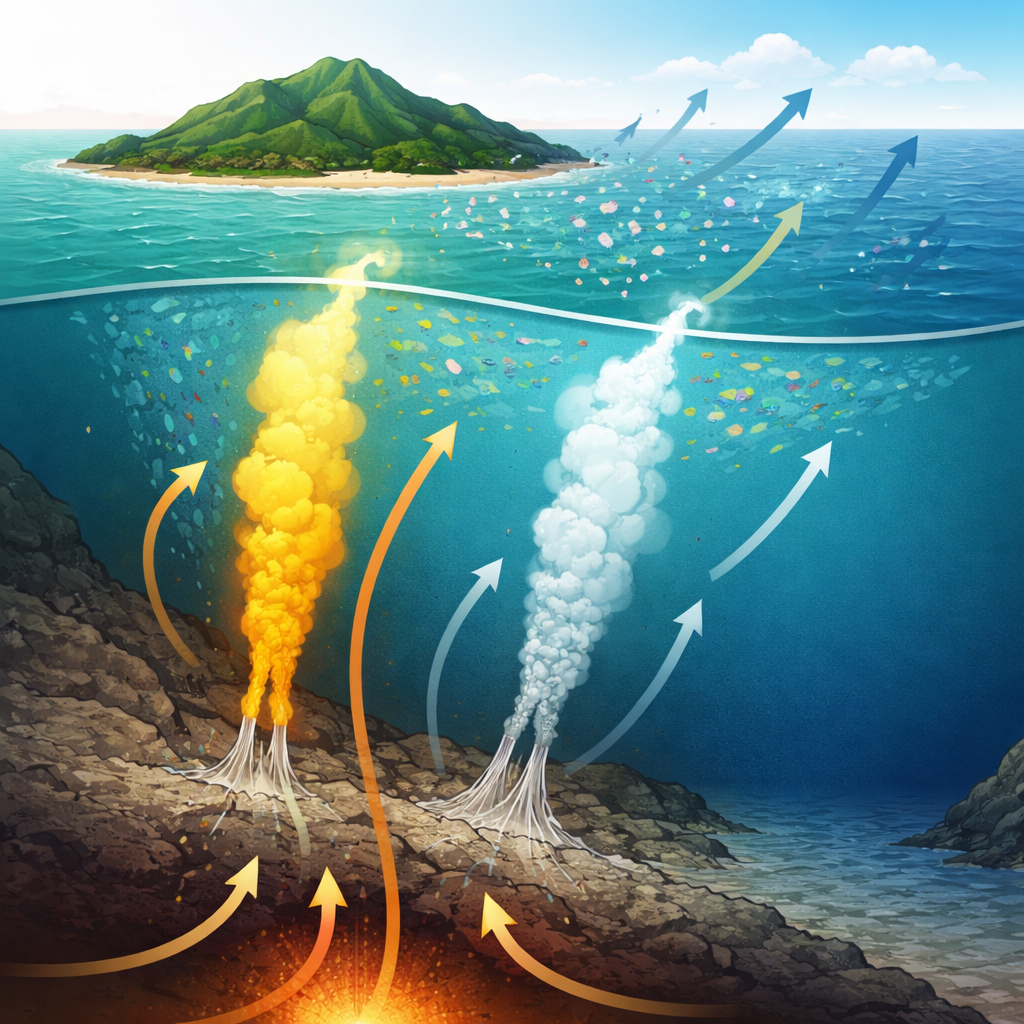
Far below the waves, hot springs on the ocean floor constantly leak ancient carbon into the sea. At first glance, these underwater vents look like small, local oddities. But they tap deep reservoirs of carbon that have been locked away for millennia. This study asks a deceptively simple question with big consequences: when this old carbon enters a shallow coastal vent field off Taiwan, does local marine life actually use it, or does most of it simply escape back into the ocean and atmosphere?
Where Heat, Acid, and Life Collide
Off the small island of Kueishantao in northeast Taiwan, seawater bubbles with gas and hot fluids from the seafloor. Two nearby vent types dominate the area: a scalding, highly acidic “yellow” vent and a cooler, less acidic “white” vent. Both release large amounts of carbon dioxide that originated deep in Earth’s mantle and carries a chemical “age signature” showing it is far older than modern surface carbon. Because the site is shallow and bathed in sunlight, it hosts both microbes that make a living from chemicals alone and ordinary photosynthetic organisms that rely on light. This mix makes it an ideal natural laboratory to track how vent carbon moves from hot fluids into living biomass.
Reading Carbon’s Fingerprints
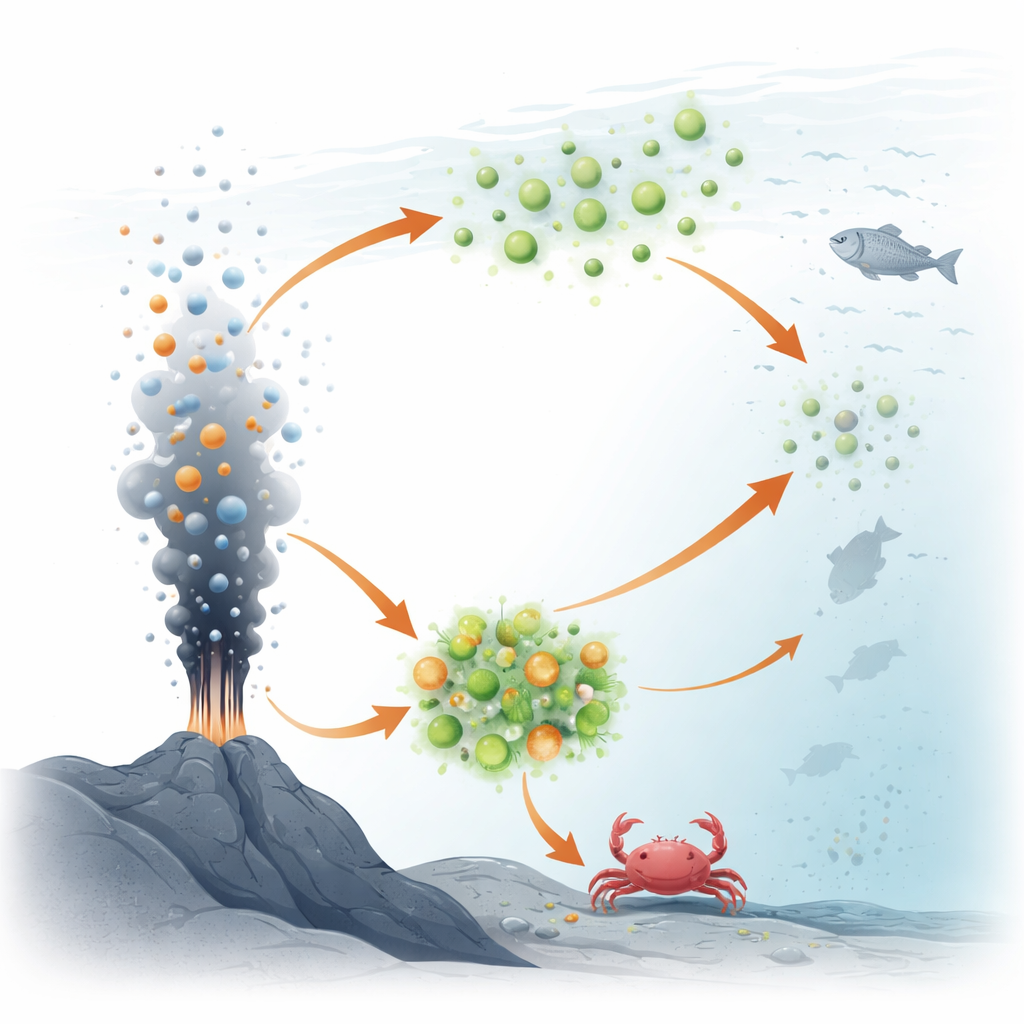
To follow this ancient carbon through the ecosystem, the researchers used a suite of isotope “fingerprints” measured in tiny particles and fats from microbes and animals. By sampling suspended particles in the water, sediments on the seafloor, and tissue from a vent-dwelling crab, they compared the chemical signatures of carbon and hydrogen in specific fatty acids to those expected for different lifestyles. Certain patterns in these signatures reveal whether microbes rely on chemical energy from the vents or on sunlight, and whether the carbon they use is modern or very old. This allowed the team to distinguish vent-derived carbon from that coming from normal seawater or from land, and to see which organisms were tapping into which pool.
Ancient Carbon in Modern Food Webs
The measurements show that carbon emerging from the vents is indeed taken up by local life, especially by sulfur-oxidizing bacteria living close to the seafloor plumes. These chemoautotrophs turn carbon dioxide into organic matter without sunlight and pass this carbon on to other organisms, including the endemic vent crab. Yet, the isotopic data also reveal that photosynthetic microbes and algae at the edge of the vent plumes, where waters are less harsh, incorporate a detectable share of this ancient carbon as well. In other words, old carbon from below does not remain confined to dark, chemically driven niches; it also finds its way into sunlit, more familiar segments of the food web.
When Gentler Conditions Win
One of the most surprising results is that the cooler, less acidic white vent holds more ancient carbon in local particles than the hotter, more chemically energetic yellow vent, even though the yellow vent emits more reactive compounds that microbes could theoretically use for fuel. The study’s isotope-based calculations suggest that while the yellow vent environment favors chemical-based metabolism, its extreme temperature and acidity restrict how much biomass can accumulate. In contrast, the milder white vent seems to provide a better balance: conditions are still rich in energy but friendlier to microbial growth, allowing more vent-derived carbon to be built into living material nearby.
Most Vent Carbon Slips Away
Despite clear evidence that both chemical- and light-driven microbes use vent carbon, the total amount of ancient carbon locked into local biomass is small compared with what the vents emit each day. The authors estimate that only a few percent of daily carbon output is present in nearby particles at any given moment, and the sediments themselves contain little organic carbon. This indicates that most vent-derived carbon is rapidly transported away by currents or escapes as gas, rather than being stored in the local seafloor ecosystem. For a lay observer, the conclusion is straightforward: shallow-water vents do feed their immediate communities with ancient carbon, but the harsh chemistry and vigorous mixing mean that only a modest fraction is retained. The details of pH and temperature, not just the amount of chemical energy available, ultimately decide how much of this deep carbon ends up woven into marine food webs versus lost to the wider ocean.
Citation: Maak, J.M., Elvert, M., Grotheer, H. et al. Physicochemical controls on ancient carbon assimilation into ecosystem biomass in shallow-water hydrothermal systems. Commun Earth Environ 7, 216 (2026). https://doi.org/10.1038/s43247-026-03254-z
Keywords: hydrothermal vents, marine carbon cycle, chemoautotrophic microbes, radiocarbon tracing, shallow-sea ecosystems