Clear Sky Science · en
Molecular fingerprinting of microbial consortia in late Oligocene microbialite architectures from a freshening Junggar paleolake, Central Asia
Ancient Lake Stones as Climate Time Capsules
In the deserts of today’s northwestern China, geologists have uncovered rounded stone balls from a vanished lake that once filled part of Central Asia. These are not ordinary rocks: they are microbialites—layered structures slowly built by communities of microbes on the lake floor over millions of years. By uncovering the chemical “fingerprints” locked inside these stones, the authors show how tiny organisms recorded the rise of nearby mountains, the freshening and shallowing of the lake, and the onset of a much drier climate across Central Asia.
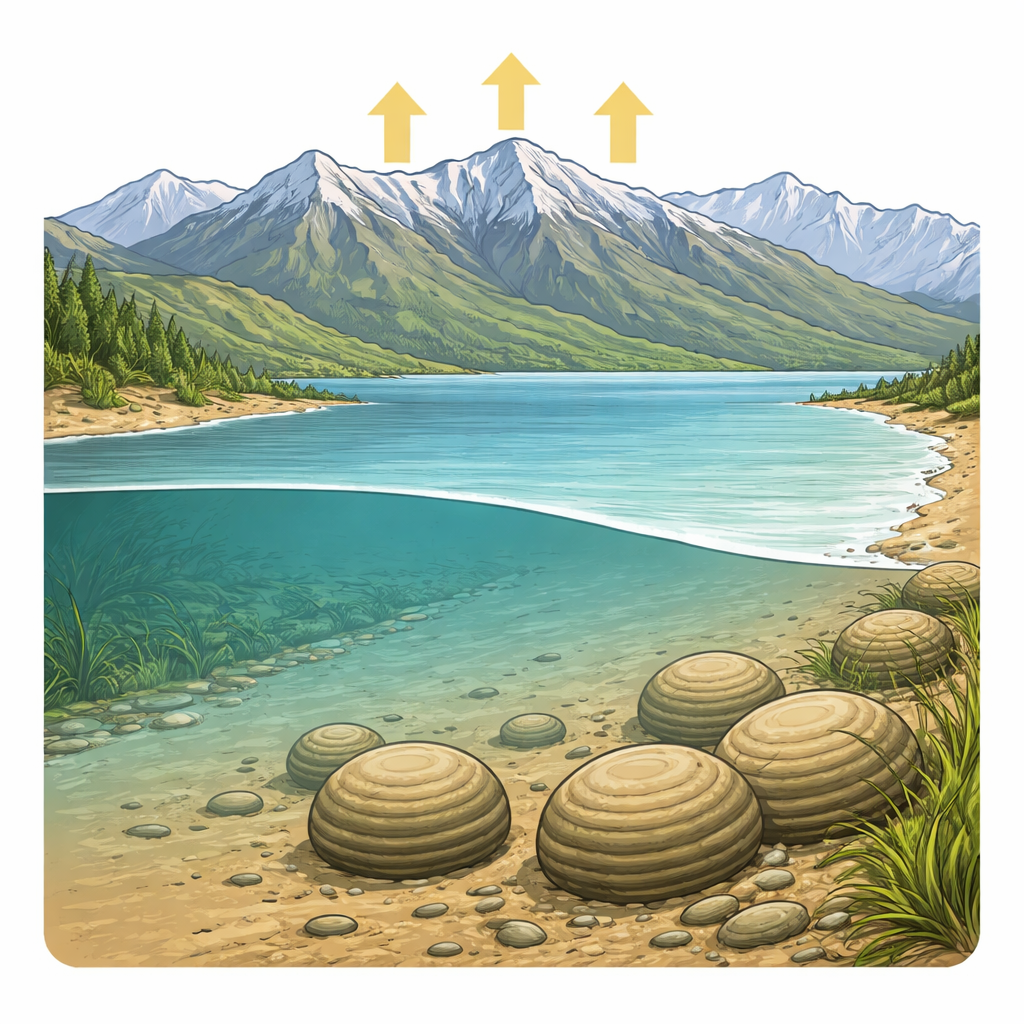
Layered Marbles from a Vanished Lake
The study focuses on large, golf-ball to grapefruit sized spheres called oncolites that formed about 25–23 million years ago in the Junggar Basin. At that time the basin hosted a deep, often salty lake. Careful cutting and imaging of the spheres reveal a nested, onion-like structure: a core made of earlier grains, a middle zone of irregular, knobby layers, and an outer zone of smooth, evenly thick coatings. Chemical maps show that these layers alternate between calcium-rich bands and darker coatings rich in iron and manganese. The rock fabrics closely resemble those made by modern microbial mats living in shallow lakes, suggesting that ancient microbial communities helped build these structures.
Microbes that Build with Stone
Under the microscope, the authors find nanoscale crystals of iron and manganese oxides closely intertwined with traces of organic matter. This pairing points to bacteria that used oxygen to turn dissolved metals into solid coatings, leaving behind dark bands within the oncolites. In other layers, the carbonate appears as very fine, almost glassy particles interpreted as amorphous calcium carbonate, a form known in modern settings to precipitate with the help of microbial films. Together, the textures and minerals show that different kinds of microbes—some forming sticky mats, others mediating metal oxidation—worked in tandem with changing water movement to sculpt the three main zones of each sphere.
Molecular Clues to an Ancient Microbial Community
The strongest evidence for life’s role comes from molecular fossils—sturdy organic molecules that survive long after cells decay. The researchers separated ordinary “free” organic compounds from those tightly bound to the carbonate itself. Inside the mineral framework they discovered a suite of saturated fatty acids, delicate molecules that almost never persist for tens of millions of years unless they are exceptionally well protected. Their chain lengths and patterns point to a community dominated by bacteria, especially cyanobacteria (microbes that perform oxygen-producing photosynthesis) along with other bacteria that feed on methane. Other diagnostic molecules called hopanes and methylhopanes appear in unusually high amounts, reinforcing the view that prokaryotic microbes, not algae or other complex organisms, drove the formation of these stones under fluctuating oxygen conditions.
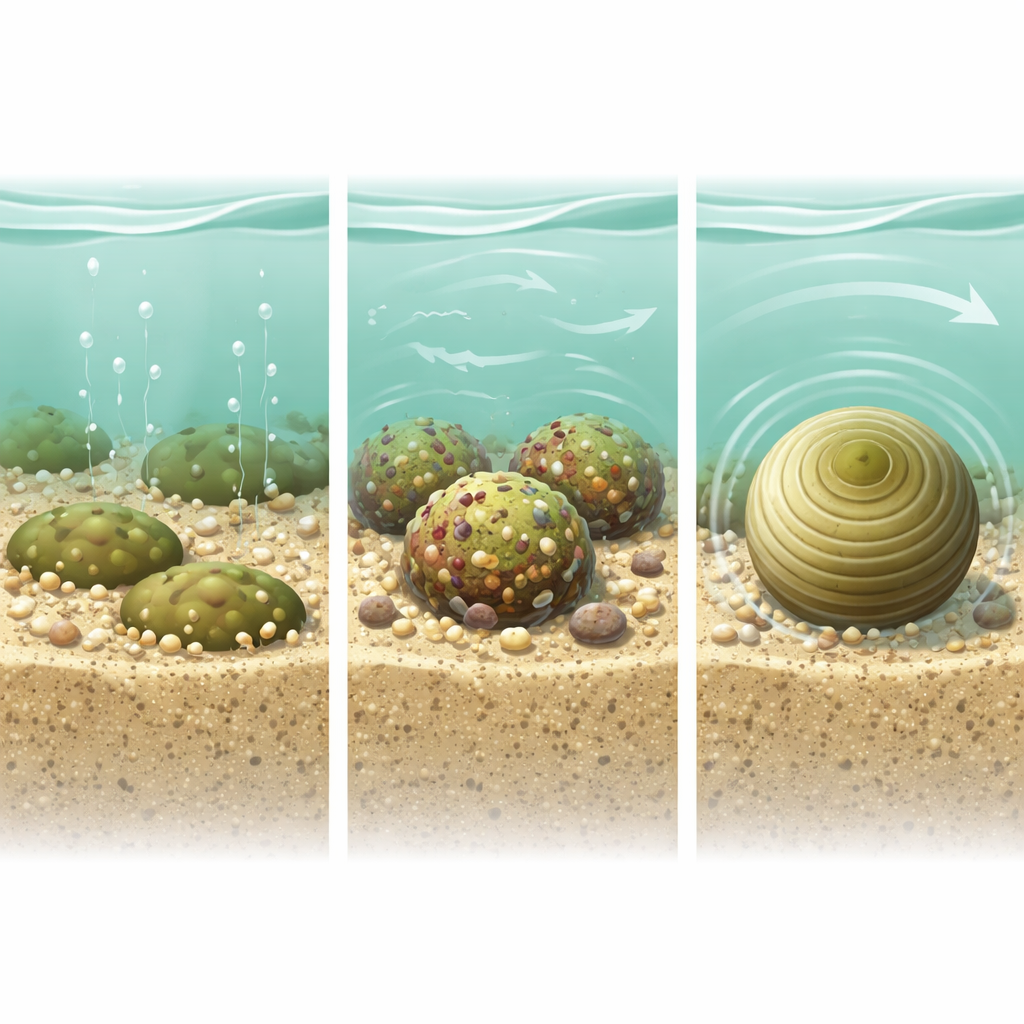
Mountains Rise, Lakes Change, Microbes Respond
By combining these molecular fingerprints with measurements of carbon and oxygen in the carbonates, the team links microbial growth to broader environmental upheaval. Around the time these oncolites formed, the nearby Tianshan Mountains were rising more rapidly, reshaping drainage patterns. Freshwater input into the lake increased, its level shallowed, and waters that had once been deep and oxygen-poor became more mixed and oxygenated. The isotopic shifts in the oncolites and surrounding rocks record this freshening. At the same time, the hydrodynamic changes—more waves and currents over the lake floor—rolled growing microbial balls along the bottom, helping them accrete smooth outer layers. These events happened just before Central Asia entered a much more arid phase, marked by the spread of deserts such as the Taklimakan.
What These Lake Stones Tell Us About Earth’s Past
To a non-specialist, the message is that these apparently simple stone spheres are in fact detailed archives of environmental change. Their internal fabrics, metal coatings, and preserved molecules together show that thriving microbial communities repeatedly laid down layers of carbonate as the lake shallowed, freshened, and became more turbulent. At the same time, the timing of their growth lines up with a pulse of mountain uplift and the first steps toward the region’s modern dry climate. The study demonstrates that microbialites can act as sensitive recorders of how tectonic forces, water chemistry, and microbial life interact—offering a powerful tool for reading Earth’s deep-time climate and landscape history.
Citation: Zhao, Z., Wu, C., Cui, X. et al. Molecular fingerprinting of microbial consortia in late Oligocene microbialite architectures from a freshening Junggar paleolake, Central Asia. Commun Earth Environ 7, 218 (2026). https://doi.org/10.1038/s43247-026-03253-0
Keywords: microbialites, ancient lakes, Central Asia climate, tectonic uplift, molecular fossils