Clear Sky Science · en
Multi-threshold time series analysis enables characterization of variable renewable energy droughts in Europe
Why Calm, Dark Periods Matter for Clean Energy
As Europe races to replace fossil fuels with wind and solar power, a simple question becomes crucial: what happens on those gloomy winter weeks when the wind barely blows and the sun is weak? This study digs into these so‑called renewable energy "droughts" across Europe, asking how often they occur, how long they last, and how bad they really are—and what that means for keeping the lights on in a future powered almost entirely by variable renewables.
Quiet Skies and Dim Days Across a Continent
The authors analyze 38 years of hourly weather-based data for onshore wind, offshore wind, and solar power in 34 European countries. They define a renewable drought as a stretch of time when average output stays below a chosen share of the long‑term norm—whether for a day, a week, or even months. Instead of picking one arbitrary cutoff, they scan many different levels to capture everything from extreme but brief slumps to long, moderately weak periods. This multi-threshold approach reveals a rich pattern: solar droughts mostly cluster in the dark months of winter, while wind droughts can occur in any season but often peak in summer. Some events are short and sharp; others are long, gentle drags on supply.
Power in Numbers: Blending Technologies and Countries
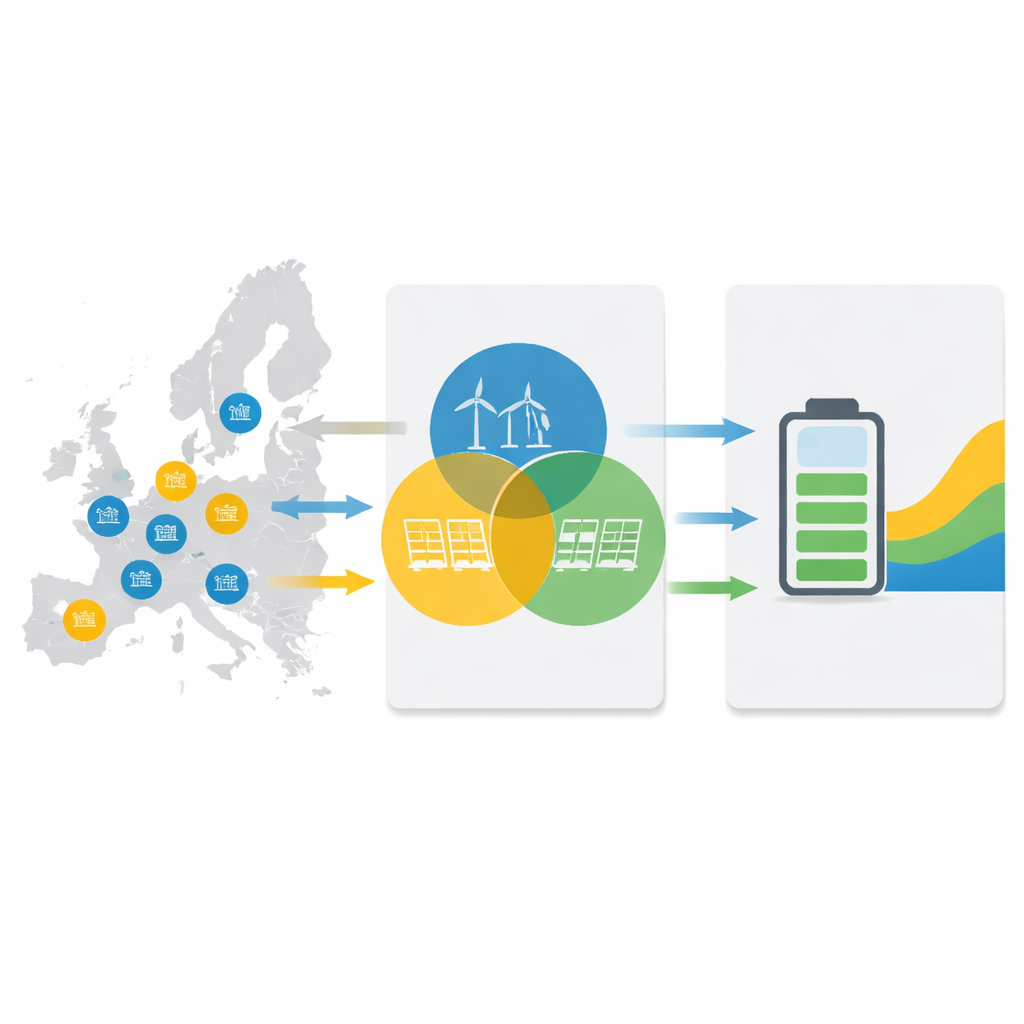
One of the study’s clearest messages is that diversity helps. When wind and solar are considered separately, each can experience long and severe droughts. But when the authors combine them into a single portfolio for each country, both the longest and average droughts shrink dramatically. On balance, mixing solar with onshore and offshore wind cuts the maximum drought length by about half or more compared with any single technology alone. Solar’s nightly and seasonal gaps are often filled by wind, while breezy nights and stormy winters can cushion low-sun periods. Stretch this idea across borders and the effect grows stronger: if Europe were connected as if by a perfect, unconstrained grid, the longest combined drought would shrink by about two‑thirds compared with individual countries acting alone.
Extreme Events That Shape Storage Needs
Yet even in such an idealized, fully interconnected Europe, long tough spells remain. To pinpoint the events that matter most for planning storage, the authors introduce a new measure they call “drought mass.” Instead of focusing on one cutoff, it stacks information across many thresholds, capturing both how long a dry spell lasts and how far output falls below normal. Using this yardstick, the study identifies a “super drought” in the winter of 1996/97: a 55‑day stretch of unusually low combined wind‑and‑solar output at the European level. Individual countries fare even worse—Germany, for example, experiences a 109‑day event in the mid‑1990s. Importantly, output does not drop to zero in these periods: in the worst European event, renewables still provide about 47% of their long‑run average, but that shortfall is sustained long enough to heavily draw down long-duration storage.

Why Simple Thresholds and Single Years Mislead
The study also highlights how sensitive conclusions are to modeling choices. Change the cutoff that defines a drought, and the apparent “worst year” or “worst event” can flip. Low cutoffs emphasize rare, almost windless or sunless stretches; higher cutoffs reveal smoother but far longer periods of merely below‑average output that can be just as important for storage planning. Likewise, different years exhibit very different drought behavior. Some winters are fairly benign, while others combine low renewable output with high heating demand. Because many planning studies and policy scenarios rely on only one or a few weather years, the authors warn that they may seriously underestimate the risk of rare but system‑defining droughts.
Planning for a Resilient Renewable Future
For non‑experts, the takeaway is straightforward: a renewable Europe is feasible, but it must be built to weather long spells of weak wind and sun. Combining wind and solar within countries, and linking countries more strongly through transmission, greatly reduces the severity and length of problem periods, yet does not eliminate them. The authors argue that planners need to account explicitly for multi‑week droughts like the 1996/97 event when sizing long‑duration storage and other backup options. They also recommend using many years of weather data, longer planning horizons that can span across New Year’s, and multi-threshold methods like their drought mass metric. Together, these steps can help ensure that a cleaner power system is also a reliably robust one—even when Europe faces its darkest, stillest days.
Citation: Kittel, M., Schill, WP. Multi-threshold time series analysis enables characterization of variable renewable energy droughts in Europe. Commun Earth Environ 7, 242 (2026). https://doi.org/10.1038/s43247-026-03251-2
Keywords: renewable energy droughts, wind and solar variability, energy storage, European power system, grid interconnection