Clear Sky Science · en
E-bikes enhance climate resilient urban mobility through heat adaptation as revealed by mediation analysis
Why staying mobile in hot cities matters
As summers grow hotter, simply getting around town can become risky for our health. Walking or biking to the bus or subway leaves people directly exposed to the sun, but abandoning these short trips can snarl traffic and increase pollution. This study from Beijing asks a timely question: can everyday choices, like riding an electric bicycle instead of walking or using a regular bike, help people stay safely on the move during heat waves?
How the study watched people in real streets
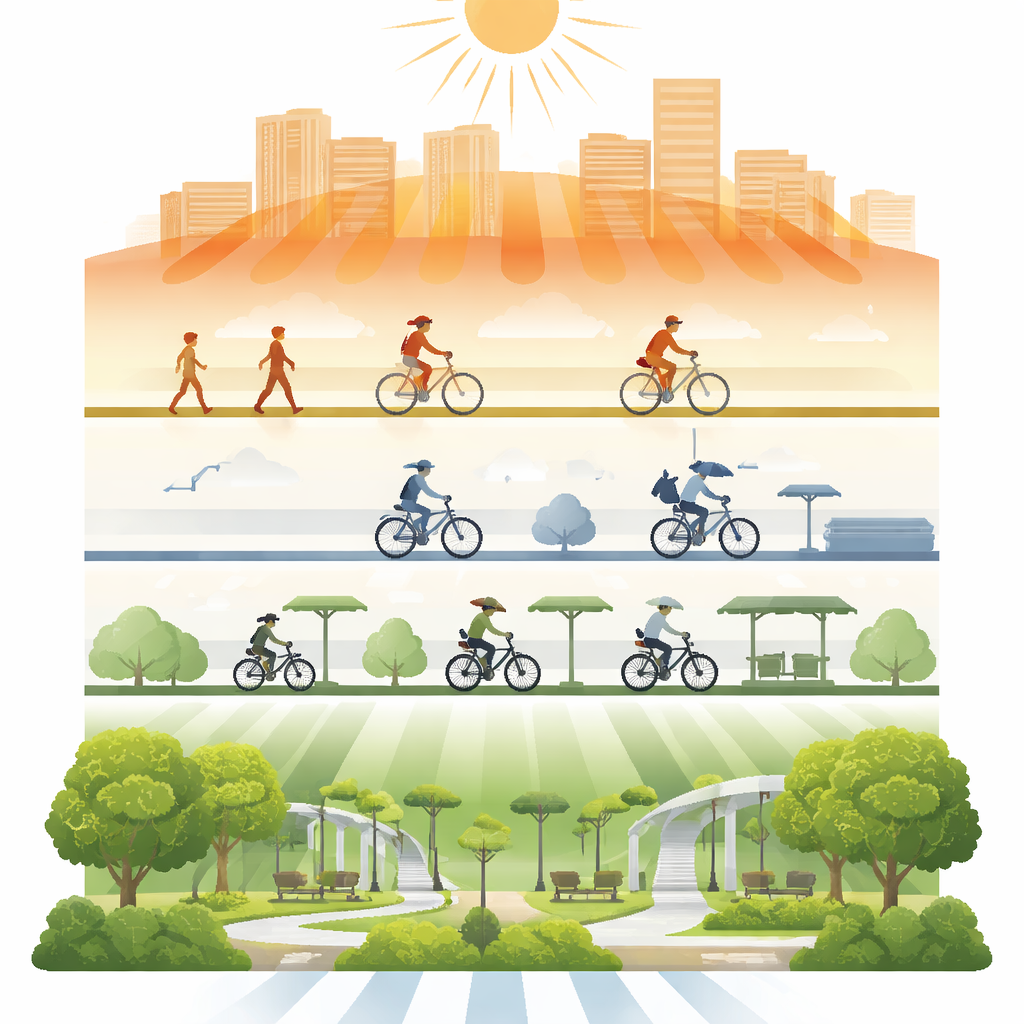
The researchers focused on a busy, green, four–square–kilometer district of Beijing known for heavy foot and bike traffic. Over ten hot mid‑day periods between late May and mid‑August, they used cameras mounted on e‑bikes to record more than 4000 people making short trips along city streets. With the help of deep‑learning algorithms and careful manual checking, they identified who was walking, riding a bicycle, or using an e‑bike, along with basic traits such as gender and age group. They also logged which simple heat‑protection steps people took, such as using umbrellas, wearing wide‑brimmed hats or sunglasses, or seeking shade, and matched all of this to local temperature, humidity, and sun intensity.
What people actually do when the heat rises
As temperatures climbed toward and above 30 °C, more people in every travel mode tried to protect themselves from the heat, but not in the same way. E‑bike users were by far the most active in using sun‑smart tactics. They most often wore UV‑blocking clothing, cooling sleeves, and hats, and combined several protections at once. Cyclists showed moderate adaptation, while pedestrians were the least protected overall, though they stood out for their frequent use of umbrellas. On the hottest and stickiest days, face and eye protection became more common, especially among e‑bike riders.
Who changes their behavior—and who does not
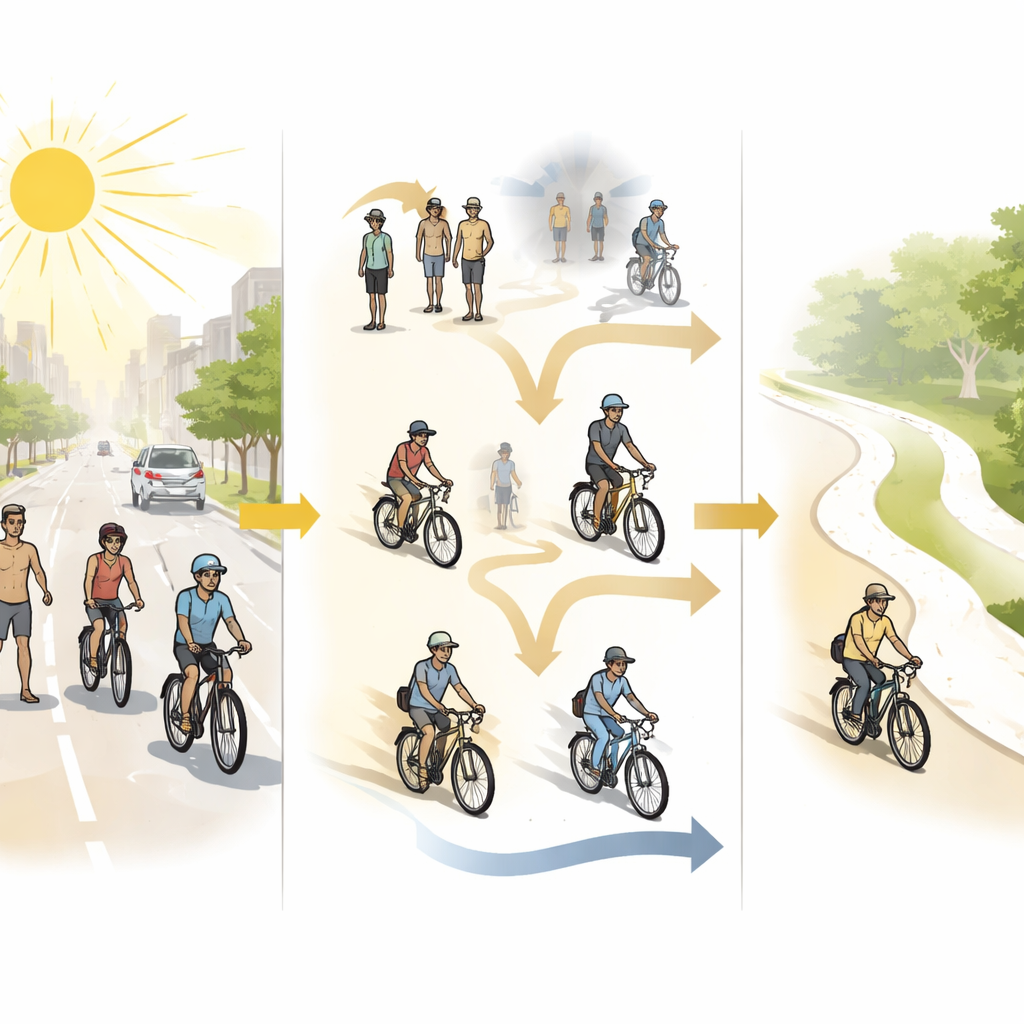
To untangle how heat changes travel, the team built what they call a Climate–Mobility–Adaptation framework. In simple terms, it separates three effects: heat can discourage people from going out at all, it can push those who do travel to protect themselves more, and it can drive extra protection directly regardless of how many people are on the street. The analysis shows that hotter weather clearly leads some people—especially walkers and cyclists—to stay home, while those who still travel tend to gear up with more protection. Women respond strongly, reducing some trips but sharply increasing protective behaviors when they do go out. Middle‑aged adults manage heat best by both adjusting how much they travel and using protective gear. In contrast, young people and especially older adults show no clear pattern of either staying home or protecting themselves more, raising red flags about their vulnerability.
Why e‑bikes stand out in hot weather
When the researchers compared travel modes, e‑bikes emerged as the most heat‑resilient form of open‑air transport. Unlike pedestrians and regular cyclists, e‑bike use barely dropped on hot days, yet riders still boosted their sun‑safety habits. This suggests that the electric assistance reduces physical strain, making it easier to tolerate heat while wearing hats, sleeves, or other gear. Meanwhile, the number of cyclists fell sharply as temperatures rose, but the few who kept riding were highly prepared with multiple layers of protection—a “filtering” effect where only the best‑equipped persisted. Green streets with more tree cover helped people of all kinds stay mobile, while wide, exposed roads tended to push them away, underlining the power of shade and urban design in shaping everyday choices.
What this means for cooler, safer cities
For city planners, the message is straightforward. If towns want people to keep walking and cycling without overheating, they need both better shade and travel options that work with, rather than against, the body in extreme heat. E‑bikes appear to offer a sweet spot: they keep people outside and active but reduce effort enough that sun‑smart behavior is easier to adopt. Expanding shaded e‑bike lanes, linking them to transit stops, and paying special attention to routes used by older residents could help cities stay moving in a warming world. While this study covers only one part of Beijing and a limited time window, it shows that small everyday tools—like hats, umbrellas, trees, and e‑bikes—can together form a powerful frontline defense against rising urban heat.
Citation: Zhang, Y., Du, P., Ma, W. et al. E-bikes enhance climate resilient urban mobility through heat adaptation as revealed by mediation analysis. Commun Earth Environ 7, 234 (2026). https://doi.org/10.1038/s43247-026-03248-x
Keywords: urban heat, e-bikes, climate resilience, active transport, heat adaptation