Clear Sky Science · en
El Niño–Southern Oscillation strengthened by North Atlantic Iceberg discharge during Heinrich stadial 1
When Distant Icebergs Shape Tropical Storms
Imagine giant icebergs breaking off ancient ice sheets in the far North Atlantic and, thousands of kilometers away, river valleys on the Peruvian coast suddenly roaring with catastrophic floods. This study shows that such a long-distance climate chain reaction really happened during the last deglaciation, when Earth was warming out of the last Ice Age. By reading climate signals stored in seafloor mud off Peru, the authors reveal that El Niño–Southern Oscillation (ENSO) events became unusually strong whenever vast armadas of icebergs were melting into the North Atlantic, suggesting that future disruptions of Atlantic ocean circulation could similarly amplify extreme El Niño–related weather.
Listening to Ancient Floods in Ocean Mud
To uncover this story, the researchers turned to finely layered sediments on the Pacific seafloor just off the Peruvian coast, one of the regions most sensitive to El Niño. Each layer contains tiny grains of clay rich in the element titanium, washed into the ocean by rivers draining the Andes. Because rainfall in both the high Andes and the normally desert-like coastal region is tightly linked to ENSO, changes in titanium delivery from land to sea act like a natural rainfall recorder. Using high-resolution X-ray fluorescence scans, the team measured titanium at roughly yearly steps across several thousand years of deposits, capturing both the typical year‑to‑year ups and downs associated with central Pacific ENSO activity and the rare, outsized spikes caused by extreme eastern Pacific El Niño floods.
El Niño on Overdrive During the Last Ice Age’s Collapse
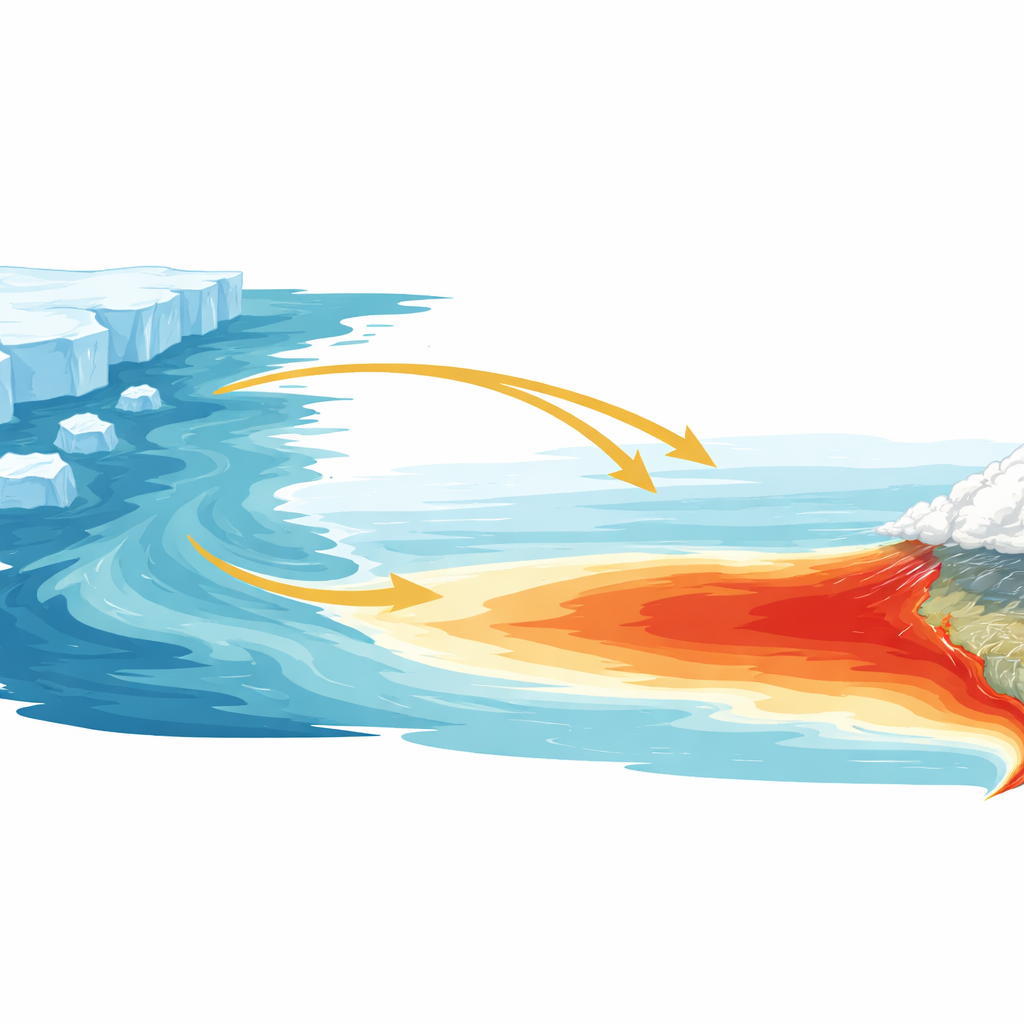
The record spans about 4,500 years of the last deglaciation, roughly 18,000 to 13,000 years ago, and is compared with a late Holocene interval when ENSO behaved much like it does today. The authors track two independent ENSO fingerprints in the mud: the overall strength of the 2.5–8‑year climate rhythm, tied mainly to rainfall shifts in the Andes, and the frequency of extreme coastal flood layers, tied to powerful eastern Pacific El Niño events. Both measures show that ENSO variability was generally higher during the deglaciation than in the late Holocene, with especially dramatic peaks during Heinrich Stadial 1, a time when massive numbers of icebergs surged into the North Atlantic as the great northern ice sheets destabilized. In the early phase of this stadial, between about 17.3 and 16.7 thousand years before present, the central Pacific El Niño–La Niña swings roughly doubled in strength, and the southern Peruvian coast experienced at least five to six catastrophic flood events per century—far above the less than one extreme per century inferred for more recent times.
A Long-Distance Link from Northern Ice to Pacific Heat
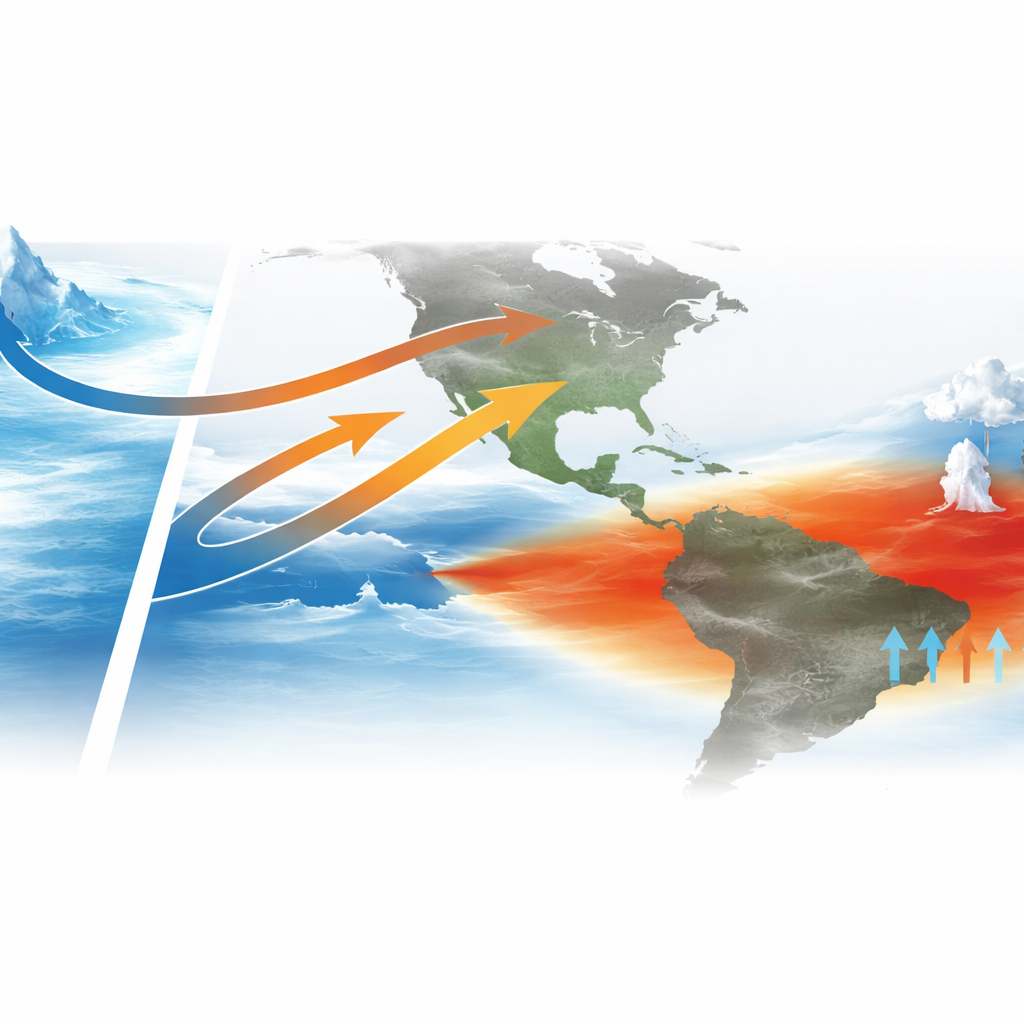
To test what might be driving these ENSO surges, the team compared their Peruvian mud record with North Atlantic indicators of iceberg discharge and with reconstructions of sea-surface temperatures. Peaks in ENSO activity line up, within dating uncertainties, with spikes in ice‑rafted debris carried by icebergs into the Nordic seas. At the same time, other evidence shows that the usual temperature contrast across the tropical Pacific—cooler waters in the east, warmer in the west—was greatly weakened. Climate model experiments and proxy data together suggest a mechanism: cold fresh water from melting icebergs cools the tropical North Atlantic, which alters wind patterns across Central America. Those wind changes then favor more symmetric, weaker temperature gradients in the tropical Pacific, making it easier for warm anomalies to spread into the eastern Pacific and ignite intense El Niño events. The authors argue that this rapid air–sea teleconnection from the North Atlantic surface, rather than the slower, deep‑ocean changes in the Atlantic circulation itself, was the main trigger for the ENSO amplification they observe.
Why Past Ice-Driven Extremes Matter for Our Future
Today, observations indicate that the Atlantic’s great overturning circulation is weakening, possibly due in part to increasing meltwater from Greenland. Climate models generally agree this slowdown will continue, but they disagree sharply on how ENSO will respond, with some simulations predicting stronger variability, others weaker, under greenhouse warming. The deglacial Peruvian record presented here shows that when North Atlantic surface waters were abruptly reshaped by huge inputs of iceberg melt, ENSO in the eastern Pacific could become much more energetic, with frequent extreme El Niño–style floods along the South American coast. Although the past conditions of Heinrich Stadial 1 differ in important ways from today’s world, this natural experiment offers a powerful benchmark: models used to predict future climate must be able to reproduce such strong ENSO sensitivity to northern meltwater if their projections of El Niño–related extremes are to be trusted.
A Take-Home Message for Non-Specialists
In everyday terms, this paper shows that what happens to ice and ocean currents near Greenland and the North Atlantic can strongly influence how often and how violently El Niño strikes countries like Peru. During a past period of rapid warming, big pulses of iceberg melt coincided with the most intense and frequent El Niño‑like events seen in the geological record, leading to repeated, devastating floods. While we cannot simply copy‑and‑paste those past conditions onto our future, the study warns that if models underestimate how sensitive ENSO is to changes in the Atlantic, we may also be underestimating the risk of more frequent extreme El Niño events in a warming world.
Citation: Yseki, M., Turcq, B., Gutiérrez, D. et al. El Niño–Southern Oscillation strengthened by North Atlantic Iceberg discharge during Heinrich stadial 1. Commun Earth Environ 7, 220 (2026). https://doi.org/10.1038/s43247-026-03247-y
Keywords: El Niño, paleoclimate, Atlantic circulation, iceberg meltwater, Peruvian floods