Clear Sky Science · en
Ultradeep drilling beyond 10 km revealing new insights into Earth systems and resources
Why Drilling So Deep Matters
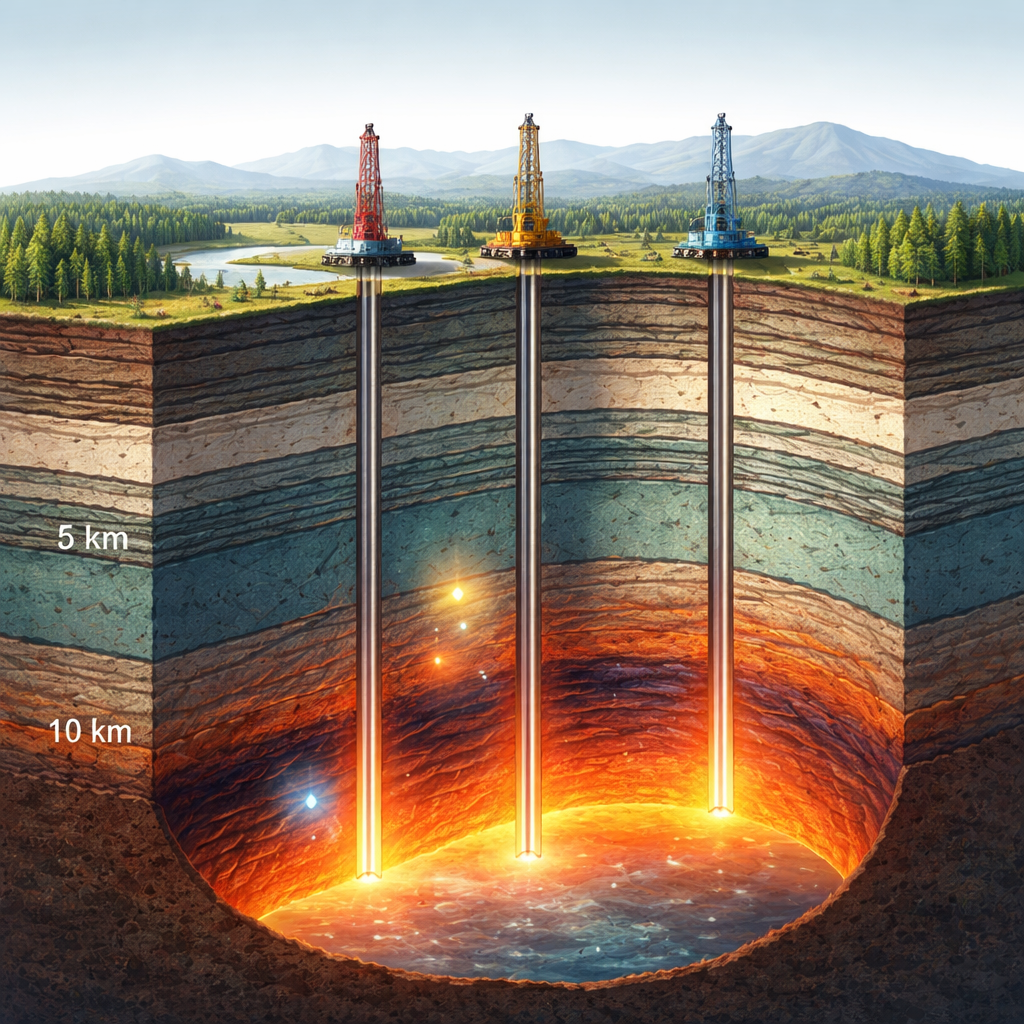
Imagine sinking a narrow metal straw more than ten kilometers into the ground—deeper than Mount Everest is tall. Ultradeep drilling projects of this kind are no longer just engineering stunts. They let scientists touch parts of Earth’s crust that were once the stuff of theory and guesswork, revealing hot, pressurized rocks that still crack, flow with fluids, and even hold oil and gas. This review pulls together what we have learned from the world’s deepest holes, from Cold War–era projects in Russia and Germany to today’s record‑setting wells in China, and asks what these extreme experiments mean for future energy, mineral resources, and our understanding of how the planet works.
Reaching the Hidden World Beneath Our Feet
For decades, scientists relied mainly on sound waves and magnetic signals to picture the deep crust and mantle. Ultradeep boreholes change that by providing physical samples and direct measurements of temperature, pressure, and stress. Russia’s Kola Superdeep Borehole, which reached 12,262 meters, and Germany’s KTB project were the first to show that supposedly solid, sealed crystalline rocks are in fact broken, fluid‑bearing, and warmer than expected. More recent Chinese efforts—the SDTK‑1 and X‑1 wells in the Tarim and Junggar basins—pushed past 10 kilometers while deliberately targeting oil and gas. Together, these projects reveal a deep crust that is dynamic rather than dormant and link abstract geophysical signals to real rocks and fluids.
Rethinking Earth’s Interior
The classic textbook view of the crust as a neat stack of granite over basalt has not survived contact with the drill bit. Instead, the deepest wells cut through thick packages of metamorphic rocks sliced by shear zones and fracture corridors. Many sharp “boundaries” seen on seismic images turn out to be zones rich in graphite, sulfides, or fluid‑filled cracks, not changes from one rock type to another. Temperature logs show that heat increases with depth in curved, uneven ways, often higher than earlier estimates. These findings force scientists to revisit how heat moves through the crust, how strong rocks really are at depth, and where earthquakes can start. They also show that water and salty brines can circulate many kilometers below the surface, carrying heat, metals, and gases.
Oil, Gas, and Hydrogen in the Deep
Conventional wisdom held that oil breaks down and gas disappears by about eight kilometers deep. Ultradeep wells now contradict that limit. In China’s SDTK‑1, drillers encountered working petroleum systems below ten kilometers, including dolomite reservoirs that still preserved pores and fractures despite crushing pressures and temperatures above 200 degrees Celsius. Gas samples show a shift from wetter, liquid‑rich gas at shallower levels to nearly pure methane in the deepest layers, produced as remaining oil cracks into smaller molecules. At the same time, several projects, including Kola, KTB, and newer Chinese wells, have found hydrogen‑rich gases in crystalline rocks. These can be generated when water reacts with iron‑bearing minerals, when naturally radioactive elements split water molecules, or when over‑cooked organic matter breaks down. The result is a new picture in which methane and natural hydrogen may coexist as part of a broader deep energy system.
New Windows on Minerals, Heat, and Hazards
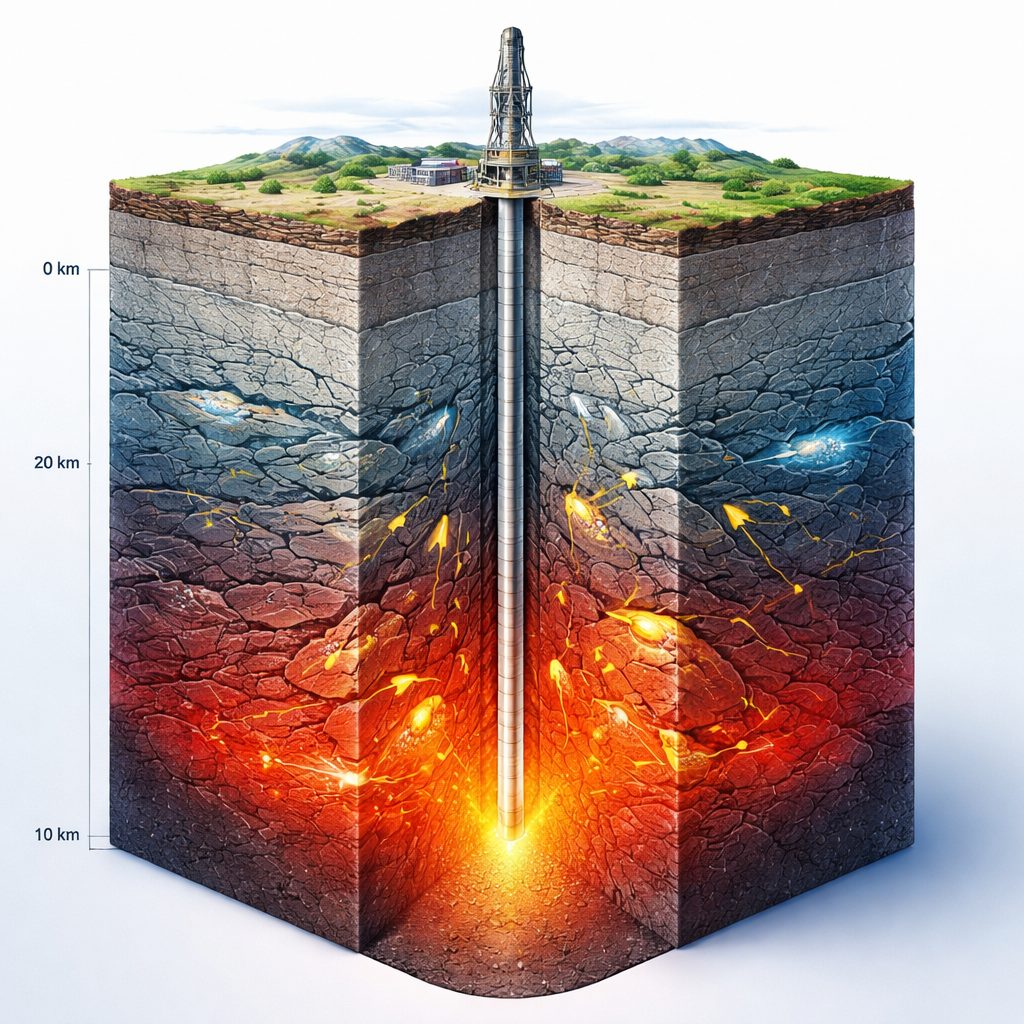
By sampling rocks and fluids at extreme conditions, ultradeep drilling also widens the search space for metals and geothermal energy. Cores from deep boreholes contain signs of copper‑nickel sulfides, gold‑bearing zones, and graphite‑rich layers that help explain how ore deposits form and how carbon is stored in the crust. Reactions such as serpentinization—where water transforms iron‑rich rock and releases hydrogen—can also fracture the rock from within, keeping pathways open for fluids and gases. Temperature profiles and permeability data from deep wells guide the design of engineered geothermal systems that might tap heat from hot but largely dry basement rocks. At the same time, downhole measurements of stress, pressure, and tiny earthquakes show how easily fault zones can be nudged toward slipping, highlighting the need for precise pressure control and real‑time monitoring when operating at such depths.
What It All Means for the Future
The emerging message from the world’s deepest holes is that Earth’s lower crust is not a dead, dry basement but a living system where heat, fluids, and chemistry remain active. Ultradeep drilling proves that hydrocarbons can survive and even flow far beyond old depth limits, that natural hydrogen may be a widespread but still poorly measured resource, and that deep rock layers can host valuable minerals and usable geothermal heat. At the same time, these projects expose how sensitive the deep crust is to changes in pressure and fluid flow, with implications for earthquake risk and safe underground storage of carbon dioxide or hydrogen. As new wells go deeper and are equipped as long‑term observatories, they will turn these once‑inaccessible zones into permanent laboratories, helping society balance resource use with a clearer, evidence‑based view of how our planet works.
Citation: Zhu, G., Huang, H. Ultradeep drilling beyond 10 km revealing new insights into Earth systems and resources. Commun Earth Environ 7, 124 (2026). https://doi.org/10.1038/s43247-026-03246-z
Keywords: ultradeep drilling, deep crust, geothermal energy, natural hydrogen, deep hydrocarbons