Clear Sky Science · en
Major Baltic Inflows do not have long-lasting consequences for 20th-century hypoxia in the central Baltic Sea
Why this matters for our seas
Across the world, coastal seas are developing growing "dead zones," areas starved of oxygen where most marine life cannot survive. The Baltic Sea in northern Europe holds one of the largest of these zones. For years, scientists suspected that a gigantic pulse of salty water that rushed in from the North Sea in 1951 might have set the stage for this long-term oxygen crisis. This study uses advanced computer simulations to ask: did that one extreme event really tip the system, or are slower, human-driven changes the main culprit?
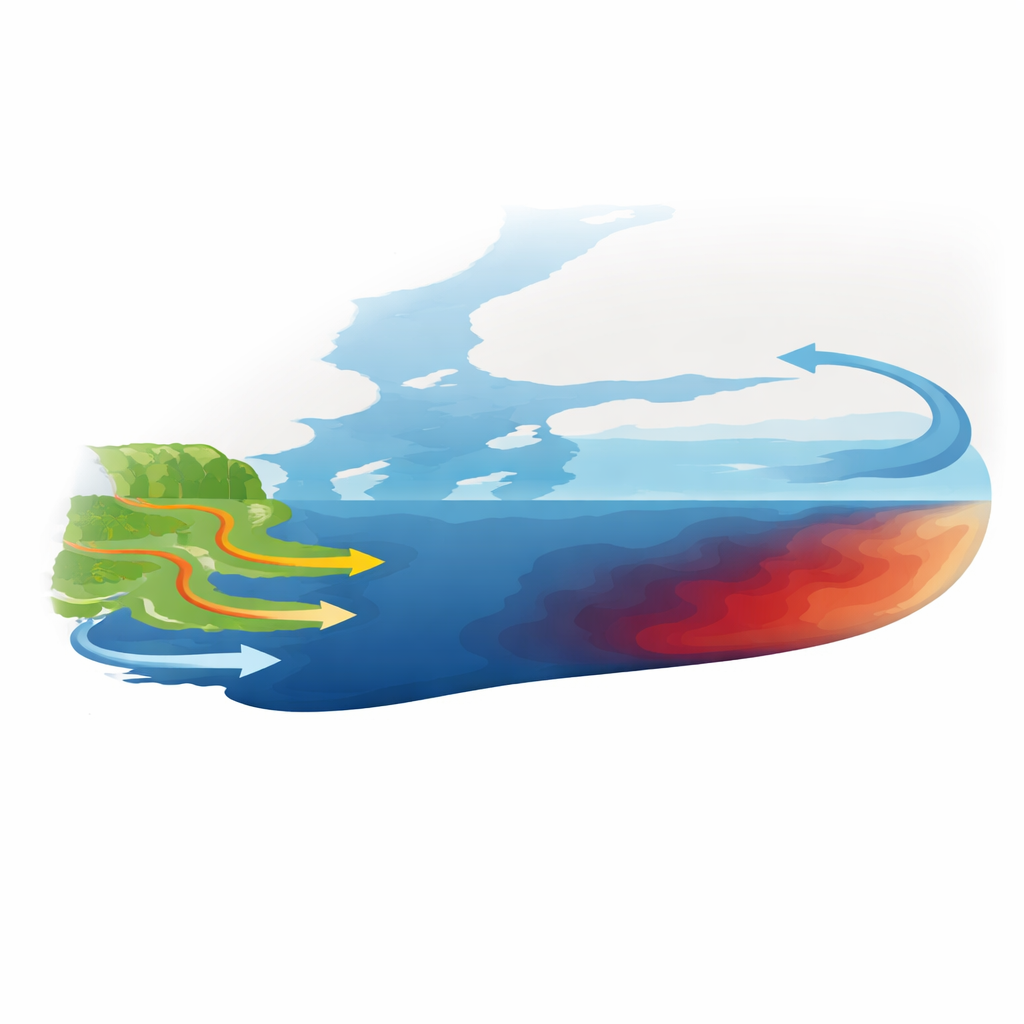
A sea prone to low oxygen
The Baltic Sea is almost enclosed, receives a lot of freshwater from rivers, and has only a narrow connection to the ocean. This creates a stable layering of lighter surface water sitting on top of heavier, saltier deep water. That density barrier, or halocline, acts like a lid: oxygen from the surface cannot easily reach the deep basins, while oxygen is steadily consumed there by decaying organic matter. When oxygen drops below a critical threshold, the deep water becomes hypoxic, and if it falls to zero, anoxic. In parallel, decades of nutrient-rich runoff from agriculture, wastewater, and the atmosphere have "over-fertilized" the sea, boosting blooms of algae that later sink and rot, further draining oxygen from depth.
Saltwater pulses and a long-standing mystery
From time to time, strong inflows of dense, salty water from the North Sea spill into the Baltic, slide along the seafloor, and temporarily ventilate the deep basins. The biggest such pulse ever measured, a so‑called Major Baltic Inflow, occurred in 1951. Sediment records and other data show that the central Baltic shifted rapidly to a more hypoxic state in the 1950s. That coincidence led to a provocative idea: perhaps the 1951 inflow strengthened the density layering so much that it locked the system into decades of oxygen loss. But earlier work could not cleanly separate the effect of this single event from other influences like nutrient loading and natural climate swings.
Testing the sea with virtual experiments
To untangle these effects, the authors used a three-dimensional ocean–ecosystem model of the entire Baltic Sea. They ran 13 simulations covering the 20th century, including a realistic reference case and several "what if" scenarios. In one, they removed the 1951 inflow entirely; in another, they replaced it with a much weaker inflow pattern; in ten more, they rearranged years with generally weak inflows to mimic a Baltic Sea that rarely receives strong saltwater pulses. Across all cases, the model tracked how strongly the water column was layered and how much of each deep basin became hypoxic or anoxic over many decades.
What really drives the dead zone
The results reveal a clear pattern. Strong inflows in general do affect how sharply the Baltic is layered, especially in the deep Gotland basins, and they influence oxygen in some regions. Yet even the record-breaking 1951 event left no lasting fingerprint on the long-term spread of low oxygen: its effects faded within about ten years, and simulations with or without that pulse converged to nearly the same hypoxic volumes. By contrast, a gradual, basin-wide increase in hypoxia from the 1940s through the 1980s appears in every scenario and matches the history of nutrient enrichment. The study also shows that different deep basins respond differently: the Bornholm Basin receives more effective ventilation from a wide range of inflows, while the remote western Gotland Basin mainly receives extra salt that strengthens layering but little extra oxygen, allowing hypoxia to expand when inflows are frequent.
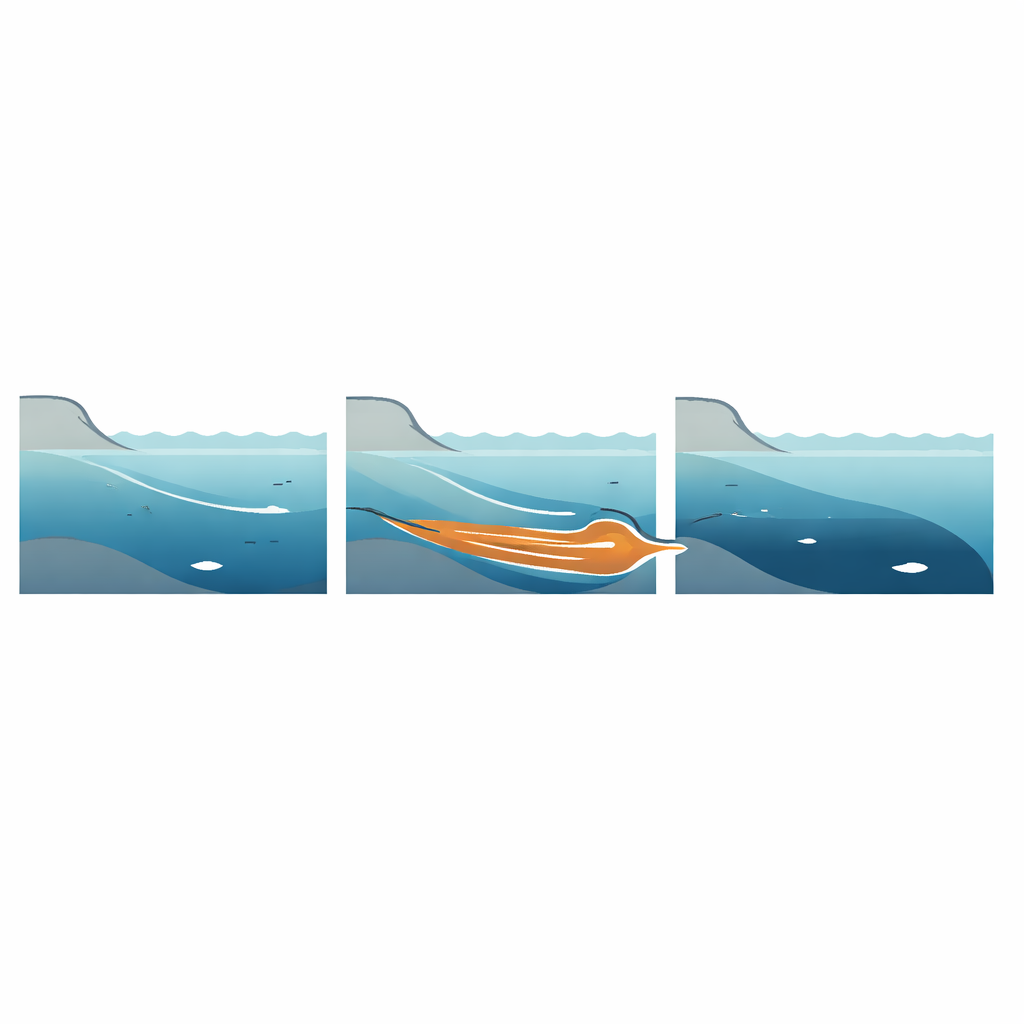
A self-reinforcing problem
Once deep waters turn hypoxic, the Baltic enters a "vicious circle": low oxygen allows sediments to release more phosphorus, which fuels blooms of nitrogen‑fixing cyanobacteria. Their decay further consumes oxygen, making the system increasingly dominated by this internal recycling rather than by nutrient inputs from land alone. The model shows this internal feedback becoming dominant roughly a decade after the 1951 inflow, regardless of whether that inflow is present in the simulations, underscoring that long-term eutrophication, not a single physical shock, controls the system’s trajectory.
What this means for saving the Baltic
For policymakers and citizens, the message is sobering but empowering. The expansion of the Baltic’s deep "dead zone" in the 20th century cannot be blamed on a one-off natural event, even one as dramatic as the 1951 inflow. Instead, it is mainly the result of long-term nutrient enrichment acting on a naturally layered sea. Natural variations in inflows and climate do shape regional details and short-term ups and downs, but they play a secondary role. That means the most effective way to shrink hypoxic zones in a warming future remains straightforward: continue and strengthen efforts to cut nutrient pollution from land, giving this vulnerable sea a chance to breathe again.
Citation: Naumov, L., Meier, H.E.M. Major Baltic Inflows do not have long-lasting consequences for 20th-century hypoxia in the central Baltic Sea. Commun Earth Environ 7, 205 (2026). https://doi.org/10.1038/s43247-026-03245-0
Keywords: Baltic Sea hypoxia, eutrophication, major Baltic inflows, coastal dead zones, marine oxygen depletion