Clear Sky Science · en
Linking ecological resilience and ecosystem services to inform spatial conservation planning
Why this matters for people and nature
Across the world, we are planting trees, restoring rivers, and reshaping land to protect soil, store carbon, and secure water. But what if landscapes that look greener and more productive on the surface are actually becoming more fragile underneath? This study tackles that puzzle on China’s Loess Plateau, a huge, erosion-prone region that has been a flagship for large-scale restoration. The authors show that boosting nature’s benefits to people is not enough; we also need to safeguard the hidden stability that keeps those benefits from collapsing when droughts, heatwaves, or other shocks hit.
A fragile landscape transformed
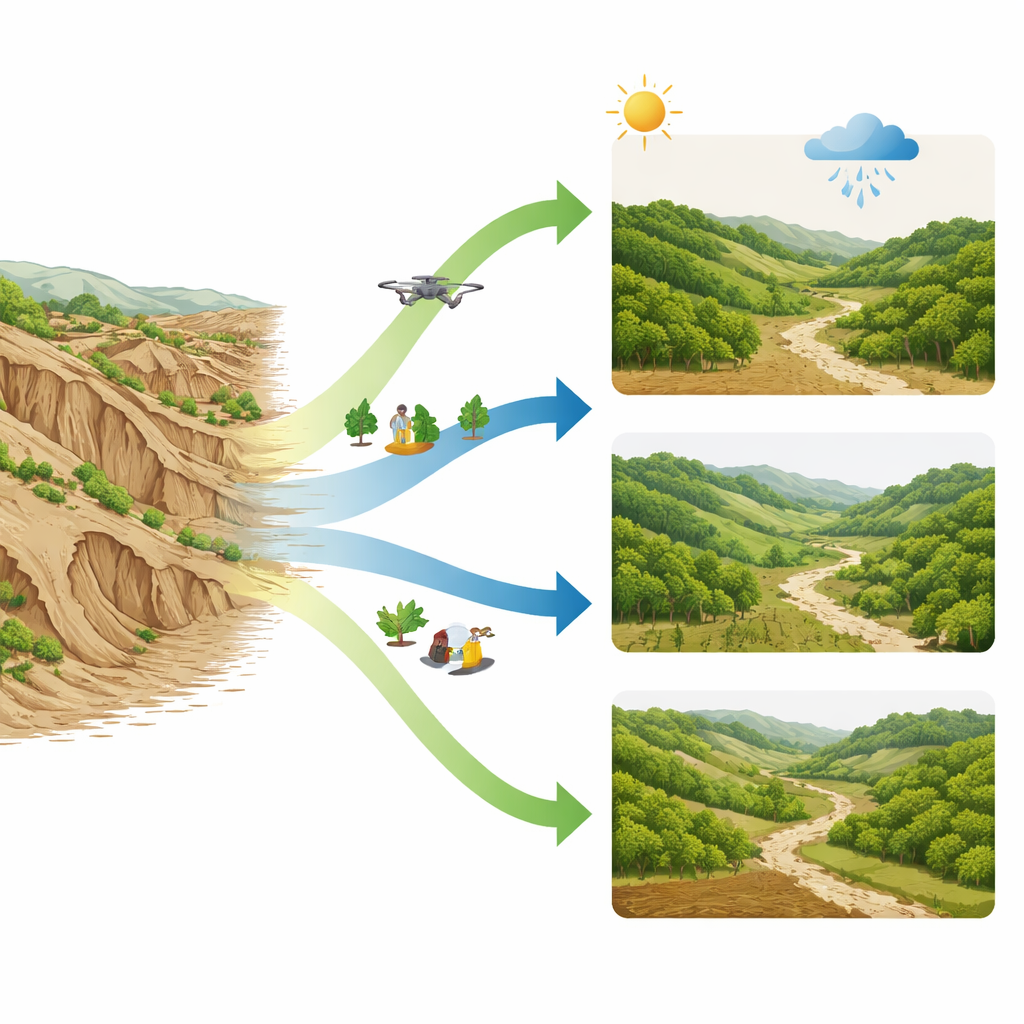
The Loess Plateau has long been known for its dusty hills, severe soil erosion, and vulnerable rural communities. Since the late 1990s, China’s Grain-for-Green Project has turned many croplands back into grasslands and forests. Vegetation cover has more than doubled, and key ecosystem services like soil conservation and carbon storage have improved across most of the region. Using satellite data and well-tested models, the researchers quantified three core services: how much soil is held in place on steep slopes, how much water is available at the surface, and how much carbon plants add to the land each year through growth.
The hidden side of recovery
Alongside these gains, the team examined ecological resilience—the ability of vegetation to bounce back after disturbances such as dry spells. They used long satellite records of vegetation greenness and applied “early warning” statistics that detect whether ecosystems are taking longer to recover and fluctuating more strongly. Such signals, known as critical slowing down, have been linked in other regions to forests approaching tipping points. On the Loess Plateau, resilience initially increased during the early years of restoration, but around 2010 the trend reversed: nearly half of the study area now shows signs of declining resilience, especially in the central and northern parts of the plateau.
When more services mean less stability
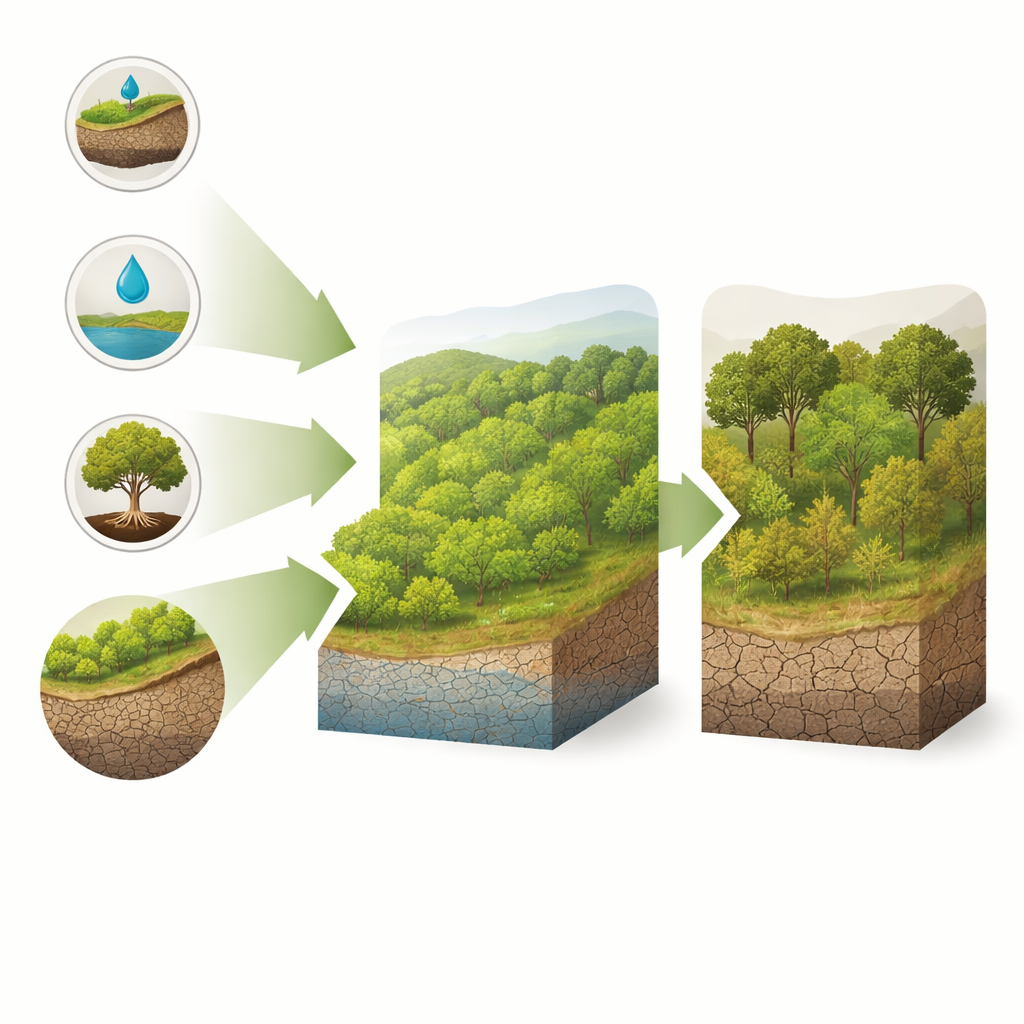
Crucially, the authors overlaid maps of ecosystem services with maps of resilience change. This revealed a worrying pattern: areas where soil erosion has dropped and carbon storage has surged often coincide with places where resilience is falling. For example, in zones with sharply rising carbon uptake, over two-fifths of the land still shows declining resilience. Even landscapes that function well today may therefore be increasingly vulnerable to future droughts or climate extremes. Part of the reason is that dense, water-thirsty vegetation in a dry region can drain soil moisture, making ecosystems less able to buffer swings in weather. Large areas have also been replanted with uniform stands of a few species, which can make the system less flexible and less able to recover when conditions change.
Choosing where to act first
To translate these insights into practical guidance, the researchers built a spatial planning framework that treats resilience and services together rather than separately. They tested three management strategies: one that favors areas with the highest current service supply, one that focuses on places with the greatest resilience concerns, and a balanced approach in between. All scenarios were limited to 30% of the land, reflecting real-world constraints. The service-focused strategy tends to highlight already productive southern areas but pays less attention to emerging fragility. In contrast, the resilience-focused and balanced strategies redirect attention toward central and northern zones where soil erosion risk and resilience loss are high, even though services are only moderate.
Balancing today’s gains with tomorrow’s security
For non-specialists, the key message is straightforward: greener hills and better ecosystem services do not automatically mean a safer future. On the Loess Plateau, strong gains in soil protection and carbon storage mask a growing risk that these benefits could be undermined if ecosystems lose their capacity to recover from stress. The study shows that by combining measurements of what nature delivers today with indicators of how stable those contributions are, planners can design restoration and conservation strategies that avoid short-term overreach and support long-term security for both people and the environment.
Citation: Wang, Z., Fu, B., Wu, X. et al. Linking ecological resilience and ecosystem services to inform spatial conservation planning. Commun Earth Environ 7, 215 (2026). https://doi.org/10.1038/s43247-026-03244-1
Keywords: ecosystem resilience, ecosystem services, Loess Plateau, ecological restoration, spatial conservation planning