Clear Sky Science · en
Early Cambrian explosive super-eruptions in the north-western margin of Gondwana may have triggered the ‘Strangelove ocean’
When Ancient Seas Suddenly Went Quiet
Over 520 million years ago, just as animal life was beginning its great burst of innovation known as the Cambrian explosion, parts of Earth’s oceans seem to have slipped into an eerie hush. Fossils and chemical clues from rocks in South China point to a brief interval when the sea was strangely poor in life and oxygen—a state scientists call a “Strangelove ocean.” This paper explores a dramatic new suspect behind that crisis: a series of gigantic volcanic blasts on the far side of the planet whose ash fell across tropical seas and may have stalled life’s early flowering.
Life’s Big Bang With a Pause in the Middle
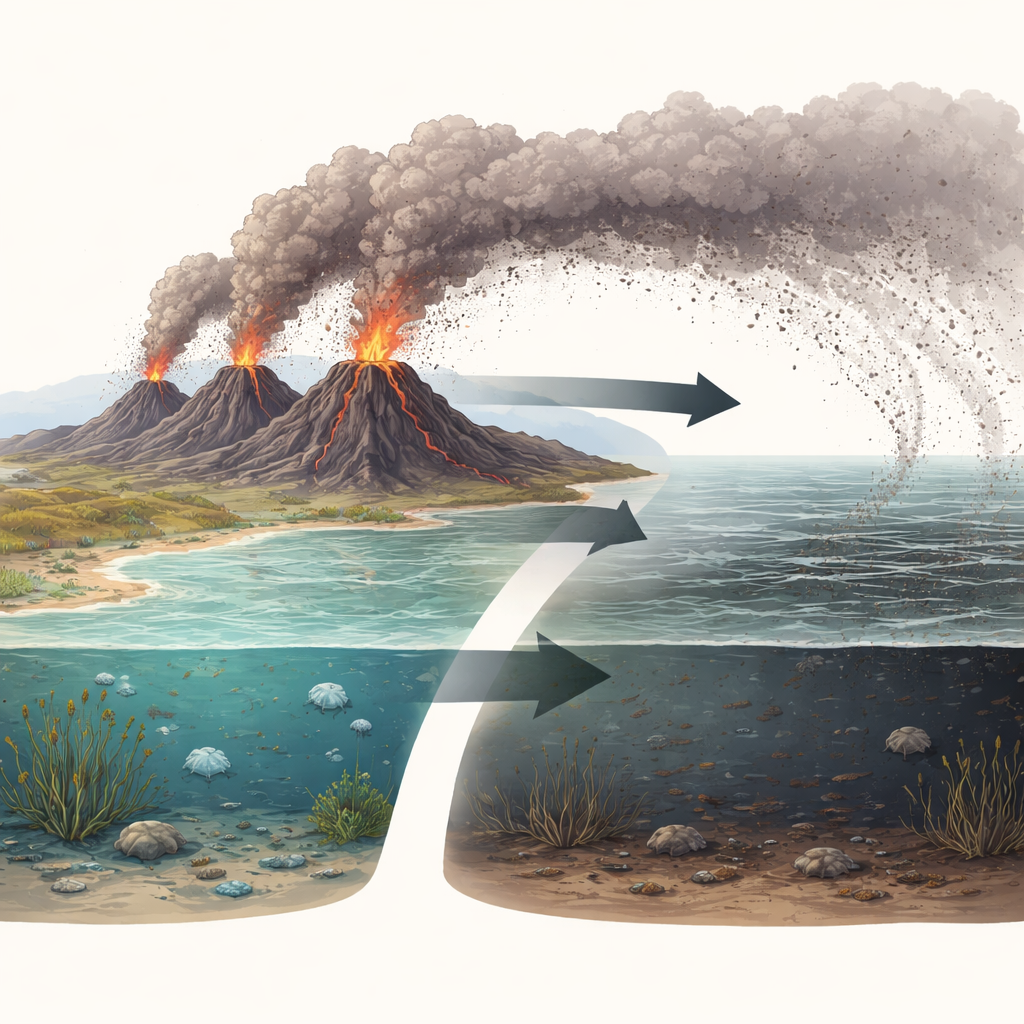
The Cambrian explosion is famous as the time when most major animal groups first appeared. In South China, rocks neatly capture two main waves of this evolutionary burst. The first wave, starting around 539 million years ago, saw the rise of small, hard-shelled animals. A second wave, a few million years later, brought richer communities that included many of the ancestors of modern animal groups. But between these waves, roughly 520 million years ago, the fossil record shows a sharp drop in those early shelly creatures, while chemical signatures in the rocks record a sudden disturbance in the carbon cycle and a spread of low-oxygen waters. Earlier researchers tied this to a possible asteroid strike, but newer measurements failed to confirm the telltale space-metal signal, pushing scientists to search for another cause.
Clues Locked in Ancient Volcanic Ash
The authors focus on thin, clay-rich layers known as K-bentonites embedded in early Cambrian rocks across South China’s Yangtze region and in the nearby Baoshan block. These layers began as volcanic ash that rained into the ocean and later altered into clay. By carefully mapping where these layers occur, studying their minerals and chemistry, and dating tiny zircon crystals inside them, the team found that multiple K-bentonites from widely separated areas formed at nearly the same time—about 520 million years ago. The chemistry of the zircons shows that the ash came from explosive, silica-rich magmas in a volcanic arc setting, the kind of environment today seen above subduction zones where one tectonic plate dives beneath another.
Tracing the Blasts Back to Distant Volcanoes
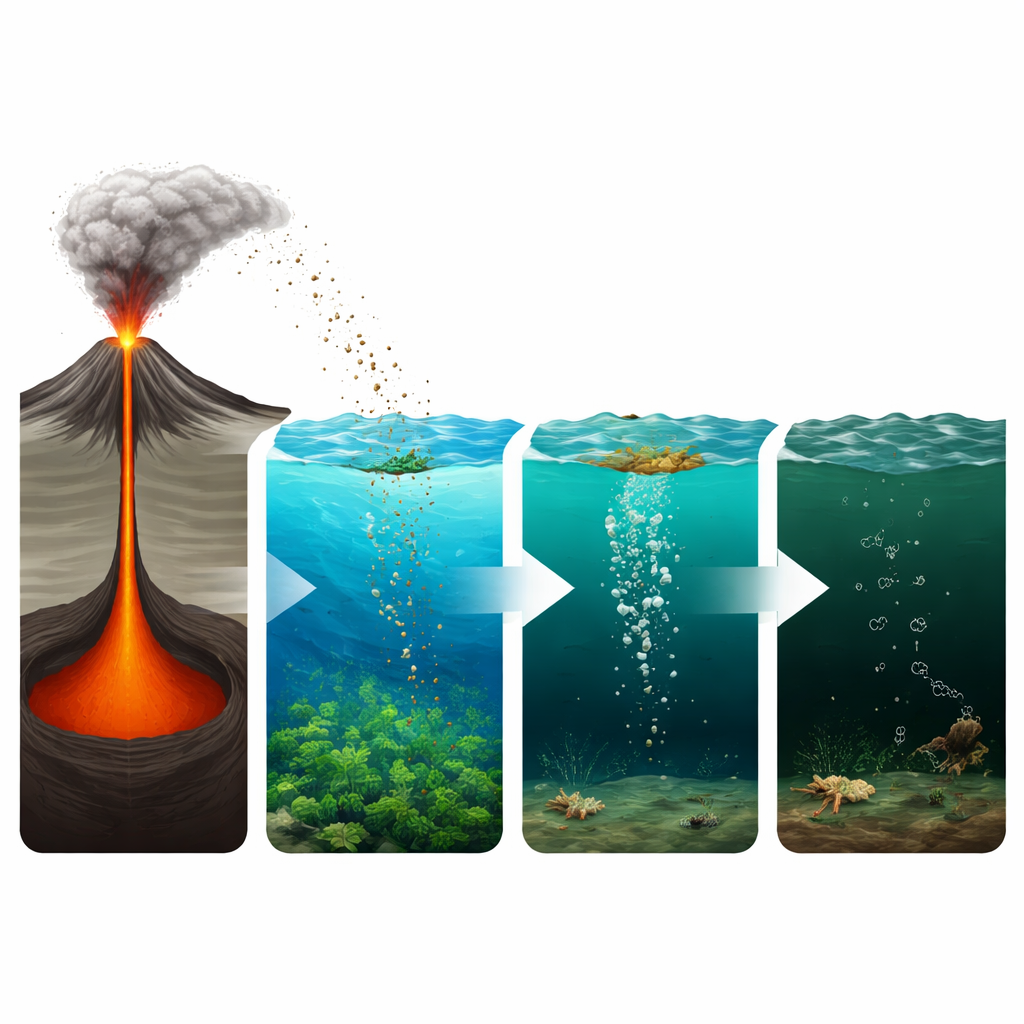
Where were these ancient volcanoes? No rocks of the right age and type are preserved in South China itself. Using global reconstructions of continental positions and a large compilation of age and isotope data from surrounding regions, the authors argue that the source was most likely a chain of volcanoes along the northwestern edge of the old supercontinent Gondwana, in what is now the Iran region. There, subduction of the Proto-Tethys ocean would have fueled powerful eruptions. The size and shape of zircon grains in the ash suggest the ash clouds traveled more than a thousand kilometers through the atmosphere before settling over tropical seas that included the Yangtze, Baoshan, and Tarim areas—evidence that these were true super-eruptions, comparable in scale to or larger than the largest historic blasts.
How Super-Eruptions Can Choke a Young Ocean
Having linked the ash to distant super-eruptions, the authors explore how these events could have reshaped the early Cambrian ocean. First, such eruptions release vast amounts of carbon dioxide, contributing to global warming. Warmer surface waters become more stratified, making it harder for oxygen-rich water to mix downward. Second, weathering of volcanic ash on land and in the sea releases nutrients, especially phosphorus, which can fertilize massive blooms of microscopic algae. The team’s calculations suggest that ash falling directly into the ocean, along with ash and lava on land, could have delivered an enormous pulse of phosphorus—enough to boost biological productivity and organic-matter burial over hundreds of years. As this extra organic matter decayed, it would have consumed oxygen in mid-depth and deep waters, expanding zones that were low in oxygen or even rich in toxic hydrogen sulfide. Independent sulfur isotope records from the same rock intervals match this picture, indicating intense bacterial activity tied to sulfate from volcanic gases.
Volcanoes, Dying Faunas, and a Delayed Boom of Life
This chain of events offers a coherent explanation for the “Strangelove ocean” that briefly interrupted the Cambrian explosion. The timing of the ash layers aligns with the extinction of small shelly animals and with geochemical signs of widespread anoxia in South China’s seas. Rather than an extraterrestrial collision, the study proposes that early Cambrian super-eruptions on the far side of the globe darkened and poisoned tropical oceans through warming, nutrient overload, and sulfur-rich emissions. In doing so, they may have temporarily suppressed marine ecosystems and postponed the full flowering of complex animal life by a few crucial million years. For readers, the message is that Earth’s deep-time history links the solid planet and the living ocean tightly together: when volcanoes roar, even worlds away, life can falter.
Citation: Zhang, D., Zhou, M., Zhou, Z. et al. Early Cambrian explosive super-eruptions in the north-western margin of Gondwana may have triggered the ‘Strangelove ocean’. Commun Earth Environ 7, 209 (2026). https://doi.org/10.1038/s43247-026-03243-2
Keywords: Cambrian explosion, Strangelove ocean, super-eruption volcanism, marine anoxia, Gondwana tectonics