Clear Sky Science · en
Atmospheric rivers and winter sea ice drive recent reversal in Antarctic ice mass loss
Why Antarctica’s recent behavior matters
For decades, scientists have watched Antarctica steadily lose ice, quietly pushing global sea levels higher. But in the last few years, that trend has unexpectedly slowed—and even reversed—despite glaciers continuing to speed up as they slide into the ocean. This study asks a simple but urgent question: what has temporarily tipped the balance, and what does it mean for our future seas?
A surprise pause in a long decline
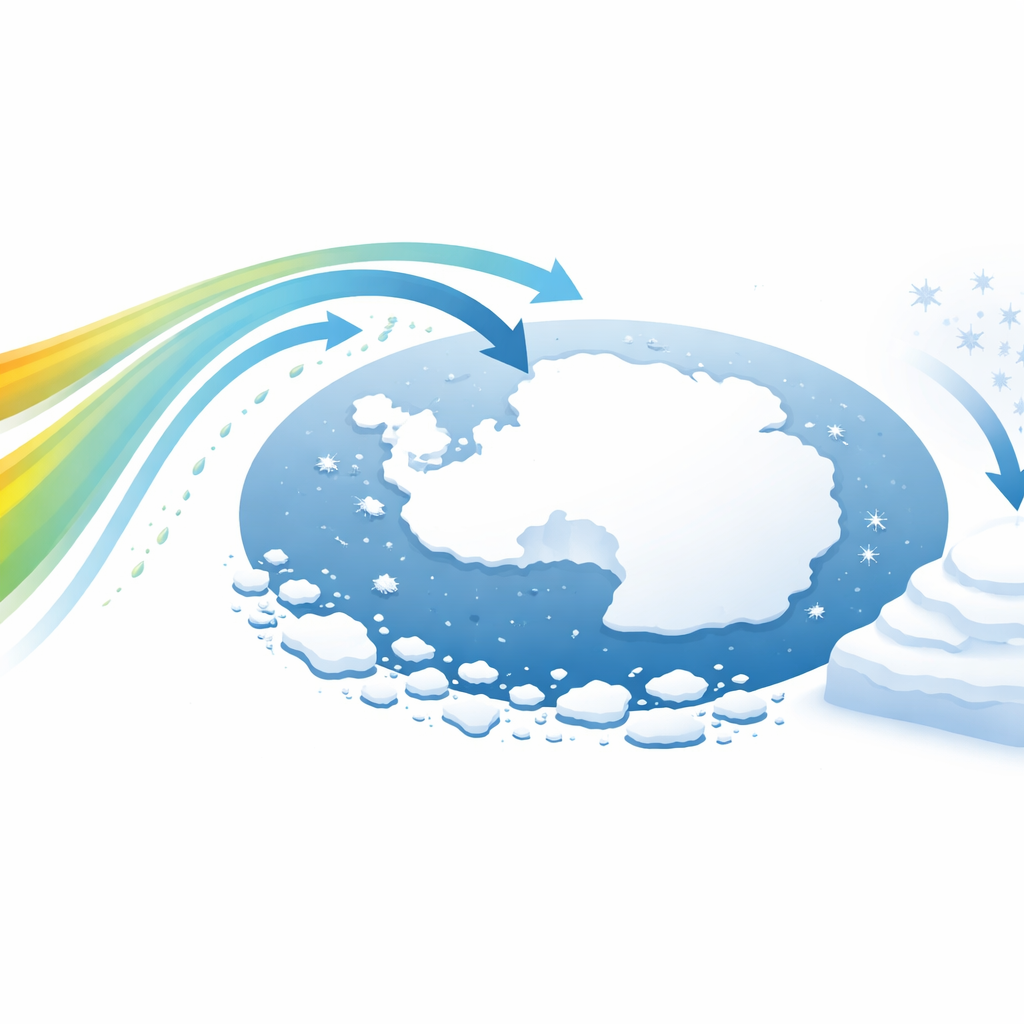
Using satellite measurements of Earth’s gravity field, the authors track how the total mass of the Antarctic Ice Sheet has changed since 2002. For almost two decades, Antarctica lost ice at a nearly steady pace. Around 2020, however, the pattern shifted: instead of continued loss, the ice sheet began gaining about 70 billion tons of ice per year over the next five years. At the same time, glaciers around the edge of the continent actually sped up their discharge into the ocean, meaning the slowdown in net ice loss could not be explained by more stable glaciers. Something else—happening at the surface—was adding ice faster than the ocean was stealing it away.
Rivers in the sky over the frozen continent
The main suspect is extra snowfall delivered by “atmospheric rivers”—long, narrow plumes of moist air that can carry huge amounts of water vapor from warmer regions toward the poles. Most of Antarctica’s precipitation already falls during short, intense episodes linked to these sky-borne rivers. Since 2020, the study finds that these events have become both more frequent and more intense, especially over the Antarctic Peninsula and along parts of East Antarctica such as Queen Maud Land and Wilkes Land. As a result, surface mass balance—the net gain or loss of snow and ice at the top of the ice sheet—has risen sharply, adding roughly 9% more snow than the long-term average and more than compensating for the increased flow of ice into the sea.
Winds, climate rhythms, and shrinking winter sea ice
Why have these moisture-laden air streams become so active? The authors point to a combination of stronger westerly winds circling Antarctica and shifts in large-scale climate patterns known as the Southern Annular Mode and El Niño–Southern Oscillation. In recent years, a tendency toward a positive Southern Annular Mode and a La Niña–like state has steered more moist air toward the Antarctic Peninsula and nearby seas, boosting snowfall there while reducing it in some parts of West Antarctica. At the same time, Antarctic sea ice has reached record low winter extents. With less ice cover, the ocean releases more heat and moisture to the atmosphere, modestly amplifying snowfall along coastal regions and ice shelves that act as “buffer zones,” catching much of this extra snow before it reaches the interior.
Testing the role of sea ice with virtual experiments
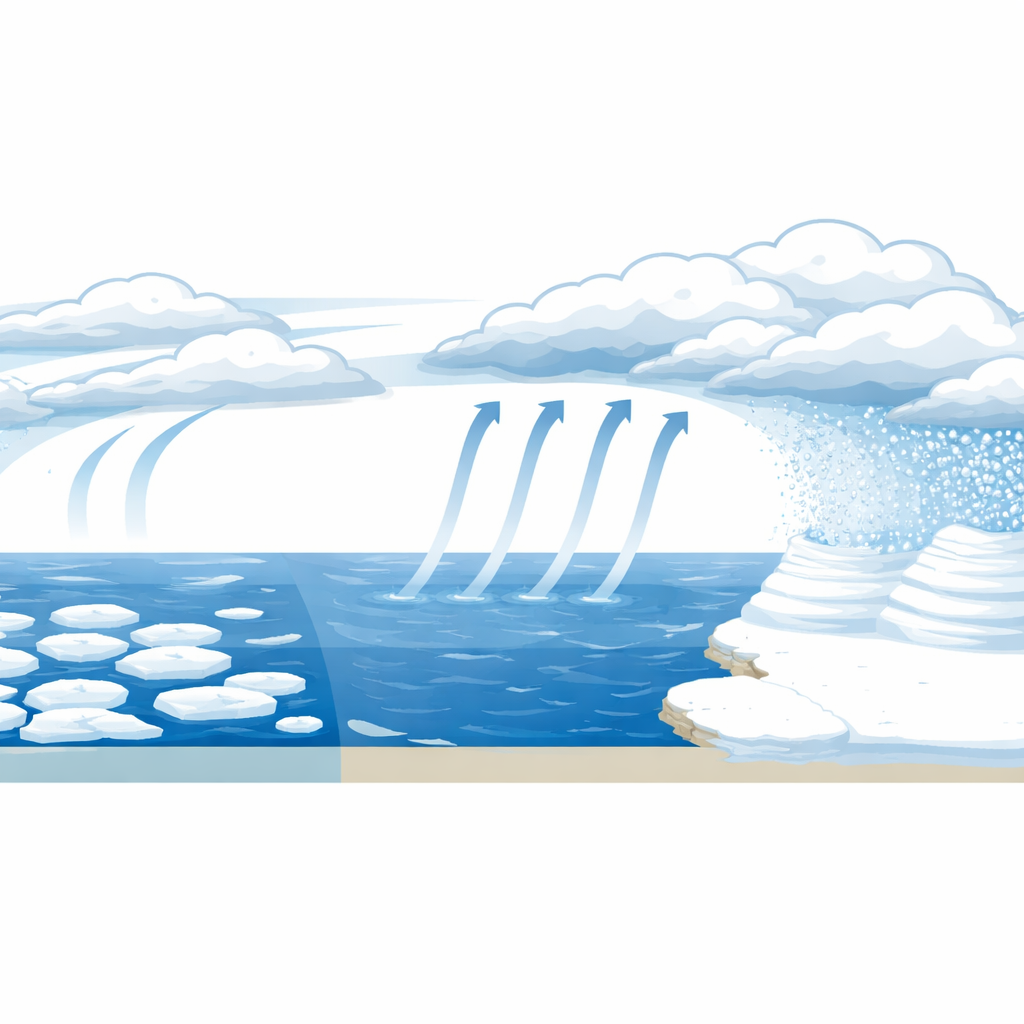
To untangle how much of the recent snowfall surge is due directly to lost sea ice, the team ran high‑resolution climate model experiments for a recent year packed with notable atmospheric river events, including the dramatic heatwaves of early 2022. They compared a control simulation with present‑day sea ice to two extremes: one with the Southern Ocean completely ice‑free, and another with sea ice expanded well beyond its usual edge. In the ice‑free case, snowfall over Antarctica increased, particularly along coasts and ice shelves, and temperatures over some regions rose sharply as darker ocean and melt‑prone surfaces absorbed more sunlight. Yet when the authors scaled these results to the real‑world amount of sea ice loss seen since 2020, they found that reduced sea ice could only explain about 3% of the recent summer snowfall increase and roughly 11% of the winter increase. The bulk of the added snow, they conclude, comes from changes in large‑scale winds and moisture pathways rather than from local sea ice alone.
What this means for future sea levels
In simple terms, Antarctica’s recent ice gain is a temporary reprieve driven by extra snowfall from more frequent and better‑aimed atmospheric rivers, nudged by shifting wind patterns and helped modestly by shrinking winter sea ice. This added snow currently outweighs the ongoing speedup of glaciers dumping ice into the ocean. However, the pattern has only been in place for about five years—far too short to declare a lasting turnaround. As the climate continues to warm, atmospheric rivers are expected to carry even more moisture, but they may also bring stronger surface melting and rain. The study underscores that short‑term gains in Antarctic ice do not cancel the long‑term threat of sea level rise; instead, they reveal how sensitive the ice sheet is to the complex dance between storms, winds, ocean ice, and a warming atmosphere.
Citation: Kolbe, M., Torres Alavez, J.A., Mottram, R. et al. Atmospheric rivers and winter sea ice drive recent reversal in Antarctic ice mass loss. Commun Earth Environ 7, 255 (2026). https://doi.org/10.1038/s43247-026-03242-3
Keywords: Antarctic ice sheet, atmospheric rivers, sea ice loss, snowfall and precipitation, sea level rise