Clear Sky Science · en
Earlier spring onset and autumn warming increase the discrepancy between leaf coloration and photosynthetic cessation
Why the color of autumn leaves hides a climate story
Many people judge the changing seasons by the bright greens of spring and the fiery reds and golds of autumn. But satellite data reveal that the timing of leaf color change is no longer a simple guide to how actively forests are capturing carbon from the air. This study shows that as springs come earlier and autumns grow warmer, trees can stay green long after they have largely stopped photosynthesizing, with important consequences for how much carbon northern ecosystems can absorb in a warming world.
Two different clocks in the same leaf
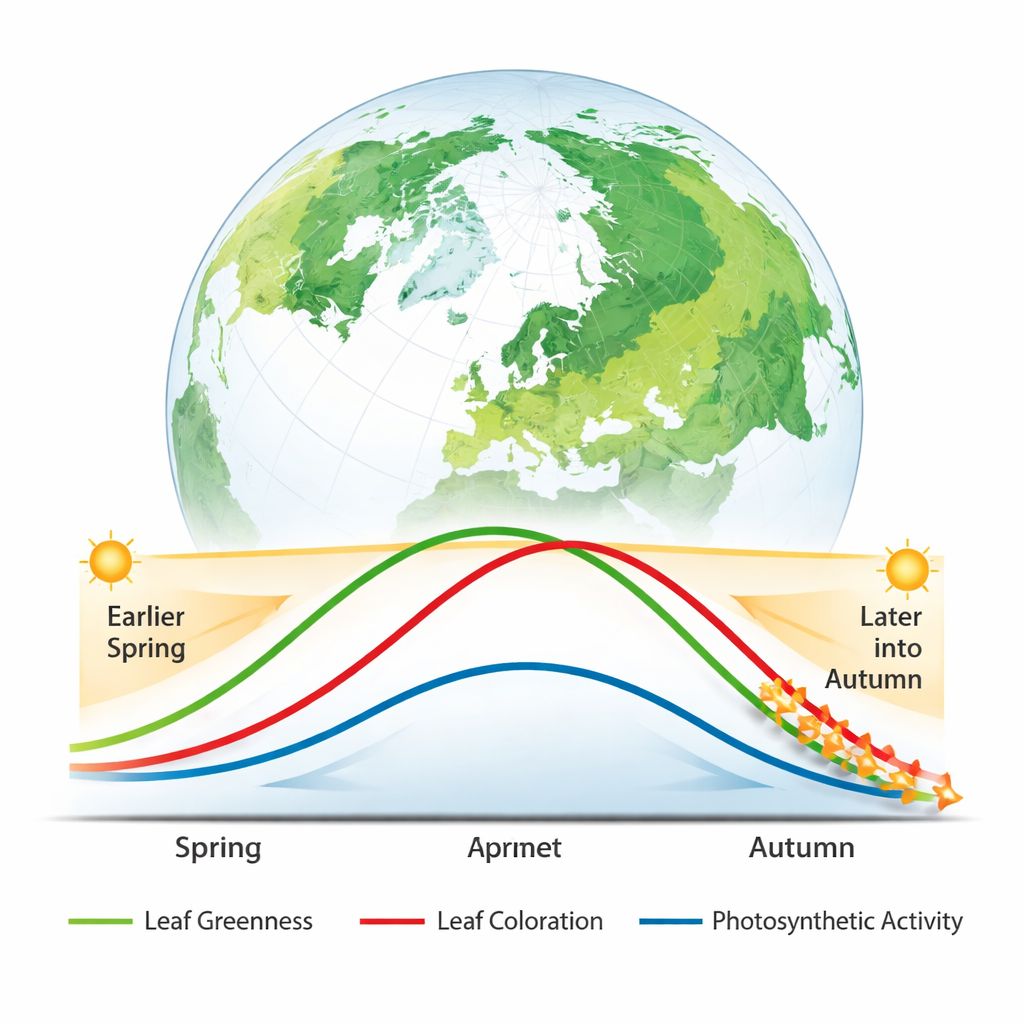
Leaves follow at least two separate seasonal schedules. One governs their color, turning green canopies into the yellows and reds of fall as chlorophyll breaks down. The other governs photosynthesis, the process by which plants use sunlight to turn carbon dioxide into sugars. Using two kinds of satellite measurements over northern lands from 2001 to 2021—one that tracks greenness, and another that tracks a faint glow linked directly to photosynthesis—the authors compared when leaves change color with when photosynthesis effectively stops. They found that, on average, the loss of photosynthetic activity comes first, while the showy leaf colors arrive later.
A widening gap between green and working
Across forests, grasslands, and tundra north of 30° latitude, the end of photosynthesis usually occurred several weeks before the peak of leaf coloration, and this gap has steadily grown. In most places, the autumn date based on greenness drifted later in the year, while the photosynthesis-based date crept earlier or changed little. Forests showed the largest mismatch, while tundra showed the smallest. By breaking the season into the start, the mid-season peak, and the end, the researchers showed that the lengthening delay in leaf coloration and the slight advance of photosynthetic shutdown together explain this growing discrepancy.
How earlier springs reshape autumn
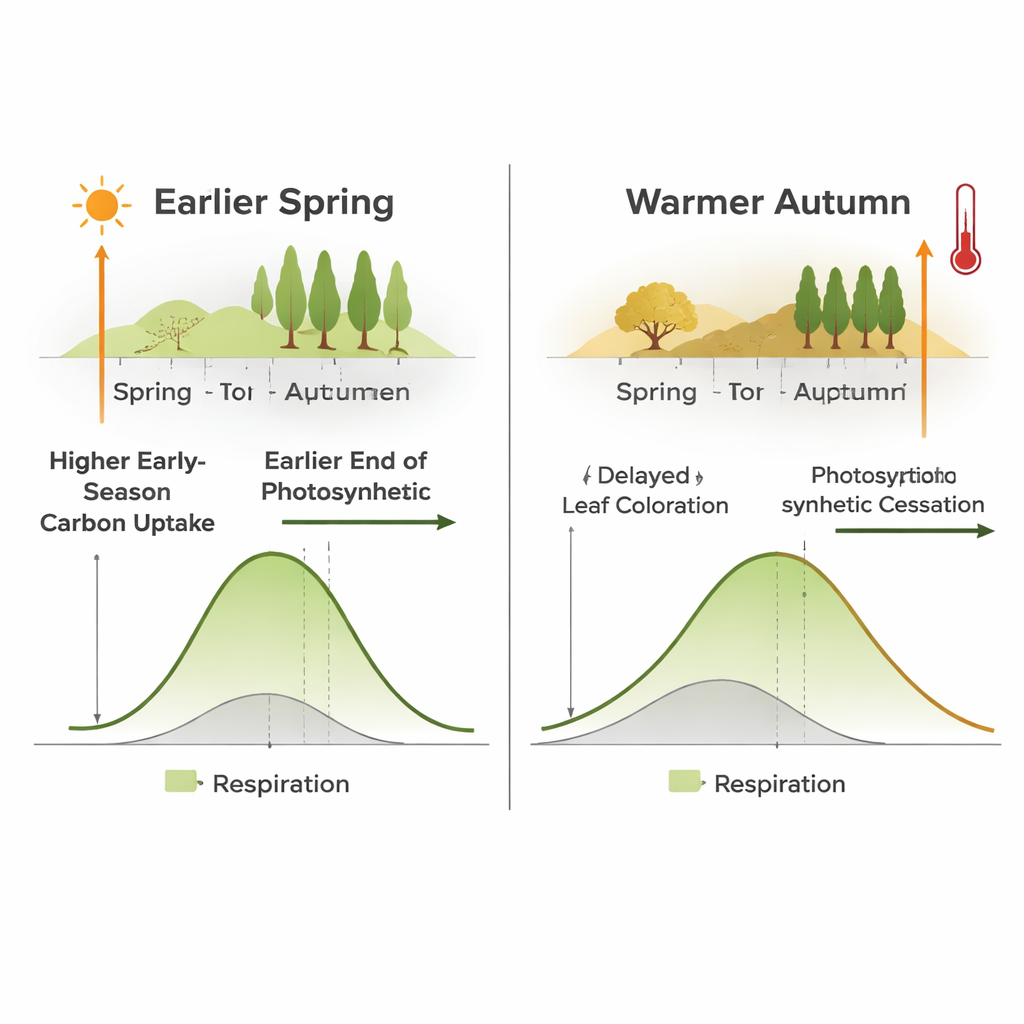
The study then asked what is driving this change in timing. One key factor is that spring now tends to begin earlier in many northern regions. Earlier leaf-out means plants start growing and taking up carbon sooner. Structural equation models—statistical tools that tease apart direct and indirect effects—suggest that this early start pushes the whole growth cycle forward. Plants reach their peak activity earlier and, especially for photosynthesis, they also tend to wind down earlier. This “carryover” from spring to autumn was much stronger for the photosynthesis signal than for the greenness signal, helping to explain why photosynthesis now ends earlier relative to when leaves visibly turn color.
Warm autumns keep leaves, not photosynthesis, going
Autumn warming turned out to be the other major player. Warmer fall temperatures generally delayed both leaf coloration and the shutdown of photosynthesis, but the delay was slightly stronger for the visible color change. At the beginning of senescence, higher autumn temperatures clearly slowed the loss of greenness, even as daylight and other limits still pushed photosynthesis down. Later in autumn, warm conditions influenced both processes more evenly, yet the overall effect was to stretch the period during which trees look green but are only weakly photosynthesizing. Other factors, such as rainfall, sunlight, and carbon dioxide levels, played smaller or more region-specific roles.
What this means for forests and the climate
To a casual observer, a longer season of green leaves might suggest that forests are absorbing more carbon for a longer time. This work cautions against that assumption. The growing mismatch between leaf color and photosynthetic activity means that trees may spend more of late autumn respiring—releasing carbon dioxide—without matching gains from photosynthesis. That could reduce the net carbon sink provided by northern ecosystems, even if they still take up more carbon than they release over the year. For scientists and forest managers, the message is clear: relying only on greenness to track the growing season can be misleading. Direct measures of photosynthesis are needed to understand how climate change is altering the true productive season of the world’s forests.
Citation: Yu, H., Mo, Z., Tan, T. et al. Earlier spring onset and autumn warming increase the discrepancy between leaf coloration and photosynthetic cessation. Commun Earth Environ 7, 199 (2026). https://doi.org/10.1038/s43247-026-03239-y
Keywords: autumn phenology, photosynthesis, climate warming, forest carbon cycle, remote sensing