Clear Sky Science · en
Mycorrhizal-specific responses of rhizosphere soil properties and fine-root traits to polystyrene microplastic addition in a temperate mixed forest
Why tiny plastics in forests matter
Most of us have heard about microplastics in oceans, but far less attention has been paid to what happens when these tiny plastic fragments build up in forests. Yet forests are major filters for airborne particles, and microplastics can gradually accumulate in the soil where tree roots and their fungal partners search for water and nutrients. This study asks a deceptively simple question with big implications: how do microplastics change the underground life of trees, and could this shift how forests function in a warming, increasingly polluted world?
Two kinds of fungal helpers under the trees
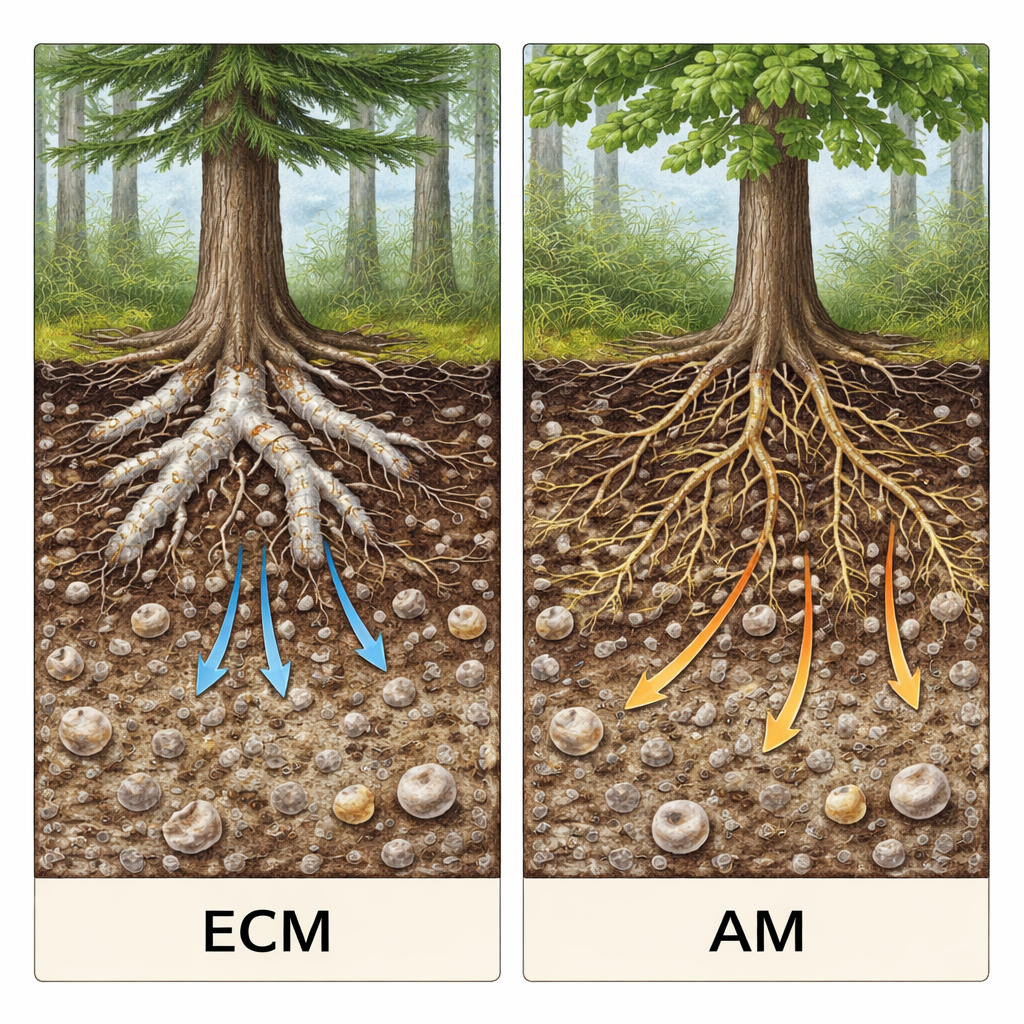
Tree roots rarely work alone. Most partner with mycorrhizal fungi, which trade nutrients from the soil for sugars from the tree. The researchers focused on two main types of these partnerships. Ectomycorrhizal (ECM) fungi form a sheath around roots and send out dense webs of filaments; they are common in conifers like pines and some broadleaf trees. Arbuscular mycorrhizal (AM) fungi, more common worldwide, slip inside root cells and help many hardwoods and crops. Because these fungal partners use different strategies to obtain nitrogen and phosphorus, the team suspected they might also respond very differently when microplastics enter the soil.
An experiment in a mixed mountain forest
In a mature Korean pine forest in China’s Changbai Mountains, scientists carefully exposed parts of tree root systems to soil mixed with tiny polystyrene beads, at a concentration similar to what has already been measured in some polluted soils. They studied four tree species, two dominated by ECM fungi and two by AM fungi. Over about five months, they tracked changes in the soil clinging to the roots (the rhizosphere) and measured a suite of root properties: chemistry (carbon, nitrogen, phosphorus), fine root length and thickness, branching patterns, tissue density, and microscopic anatomy. They also quantified the density of fungal threads (hyphae), how much of the roots were colonized, and the activity of soil enzymes involved in breaking down organic matter.
Opposite soil changes for the two fungal teams
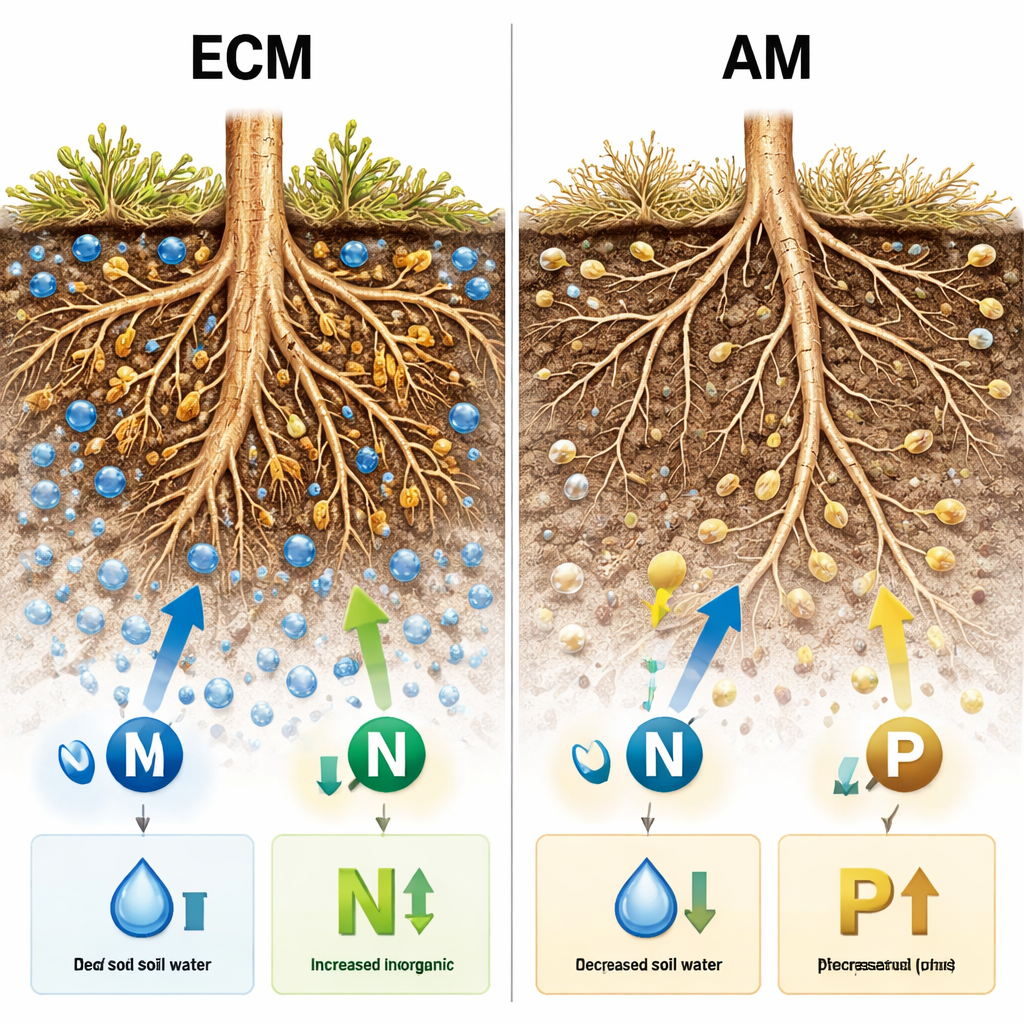
The addition of microplastics pushed ECM and AM rhizospheres in almost opposite directions. Around ECM roots, microplastics increased nitrogen in forms that plants can use and boosted an enzyme linked to nitrogen processing, but reduced phosphorus and related enzyme activity. Soil became moister and slightly more acidic. Around AM roots, the pattern flipped: available nitrogen, especially nitrate, declined, while available phosphorus and a key phosphorus-releasing enzyme rose, and soil tended to be drier and less acidic. These contrasts suggest that the same pollution pressure can rewire nutrient cycling in very different ways, depending on which fungal partners dominate a patch of forest.
Roots reshape themselves to cope
Tree roots also remodeled their form and chemistry in response to microplastics, again in contrasting ways. In both partnership types, roots ended up richer in carbon relative to nitrogen and phosphorus, indicating poorer nutrient status despite some gains in the surrounding soil. ECM trees produced shorter, thicker root systems with fewer branches and lower tissue density, but with denser fungal networks and higher colonization. This points to a strategy of investing carbon into fungi rather than into ever-finer roots, leaning on fungal exploration to reach nutrients in a disturbed soil. AM trees, by contrast, grew longer, finer roots with more tips and thinner outer tissues, while showing reduced fungal colonization. They thickened the root surface layer and enlarged inner transport tissues, likely to defend against physical damage from plastic particles and to move water and nutrients more efficiently with their own roots rather than via fungi.
What this means for future forests
Seen together, these findings reveal that microplastic pollution does more than just sit inert in forest soil: it changes moisture, acidity, and how nitrogen and phosphorus move, and it pushes trees with different fungal partners toward distinct survival tactics. ECM-associated trees respond by strengthening fungal alliances, while AM-associated trees rely more on highly exploratory fine roots. For a layperson, the take-home message is that tiny plastic fragments can quietly shift who thrives in a forest, how fast nutrients cycle, and how much carbon trees send belowground. As microplastic deposition continues to rise, these hidden changes in root–fungus teamwork could gradually alter forest composition and the ability of forests to store carbon and support biodiversity.
Citation: Zhou, Y., Brunner, I., Liu, Z. et al. Mycorrhizal-specific responses of rhizosphere soil properties and fine-root traits to polystyrene microplastic addition in a temperate mixed forest. Commun Earth Environ 7, 203 (2026). https://doi.org/10.1038/s43247-026-03237-0
Keywords: forest microplastics, tree root fungi, soil nutrients, temperate forests, rhizosphere