Clear Sky Science · en
Three hundred thousand years of multi-millennial hydroclimate variability in Northern Africa based on speleothem records from Tunisia
Why North Africa’s Ancient Weather Matters Today
North Africa is home to the world’s largest hot desert, yet its past was punctuated by surprisingly green, wet periods that helped shape human evolution and migration. This study looks deep into that past—300,000 years—using mineral formations in Tunisian caves as natural archives of rainfall. By decoding when these cave deposits grew and when they stopped, the researchers reveal how shifting wind systems and monsoon rains repeatedly turned parts of today’s desert into lakes, grasslands, and habitable corridors.
Reading Climate History from Cave Stone
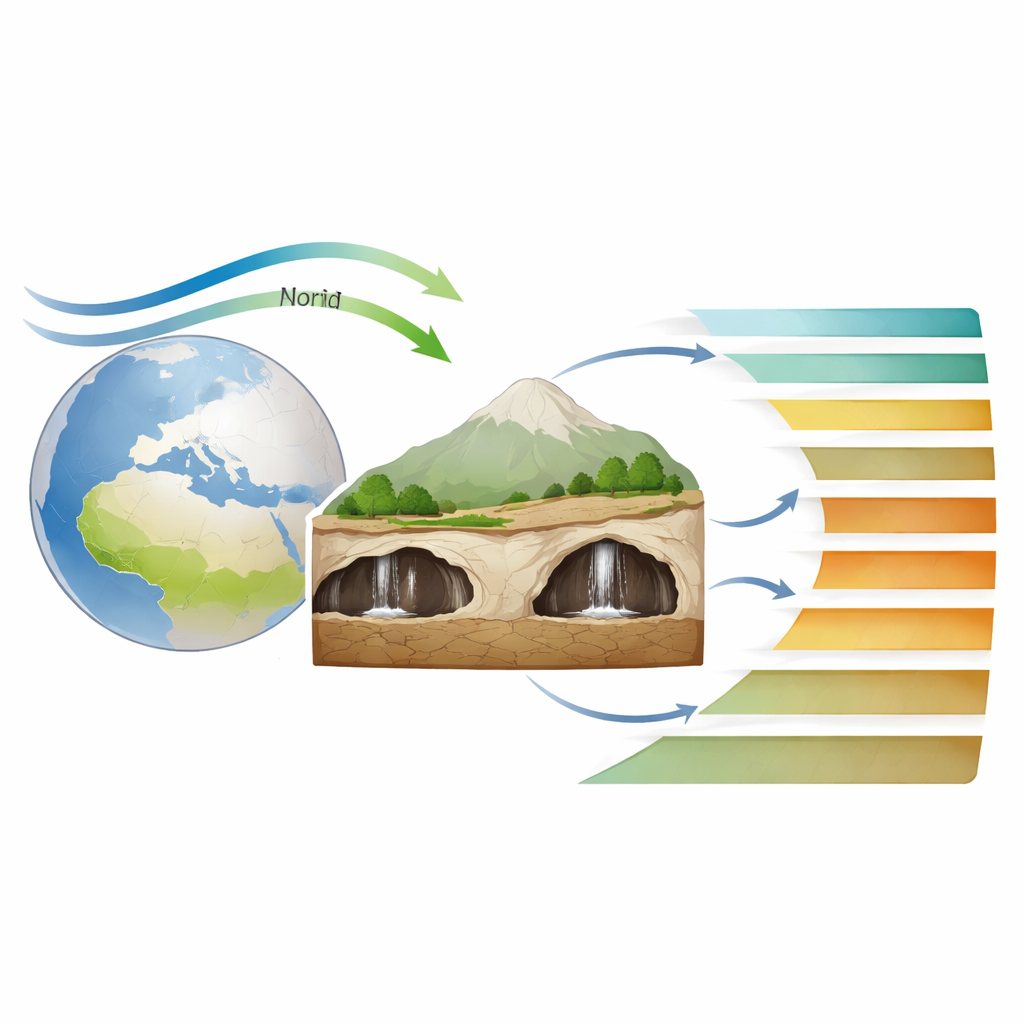
In two caves in north-central Tunisia, researchers collected 21 mineral formations known as speleothems—stalagmites, stalactites, and flowstones. These grow when rainwater seeps through the ground, drips into a cave, and slowly deposits dissolved minerals. When conditions are dry and recharge stops, growth ceases. By precisely dating 132 layers with uranium–thorium methods, the team built a timeline of when growth occurred over the last 300,000 years. Instead of a continuous record, they treated each growth interval as a yes–no signal for moisture, then used statistical tools to highlight multi‑thousand‑year clusters of wet phases and the gaps between them.
Wet Intervals, Dry Ice Ages
The Tunisian caves reveal a clear pattern: speleothems grew mainly during warm interglacial periods and were mostly absent during cold glacial times. Major peaks in cave growth line up with key warm phases in Earth’s history, including intervals around 281, 207, 119, 88, and 6 thousand years ago. These wet phases match evidence from European lakes and caves showing expanded forests and increased rainfall around the Mediterranean. Together, they point to a shared regional story: when ice sheets shrank and seas warmed, storm tracks shifted in ways that brought more winter rain to North Africa and southern Europe, while ice‑age configurations pushed those storms northward, leaving the Mediterranean borderlands drier.
How Winter Storms and Summer Monsoons Worked Together
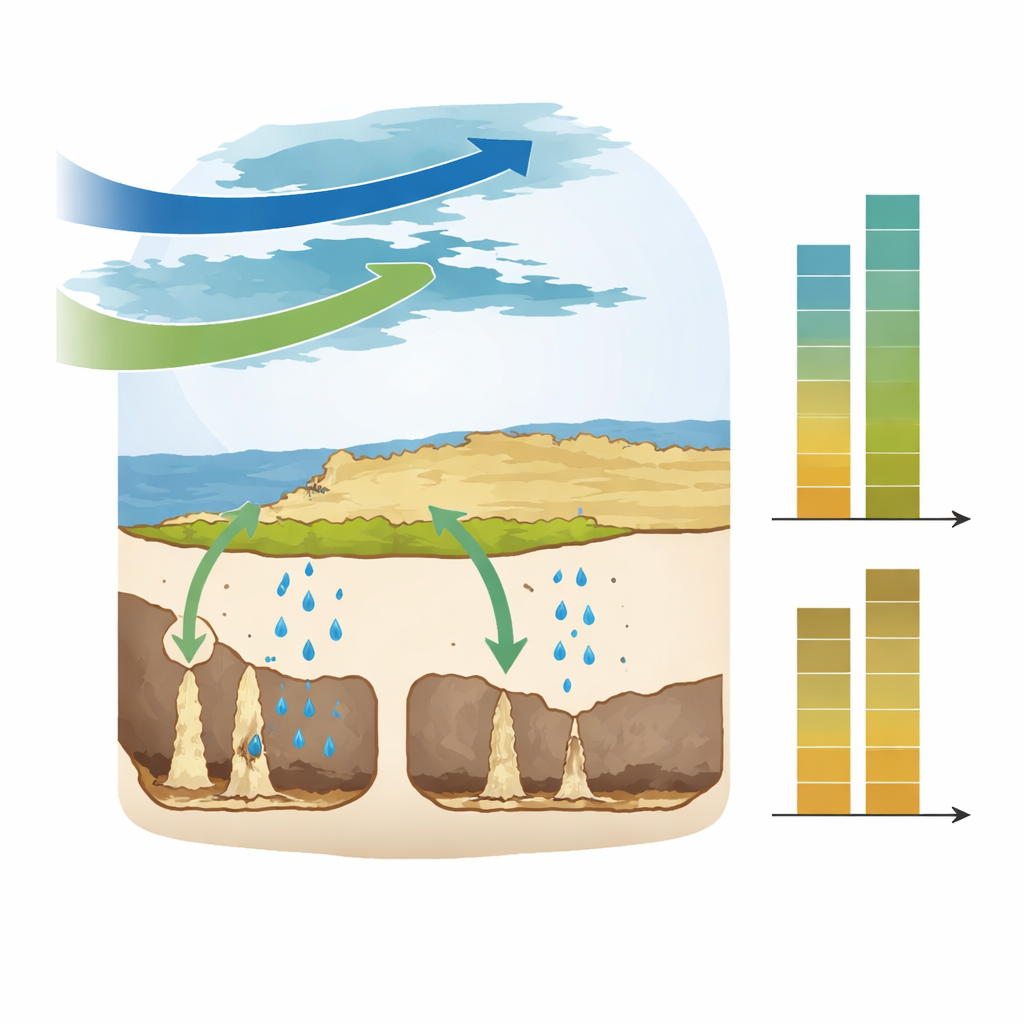
Modern North Africa receives moisture from two main sources: winter storms carried by mid‑latitude westerly winds, and the West African monsoon that brings summer rain from the south. For the most recent African Humid Period, roughly 14,500 to 5,000 years ago, many studies have emphasized a stronger monsoon as the driver of Sahara greening. The Tunisian cave data add an important twist. Peaks in speleothem growth at about the same times as strong monsoon signals in West African lake and marine records show that winter storms also intensified and shifted south. This meant that, during key interglacials, North Africa was watered by both summer monsoon rains in the interior and winter Mediterranean storms farther north, extending humidity over a wide swath of what is now desert.
Ocean Changes, Ice Sheets, and Shifting Winds
By comparing their cave growth record with North Atlantic ocean cores, the authors link North African rainfall to large‑scale changes in ice sheets and ocean circulation. Periods when icebergs dumped debris into the North Atlantic cooled the sea surface, disrupted deep‑water circulation, and altered pressure patterns. These changes nudged the storm‑bearing westerlies northward, reducing winter rain over Tunisia even when global conditions were otherwise warm. In contrast, during especially warm interglacials like the last one (about 125,000 years ago), higher sea levels and warmer seas appear to have strengthened local cyclones and fed more moisture into the Mediterranean storm track, boosting cave growth and coinciding with the formation of vast “megalakes” across the Sahara.
From Stone Records to Human Landscapes
When the Tunisian cave record is compared with the timing of giant Saharan lakes, it shows that the biggest lakes formed during the same interglacial intervals when speleothems grew most vigorously. This agreement suggests that winter storms from the Mediterranean and summer monsoon rains together sustained wet corridors across North Africa, helping create windows of opportunity for plants, animals, and early humans to move through and inhabit the region. In simple terms, the study concludes that the Sahara’s swings between green and barren were not driven by the monsoon alone: persistent winter rainfall, guided by the shifting westerly winds, was just as essential in turning today’s desert into yesterday’s habitable landscape.
Citation: Chung, YC., Dhaouadi, H., Marino, G. et al. Three hundred thousand years of multi-millennial hydroclimate variability in Northern Africa based on speleothem records from Tunisia. Commun Earth Environ 7, 251 (2026). https://doi.org/10.1038/s43247-026-03236-1
Keywords: North Africa climate history, Sahara humid periods, speleothem cave records, Mediterranean westerlies, West African monsoon