Clear Sky Science · en
Unique atmospheric boundary layer structures driven by lake effects
Why Big Lakes Matter for the Air Above Us
Most of us think of lakes as tranquil water bodies that offer drinking water, fish, or vacation views. This research shows that large inland lakes also quietly reshape the air we live in. By changing how heat and moisture move between the surface and the sky, big lakes can deepen or suppress the lowest layer of the atmosphere, where clouds form and weather unfolds. Understanding these "invisible footprints" of lakes helps improve weather forecasts, flood warnings, and climate projections for the millions of people who live near them.

The Busy Lower Atmosphere Over Land and Water
Just above the ground sits a restless layer of air where sunlight, surface heat, and turbulence constantly mix. This layer, called the atmospheric boundary layer, acts as the working space for clouds, pollution, and storms. Its height changes through the day: typically shallow and calm at night, then growing deeper as the sun warms the surface. While scientists have long known that lakes influence nearby weather, most studies focused on single regions, such as the Great Lakes in North America or Lake Victoria in Africa. What was missing was a global look at how big inland lakes systematically raise or lower this restless layer, and how far from the shore those effects extend.
Taking a Global Look From Space
To answer these questions, the authors analyzed four years of satellite-based measurements of temperature and humidity profiles over 86 large inland lakes located far from the ocean. They combined these profiles with a state-of-the-art global weather reanalysis, which blends observations with computer models. By comparing air above lakes, nearby land within 25 kilometers, and more distant land up to 200 kilometers away, they traced how heat, moisture, and stability change with height and season. They also used statistical tools to tease apart the roles of temperature differences, wind, humidity, and surface heat flows in controlling how tall the boundary layer grows.
How Lakes Reshape the Air Nearby
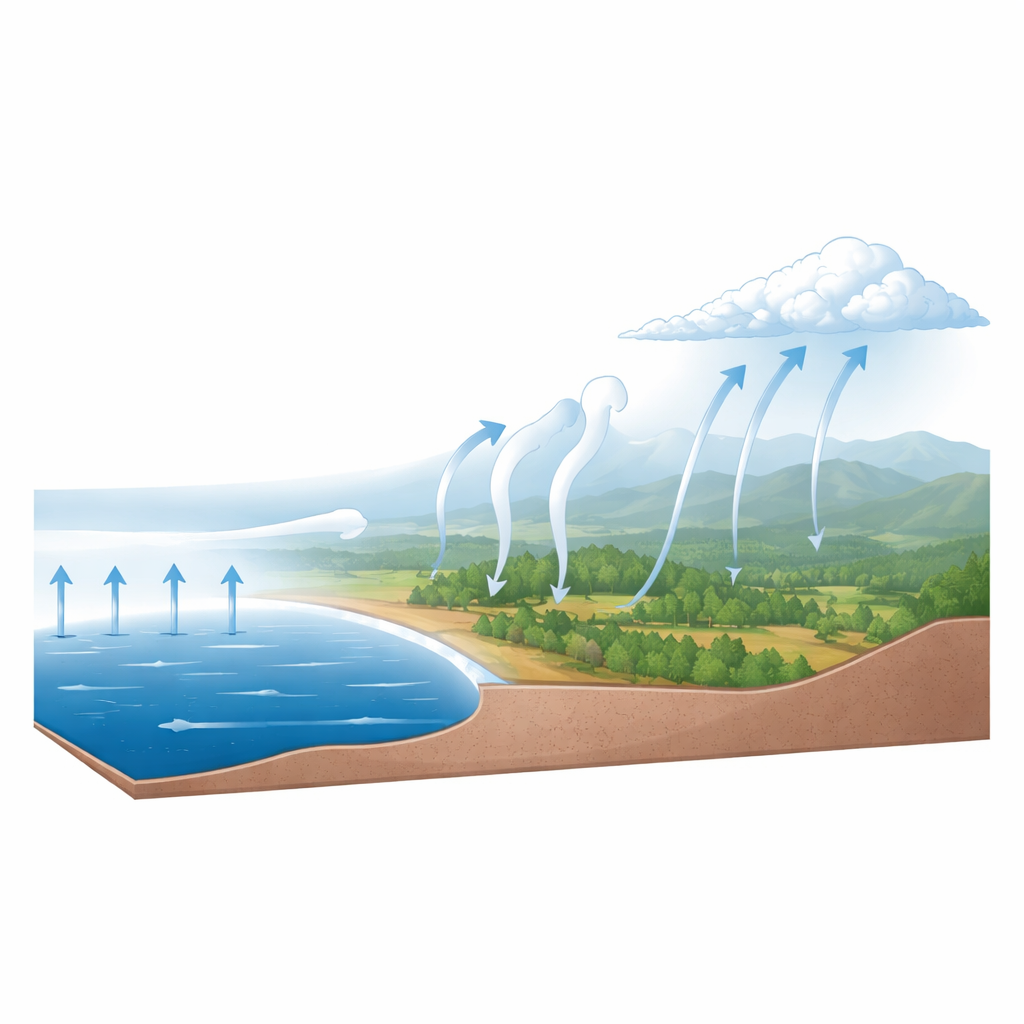
The study reveals a distinct "halo" of influence around big lakes. In summer and autumn, air over the water is more stably layered, so the boundary layer there remains relatively low. Yet the same lakes send extra heat and moisture toward the nearby shoreline, where the boundary layer grows 0.3 to 0.6 kilometers taller during the day than over the lake itself. This enhancement is strongest within about 25 kilometers of the shore and fades rapidly beyond 50 kilometers. The downwind side typically shows deeper, more vigorous mixing than the upwind side, reflecting lake–land breezes that carry warm, moist air inland. At night, the pattern flips: lakes release stored heat, keeping the air above them more turbulent than the quickly cooling land.
Different Lakes, Different Ways of Shaping Weather
Not all lakes influence the atmosphere in the same way. In warm tropical and subtropical regions, intense sunshine and abundant moisture mean that heat exchange and evaporation dominate, helping air rise and deepen the boundary layer. In cooler temperate zones and at higher elevations, wind and terrain become more important, as complex landscapes and stronger wind shear stir the air vertically. Lake size also matters but mainly through its impact on heat storage: very large lakes smooth out daily temperature swings, while smaller lakes respond more quickly to heating and cooling. Across all these settings, the key driver is the temperature contrast between lake and land, which sets off breezes and organizes where convection and clouds are most likely to form.
What This Means in a Warming World
As the climate warms, lakes are losing ice cover, storing more heat, and evaporating more water. The study suggests that these shifts will further deepen the boundary layer around lakes, enhance convection, and funnel more moisture into the atmosphere. That can translate into heavier downpours, more frequent intense storms, and stronger local weather extremes in nearby regions. The authors argue that many weather and climate models still treat lakes too simply and underestimate their role in shaping the lower atmosphere. Incorporating realistic lake–atmosphere coupling will be essential for more reliable forecasts and for understanding how regional water and climate patterns will evolve in the decades to come.
Citation: Ma, W., Ma, W., Xie, Z. et al. Unique atmospheric boundary layer structures driven by lake effects. Commun Earth Environ 7, 221 (2026). https://doi.org/10.1038/s43247-026-03234-3
Keywords: lake–atmosphere interaction, boundary layer height, regional climate, heat and moisture transport, inland lakes