Clear Sky Science · en
Discovery of Antarctic moulting sites in satellite imagery reveals new threat to emperor penguins
A Hidden Chapter in the Life of Emperor Penguins
Emperor penguins are famous for braving the Antarctic winter to raise their chicks, but there is another, far less visible stage of their lives that may be even more dangerous: the annual replacement of all their feathers, or moult. This study reveals, for the first time, where huge numbers of emperor penguins go to moult by spotting them from space—and shows how rapidly shrinking sea ice may be turning this crucial life stage into a new climate-driven threat.
Why Feather Replacement Is a High-Stakes Gamble
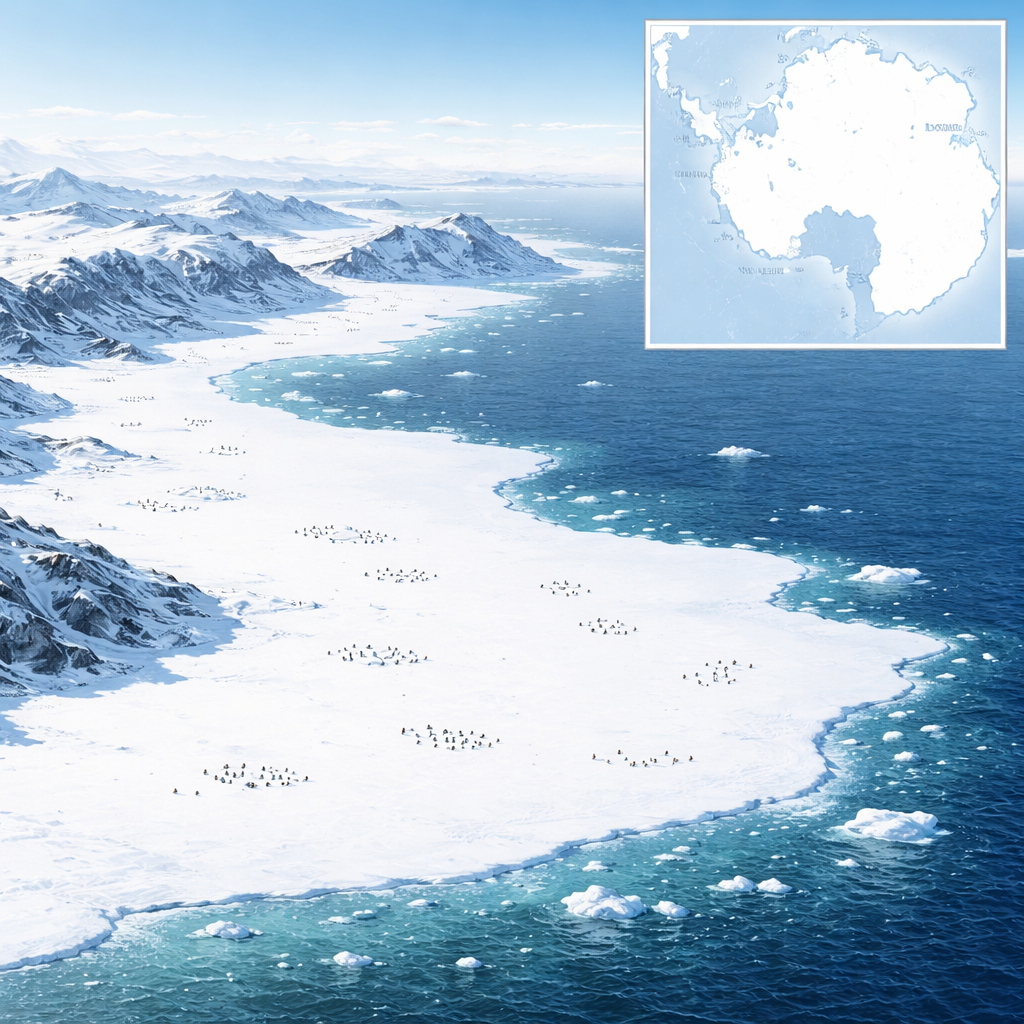
Once a year, every emperor penguin older than one year must grow an entirely new coat of waterproof feathers. They stop feeding, haul out of the ocean, and stand on sea ice for 30–40 days while old feathers are shed and new ones grow in. During this period, they burn through their fat reserves, cannot safely swim or hunt, and are vulnerable to cold and predators if they are forced back into the water too soon. Many scientists suspect this is when adults are most likely to die, yet until now almost nothing was known about where, exactly, most of these birds moult.
Using Space Cameras to Find “Feather Fields”
The researcher discovered unusual brown patches on bright white Antarctic sea ice in free, medium-resolution images from Europe’s Sentinel-2 satellites. These stains, concentrated along a 200-kilometre stretch of coast off Marie Byrd Land in West Antarctica, were suspected to be groups of moulting emperor penguins and their guano. To be sure, the study compared the Sentinel-2 images (each pixel 10 meters across) with much sharper commercial WorldView-2 pictures (50-centimetre pixels) taken on the same day. In the high‑resolution images, individual penguins appeared as tiny black dots clustered within the brown areas. When the two types of imagery were matched, almost all brown patches seen by Sentinel-2 corresponded to real penguin groups in WorldView-2, showing that medium-resolution satellites can reliably pick out moulting flocks over vast areas.
A Seven-Year Map of Moulting Hotspots
Armed with this confirmation, the study examined cloud‑free Sentinel-2 scenes from 2019 to 2025, focusing on mid‑January through late February, when emperor penguins moult and other penguin species are not yet on the ice. Hundreds of moulting groups—usually clusters of a few dozen birds, but sometimes many hundreds—were mapped each year. They almost always stood on land‑fast sea ice attached to the coast, not on the looser pack ice farther offshore. The flocks concentrated in four main zones of fast ice near islands and ice shelves along the Saunders Coast, strongly suggesting that this region is the primary moulting area for the large Ross Sea emperor penguin population, which may represent 30–40 percent of the global total.
When the Ice Vanishes Under Their Feet
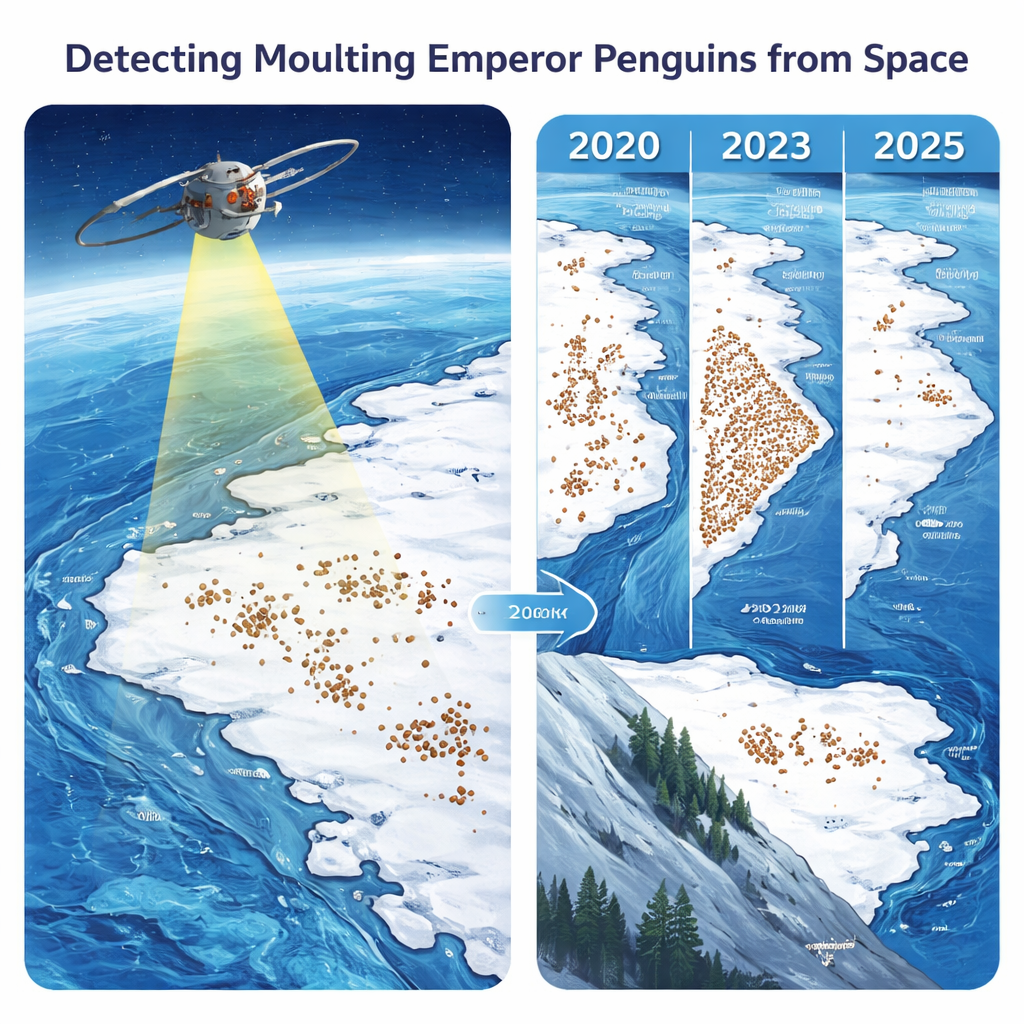
The time series reveals a worrying pattern as the region’s summer sea ice has shrunk to record lows in recent years. In 2019 and 2020, extensive fast ice allowed penguins to spread out over a wide area. But in 2022, 2023, and 2024, fast ice broke up unusually early—sometimes while hundreds of moulting groups were still present. Satellite images show the ice beneath them shattering into small floes that quickly disintegrated into open water. In these low‑ice years, the birds were crowded into the few remaining stable patches of ice, often close to the shore or even moving onto ice shelves. By contrast, in 2025, when fast ice was more extensive again, surprisingly few moulting groups appeared in the original study area, even though suitable ice had returned; some flocks had shifted farther east, lengthening their already thousand‑kilometre journeys between breeding colonies and moulting sites.
What This Means for Penguins—and for Us
The study shows that we can now monitor emperor penguins during one of the most critical, previously hidden phases of their lives simply by analysing satellite images. It also suggests that rapid losses of coastal sea ice are exposing moulting birds to new dangers by stripping away their solid platform mid‑moult, when they can neither feed nor swim well. The sharp drop in moulting groups in the main study area after several bad ice years raises urgent questions: Did many birds die, move elsewhere, or both—and how will this affect breeding colonies in the Ross Sea? As climate change drives more extreme swings in Antarctic sea ice, tracking moulting sites from space offers a powerful way to understand and, potentially, protect these iconic birds.
Citation: Fretwell, P.T. Discovery of Antarctic moulting sites in satellite imagery reveals new threat to emperor penguins. Commun Earth Environ 7, 192 (2026). https://doi.org/10.1038/s43247-026-03231-6
Keywords: emperor penguins, Antarctic sea ice, climate change, satellite imagery, wildlife conservation