Clear Sky Science · en
Massive concentrations of old dissolved organic carbon from Yedoma thaw in lakes in Siberia
Hidden Carbon in Thawing Arctic Lakes
As the Arctic warms, ancient ground that has been frozen for tens of thousands of years is starting to thaw. In Siberia, this frozen soil—called permafrost—holds enormous amounts of old organic carbon. When that frozen ground collapses and forms lakes, scientists fear that this long-stored carbon could be quickly turned into greenhouse gases and released to the atmosphere. This study looks closely at lakes in Central Yakutia, Eastern Siberia, to find out how much old carbon is actually being freed, what form it takes in the water, and how much of it ends up as carbon dioxide or methane.
Different Kinds of Arctic Lakes
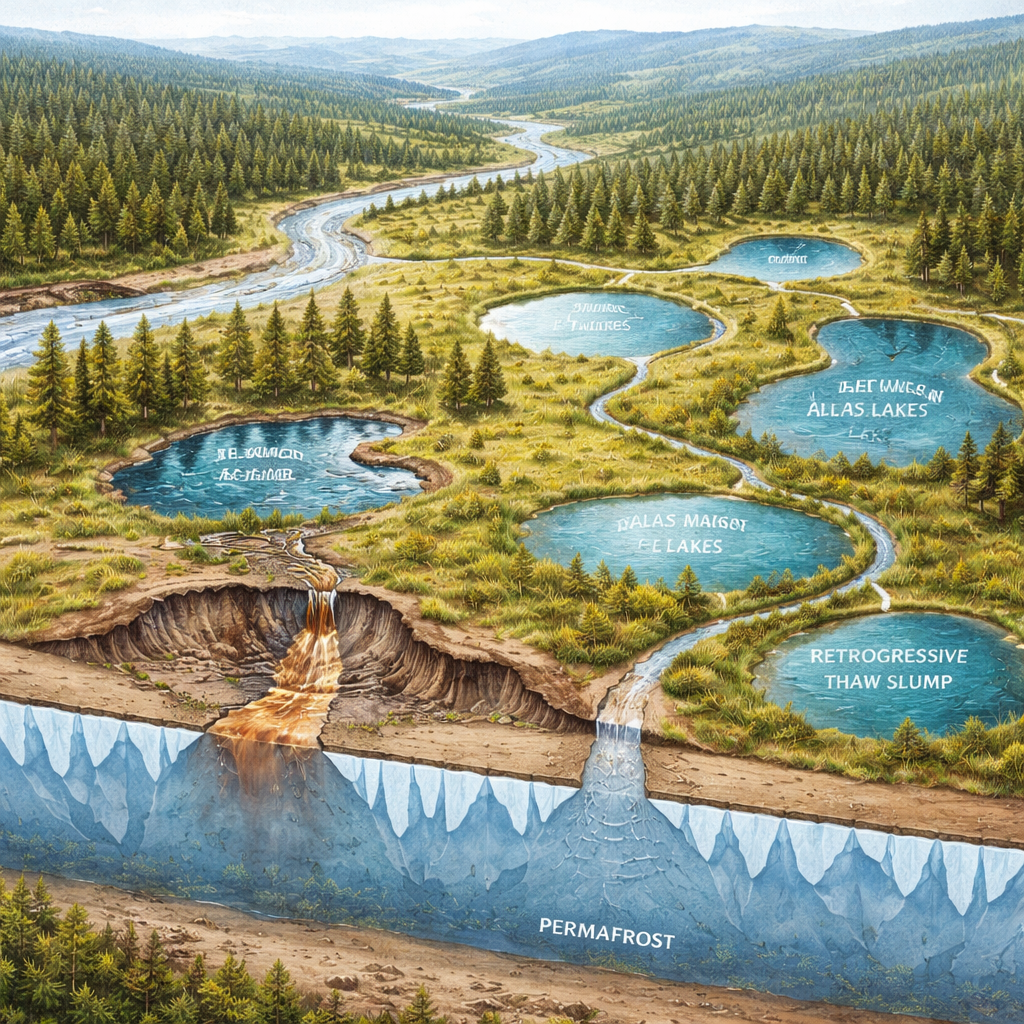
The research team focused on a network of small lakes in the Syrdakh Creek watershed, a region underlain by ice-rich “Yedoma” permafrost that formed during the last ice age. They examined four main lake types. Recent thermokarst lakes are young ponds that have appeared since the 1950s where the ground has suddenly sagged as the ice within it melts. Older “alas-lakes” occupy broad, shallow basins created by permafrost thaw thousands of years ago. Some of these basins are now connected to streams and rivers, while others are isolated. A fourth category, thermokarst-modified alas-lakes, are old basins that have begun to thaw again along their banks, with fresh slumps of muddy, ice-rich soil sliding into the water. The team also sampled meltwater directly from an active thaw slump to capture the signature of freshly thawed permafrost carbon.
Massive Loads of Dissolved Carbon
Across all lake types and seasons, most of the organic carbon in the water was dissolved rather than in particles. In many lakes, concentrations of dissolved organic carbon were extraordinarily high—among the highest ever reported for Arctic lakes—especially in recent thermokarst lakes and in alas-lakes currently disturbed by new thaw along their shores. By measuring the radiocarbon content, the researchers could distinguish ancient permafrost-derived carbon from recently formed organic matter. They found that up to three-quarters of the dissolved carbon in young thermokarst lakes and thermokarst-modified alas-lakes came from old permafrost, with ages of several thousand years. In contrast, connected alas-lakes and undisturbed alas-lakes were dominated by modern, recently fixed carbon.
Old Carbon Builds Up, New Carbon Fuels the Gases
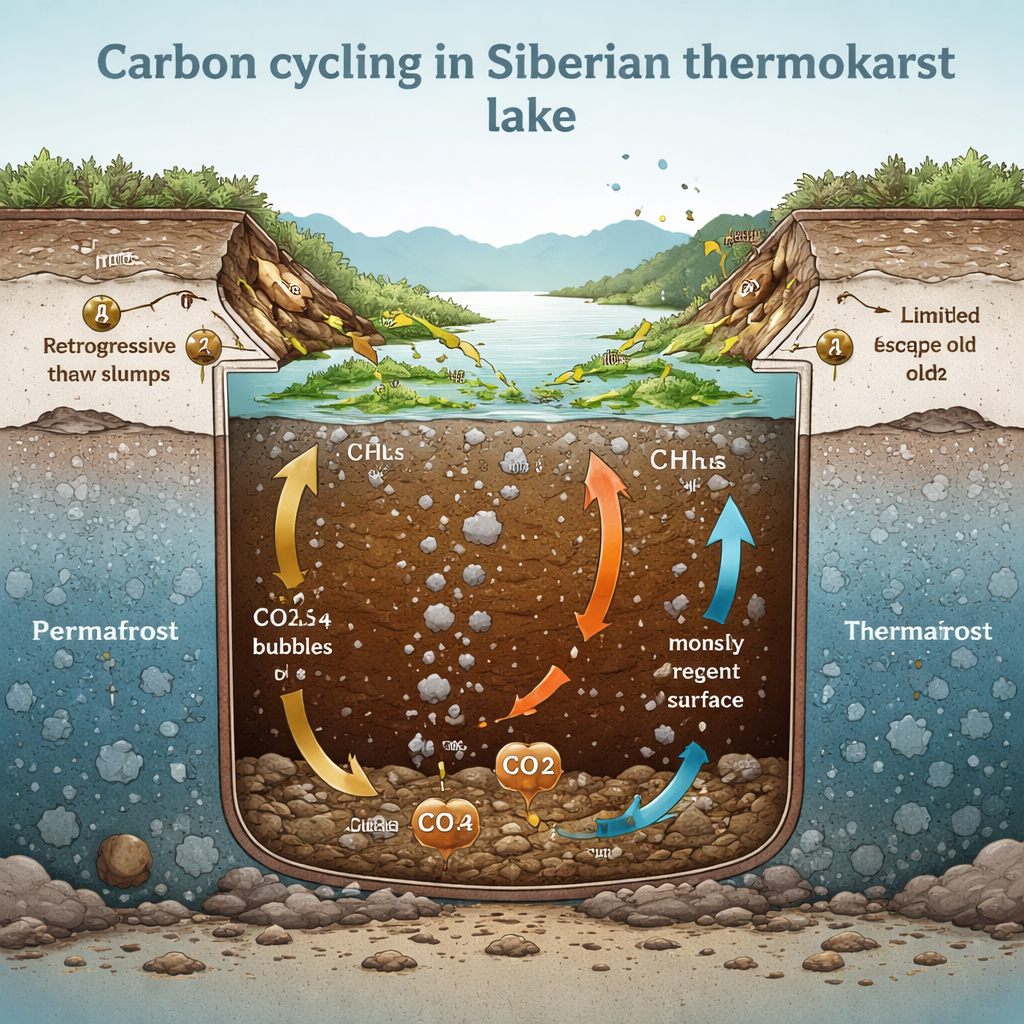
To understand what happens to this dissolved carbon, the team measured the age of carbon present in sediment bubbles of carbon dioxide and methane rising from the lake bottoms. They discovered that, although old permafrost carbon contributes to some of the carbon dioxide released, most of the methane—and much of the remaining carbon dioxide—comes from fresh organic matter produced in the lakes themselves, such as algae and aquatic plants. The methane bubbles were generally “modern” in radiocarbon terms, meaning they were formed from carbon that entered the system only decades or at most a few centuries ago. Meanwhile, a large pool of ancient dissolved organic carbon simply accumulates in the water instead of being fully broken down.
Why Some Lakes Leak Old Carbon and Others Do Not
The study also shows that lake history and water connections strongly control how old carbon moves. Isolated recent thermokarst lakes and thermokarst-modified alas-lakes receive strong inputs of old dissolved carbon from thawing banks and from the collapsing lake floor. Because these lakes are shallow, often disconnected from rivers, and experience intense summer evaporation, dissolved substances become concentrated and are not easily flushed away. Connected alas-lakes, which exchange water with streams, behave more like rivers: they are fed mainly by modern carbon from surface vegetation, have lower dissolved carbon levels, and export little ancient permafrost carbon.
What This Means for Climate Feedbacks
For non-specialists concerned about climate change, the key message is that thawing Yedoma permafrost does indeed release very old carbon into Siberian lakes, but much of it remains dissolved in the water instead of immediately turning into greenhouse gases. Carbon dioxide emissions from recent thermokarst lakes do contain an old component and therefore help reinforce warming, while methane emissions appear to be fueled mainly by new plant growth rather than by ice-age carbon. The creation of these lakes still matters greatly for the climate, because they replace forested land that once stored carbon and turn it into wet areas that release it. As warming and rainfall increase, more thaw, more lake formation, and changing water pathways across the Arctic could gradually shift even more ancient carbon from the ground into the air.
Citation: Ollivier, S., Séjourné, A., Hatté, C. et al. Massive concentrations of old dissolved organic carbon from Yedoma thaw in lakes in Siberia. Commun Earth Environ 7, 200 (2026). https://doi.org/10.1038/s43247-026-03229-0
Keywords: permafrost thaw, thermokarst lakes, dissolved organic carbon, Arctic greenhouse gases, Yedoma Siberia