Clear Sky Science · en
Reactivation of basement faults by deep fluids during the 2017 Changdao earthquake swarm, Eastern China
Hidden Cracks Beneath a Quiet Coast
Along the tranquil shores of eastern China’s Bohai Bay, a burst of small earthquakes in 2017 revealed a dramatic story unfolding deep below ground. Instead of one big destructive shock, thousands of tiny quakes rippled through ancient rock, hinting that high-pressure fluids—rather than slow grinding of tectonic plates—were jolting long-silent faults back to life. Understanding this hidden process matters wherever people live above old fault systems and tap deep underground reservoirs for oil, gas, or geothermal energy.
A Swarm Instead of a Single Big Quake
The Changdao area has a long record of shaking, including a major quake in the 1500s and several modern swarms of smaller events. In early 2017, another swarm began beneath nearby islands and seafloor, about 7 to 13 kilometers down. Instead of one dominant mainshock followed by aftershocks, this sequence looked like a buzzing hive: many similar-sized earthquakes clustered in time and space. To see the swarm clearly, the researchers went beyond the standard catalog and re-examined continuous seismic recordings, using pattern-matching techniques to pick out more than 11,000 events—about six times as many as official records showed—and then relocating over 2,000 of them with meter-scale precision.
An Underground X Shaped Fault Network
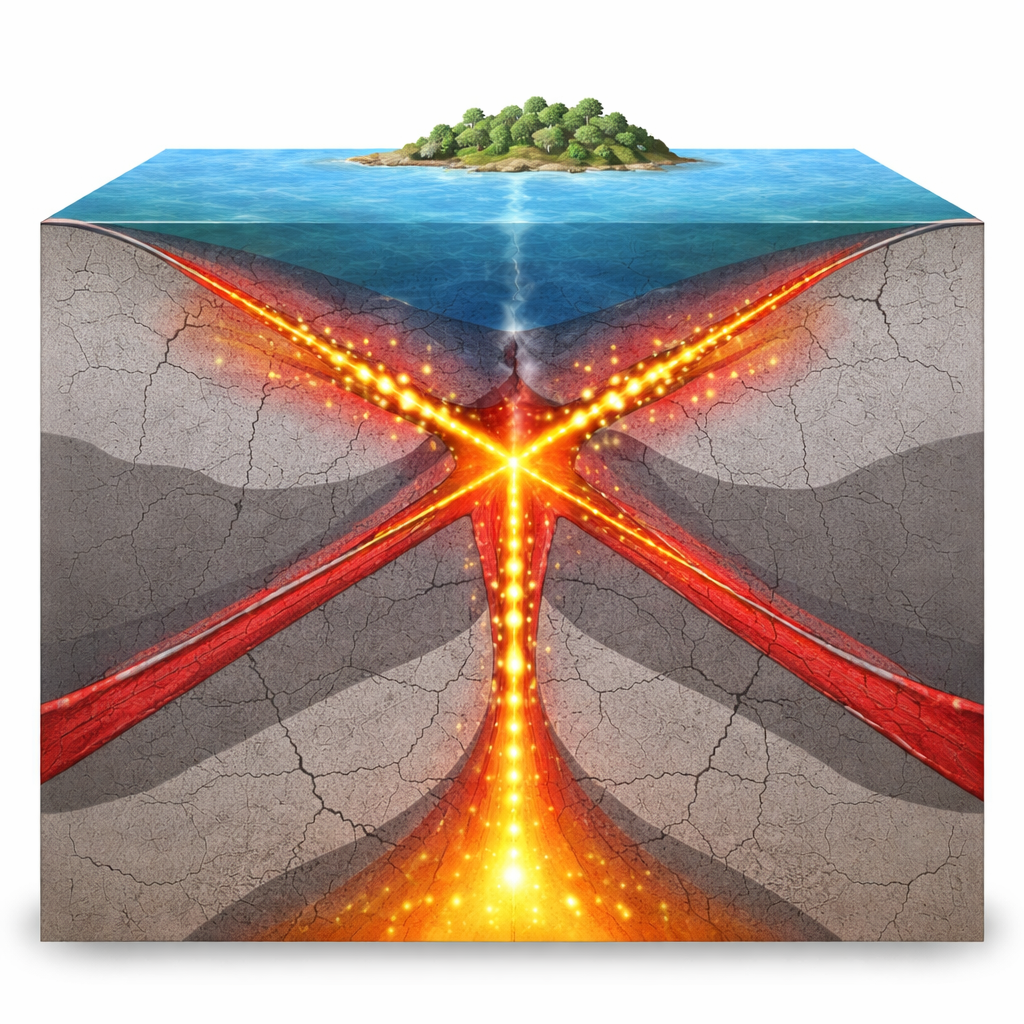
With this sharpened view, the swarm no longer looked like a blurry cloud of dots. Instead, the quakes traced out a detailed X-shaped network of intersecting faults. One major fault bends from steep to flatter angles with depth, while another cuts across it in the opposite direction, together forming a complex three-dimensional intersection zone. Most of the earthquakes occurred in a compact volume only a few kilometers across. Over about three and a half months, activity started near the northeastern part of the intersection and then migrated southwest, hinting that some agent—likely pressurized fluid—was moving through this network rather than the ground simply releasing stored tectonic stress all at once.
Deep Fluids Pushing Rocks Apart
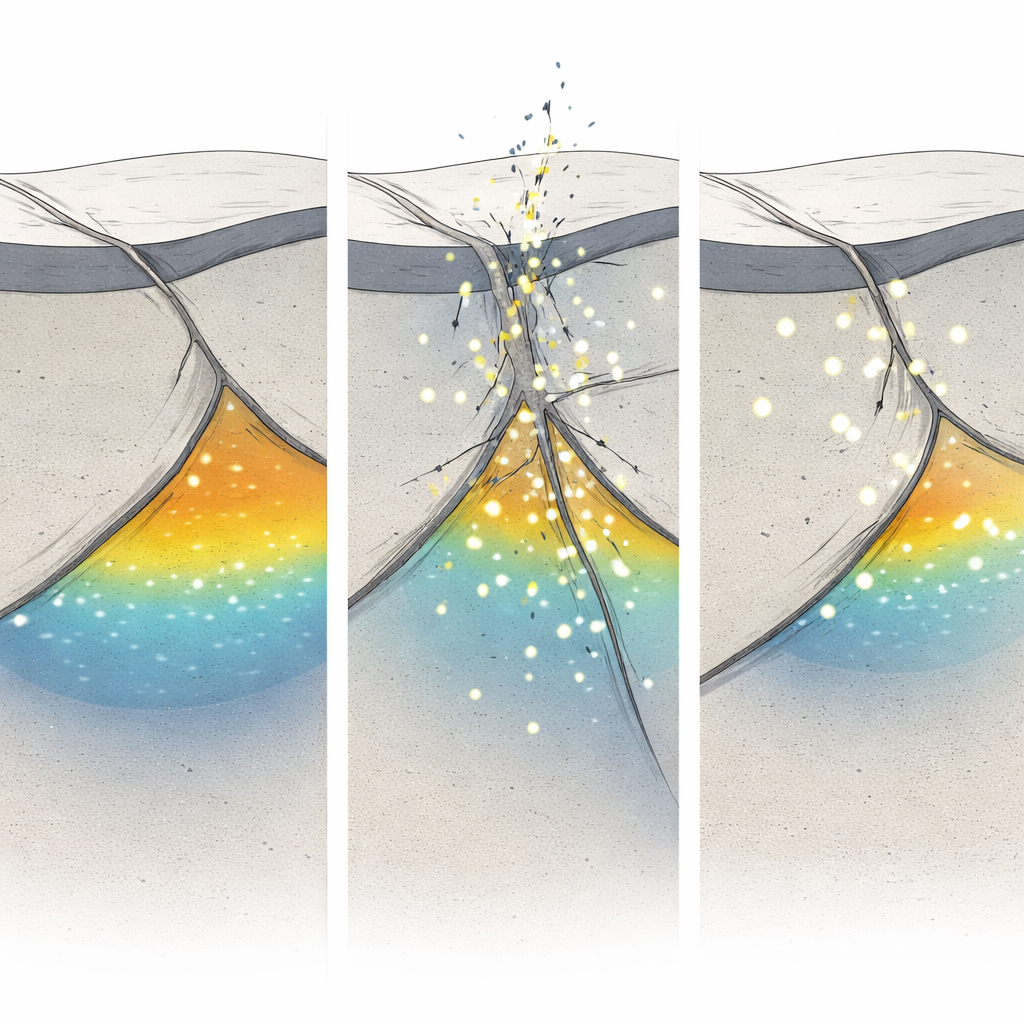
The team combined several independent lines of evidence to probe what was driving the swarm. By studying the way seismic waves radiated from individual quakes, they found that many events involved not only sideways slipping of fault surfaces but also a subtle opening motion, as if the rock was being pried apart. This kind of mixed motion is easier to explain if high-pressure fluids are temporarily lifting the weight pressing the faults shut. Statistical models of how one quake triggers another showed that nearly two-thirds of the events were likely forced by some external influence rather than by typical aftershock cascades. The way the swarm front expanded over time fit classic patterns of pressure diffusion through cracks and pores, with calculated diffusion rates similar to those seen in other fluid-driven swarms around the world.
A Fault-Valve That Opens and Closes
Seismic images of the crust in this region reveal a corridor where seismic waves slow down and change character, a sign of fractured rock and unusual fluids. Geochemical studies from Changdao Island point to deep-sourced carbon dioxide–rich gases rising from far below, likely tied to the stalled Pacific plate beneath East Asia. Putting these clues together, the authors propose a “fault-valve” scenario. In this picture, a gently curving basement fault acts like a caprock, trapping deep fluids just above the level where hot rocks begin to deform more plastically. Over time, pressure builds until the intersection with the steeper fault suddenly opens, like a valve, allowing fluids to surge upward into the overlying fracture mesh. As the fluids rush through, they trigger swarms of small quakes along the branching faults. Then, as fractures seal or pressures drop, the system quiets until the next buildup.
What This Means for Future Quakes
This study shows that even in the middle of a tectonic plate, far from plate boundaries, deep fluids can reawaken ancient faults and produce intense but mostly moderate shaking. By tying together earthquake patterns, rock structure, and geochemical signals, the authors demonstrate that fluid overpressure was the main driver of the 2017 Changdao swarm, rather than distant earthquakes or steady tectonic loading alone. For regions with buried faults and active fluid systems—especially where people extract or store fluids underground—this work offers a framework for recognizing the fingerprints of fluid-driven seismicity and for better assessing the hidden earthquake hazards beneath seemingly stable landscapes.
Citation: Wang, P., Wang, B., Peng, Z. et al. Reactivation of basement faults by deep fluids during the 2017 Changdao earthquake swarm, Eastern China. Commun Earth Environ 7, 207 (2026). https://doi.org/10.1038/s43247-026-03228-1
Keywords: earthquake swarms, deep crustal fluids, fault reactivation, intraplate seismicity, CO2-rich reservoirs