Clear Sky Science · en
Positive glacial regulatory processes promote sustainability of Asian glacier water resources
Why Asia’s High Glaciers Matter to Everyday Life
High Mountain Asia, stretching from the Himalaya to the Tien Shan, holds the largest store of ice outside the polar regions. These glaciers act like giant water towers that feed many of Asia’s great rivers, supporting hundreds of millions of people downstream. As the climate warms, these ice reserves are shrinking, raising fears of future water shortages and rising seas. This study asks a hopeful but hard question: are there natural “brakes” in the glacier system that can slow the loss of ice and make water supplies more sustainable than we think?
Hidden Cushion in a Warming World
The authors introduce the idea of “glacial regulatory processes” – natural mechanisms that either speed up or slow down the loss of glacier ice. Many earlier studies have focused on the bad news: darker glacier surfaces that absorb more sunlight, or lakes at glacier fronts that hasten melting. Here, the focus is on the quieter, positive side of the ledger: processes that help glaciers hold on to water a little longer. Using a streamlined but physics‑based glacier model, fed with the latest climate projections, the team simulates nearly 16,000 glaciers across High Mountain Asia through the 21st century. They then isolate how much extra water is saved by several key regulating processes, rather than being lost to the oceans.
Snowfall Shifts and Slowing Ice
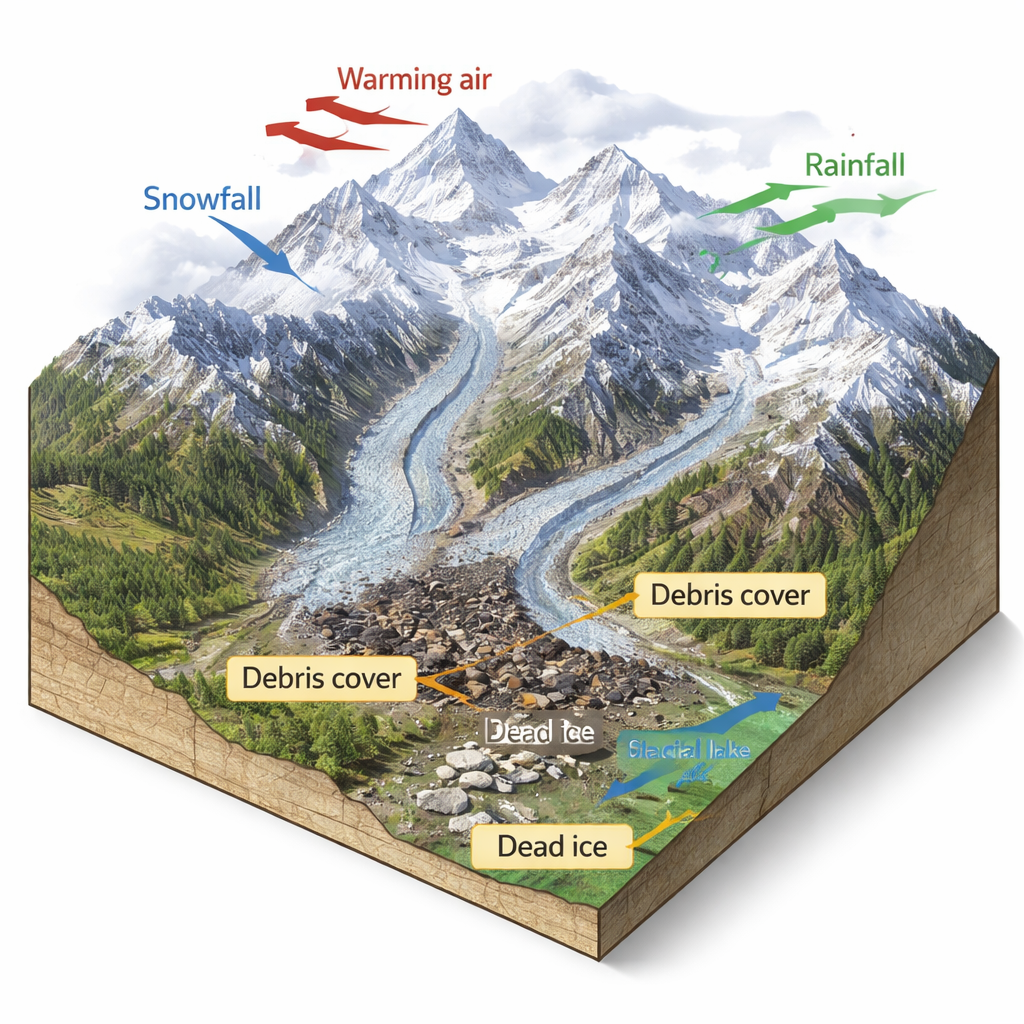
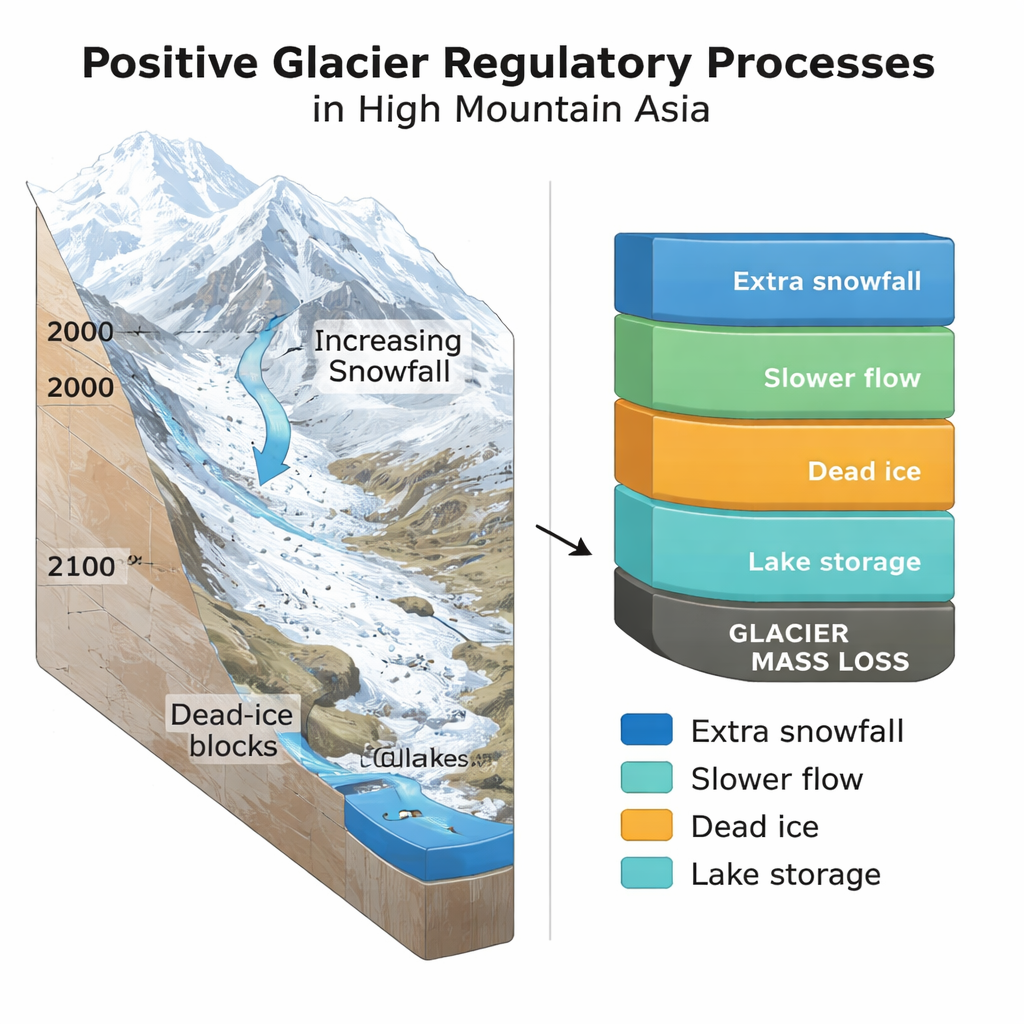
One helpful factor is how future storms change as the region becomes warmer and wetter. Climate models suggest that overall precipitation will increase across High Mountain Asia, especially at high elevations. Even though more of this moisture will fall as rain at lower, warmer altitudes, the coldest summit zones should still see extra snow. That added snowfall slightly boosts glacier “income,” offsetting a small share of the “expenses” caused by melting. Another, more powerful brake comes from the way glaciers themselves respond as they thin. As ice becomes thinner, gravity drives it downhill more slowly, so less ice is carried into the warm, low‑lying melt zones each year. This widespread slowdown reduces the rate of mass loss, especially on the largest and thickest glaciers.
Dead Ice and New Mountain Lakes as Water Banks
Glaciers do not simply vanish; in many places they rearrange how and where ice and meltwater are stored. Thick blankets of rock and debris on glacier surfaces can act like insulation. Under the right conditions, they cut off blocks of ice from the actively flowing glacier, creating isolated “dead ice.” These stranded bodies melt far more slowly than bare ice, acting as temporary, hidden reservoirs. At the same time, as glaciers retreat, they leave behind deep hollows that fill with meltwater to form new glacial lakes. These lakes hold back a portion of the runoff that would otherwise quickly rush downstream. The study estimates that by 2100, tens of gigatons of water will sit in such dead ice and new lakes, effectively banking part of the glacier water within the mountain zone rather than immediately adding to sea level.
How Much Loss These Natural Brakes Can Offset
By combining all of these processes – extra high‑altitude snowfall, glacier slowdown, dead‑ice formation, and meltwater held in lakes – the authors find that High Mountain Asia’s glaciers lose about 9 to 13 percent less ice this century than they would without these natural brakes. In absolute terms, that amounts to roughly 236 to 255 billion tons of water that remains in the mountains instead of flowing out to sea. Even with this cushion, the glaciers are still projected to lose between one‑third and more than half of their current mass by 2100, depending on how quickly greenhouse gas emissions rise. But the results show that earlier estimates that ignored these stabilizing processes probably overstated both the fragility of Asia’s water towers and their contribution to sea‑level rise.
What This Means for Future Water and Coasts
For non‑specialists, the main message is two‑sided. On one hand, High Mountain Asia’s glaciers are still on track to shrink substantially this century, and water planners must prepare for long‑term changes in river flow, new lakes, and shifting flood risks. On the other hand, the mountain system is not entirely helpless. Natural regulating processes buy some time by slowing the loss of ice and storing part of the meltwater as dead ice and lakes. This extra resilience slightly reduces future sea‑level rise and supports more sustained runoff to downstream communities, especially in already dry basins. The study argues that including these subtle brakes in global models will give decision‑makers a more realistic – and less uniformly catastrophic – picture of how the world’s high‑mountain water towers will respond to continued warming.
Citation: Wang, Q., Wang, X., Duan, K. et al. Positive glacial regulatory processes promote sustainability of Asian glacier water resources. Commun Earth Environ 7, 110 (2026). https://doi.org/10.1038/s43247-026-03225-4
Keywords: High Mountain Asia glaciers, glacier meltwater, climate change impacts, glacial lakes, water security