Clear Sky Science · en
Maize cultivation and forest collapse over five centuries in southern China
Why this story of corn and forests matters
In the rugged hills of southwest China, a quiet drama has unfolded over the last 500 years: dense forests have given way to open, rocky ground where trees struggle to return. This shift is not just a local curiosity. It offers a window into how farming choices made centuries ago can still shape today’s landscapes, carbon storage, and wildlife. Understanding this long memory of the land helps us avoid false hope and wasted effort as countries pour billions into planting trees and restoring damaged ecosystems. 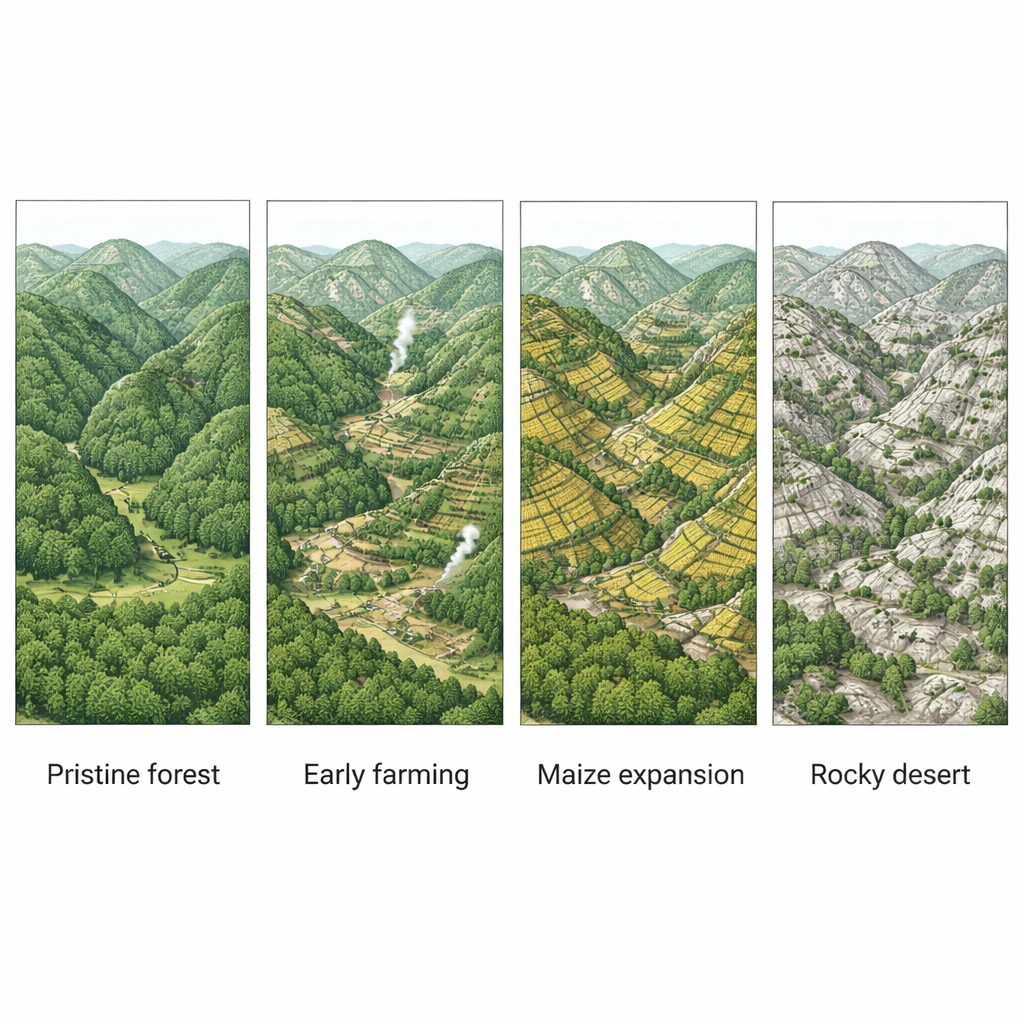
From deep green hills to bare rock
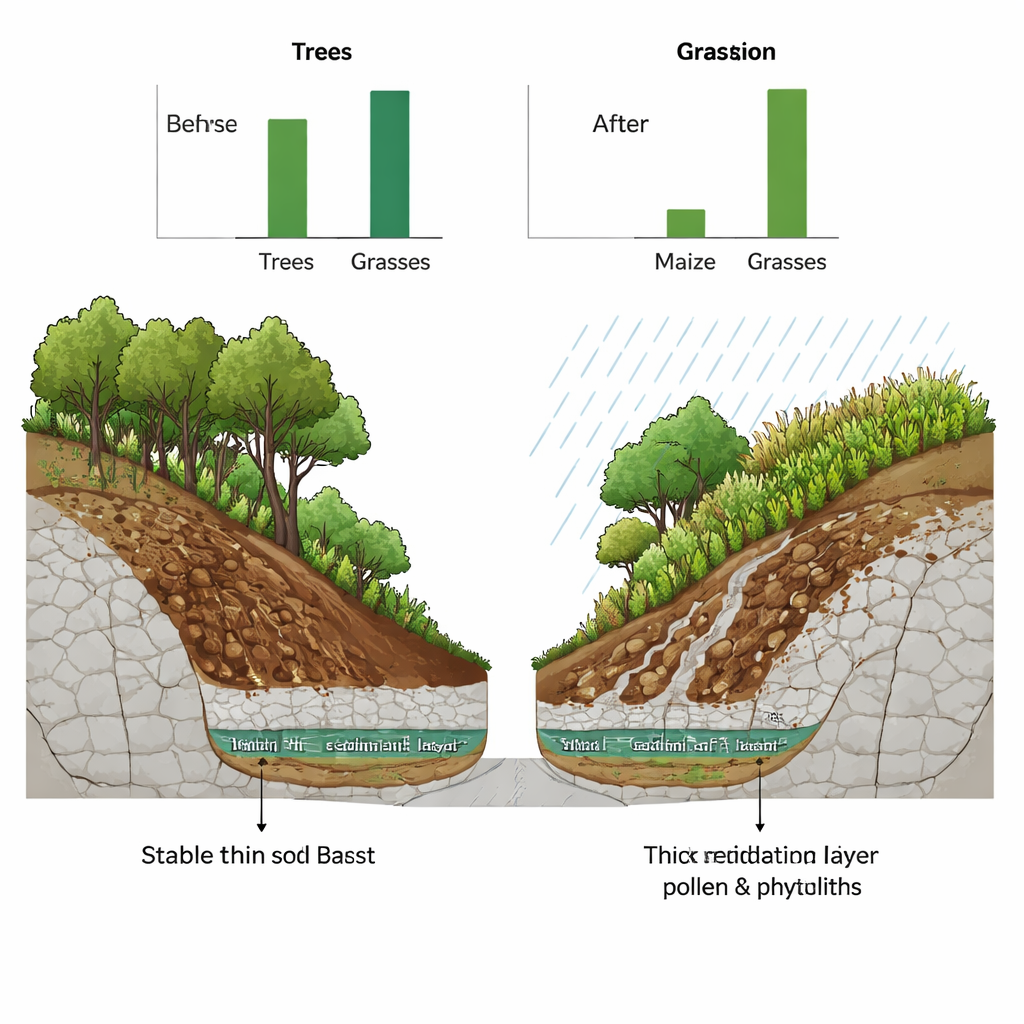
The study focuses on a karst region of Guangxi, where rainfall, thin soils, and crumbling limestone make the land both lush and fragile. Researchers drilled into the mud at the bottom of three natural basins, or depressions, that collect soil washed off the surrounding hills. These muddy layers act like pages in a history book, preserving microscopic plant remains that reveal which plants once dominated the slopes. Before the 18th century, the records show a landscape cloaked in forest, with tree pollen—especially from oak—strongly outweighing herbs and grasses.
How a new crop rewrote the landscape
That balance changed sharply with the arrival of maize (corn), a New World crop introduced to China several centuries after Columbus. Unlike rice, which needs flat, wet fields, maize can grow on steep, rain‑fed hillsides. Once local farmers adopted it, more and more slopes were cleared to grow this hardy grain. In the sediment, maize pollen and distinctive maize phytoliths (tiny glassy plant particles) appear at the same time as a surge in spores from Dicranopteris, a tough fern that thrives in disturbed, deforested ground. Grass pollen rises by several to more than ten percentage points, while tree pollen declines, especially in the most heavily affected basin. Together, these clues point to a lasting shift from tree‑dominated hills to grass‑ and fern‑covered slopes.
Past damage still limits today’s recovery
People, not climate, drove the change
Could climate shifts be to blame instead of people and maize? The authors tested this idea by examining temperature and rainfall reconstructions from the wider region, along with records of the Asian monsoon. Over the last five centuries, conditions have generally become warmer and wetter—weather that should favor forests, not grasslands. Historical documents, meanwhile, describe how population growth, migration, and the spread of slope farming intensified after the 18th century. Forest area shrank as more hillsides were cleared. The timing of maize’s arrival in local records closely matches its first appearance in the sediment. Taken together, the evidence points to human‑driven deforestation and farming on unsuitable, rocky slopes as the main drivers of long‑term forest loss.
Lessons for fixing damaged lands
The authors conclude that the land’s history sets hard limits on how easily forests can bounce back. Where deforestation was modest and soils remain relatively deep, simply leaving nature alone may allow forests to recover at low cost. But where centuries of maize farming stripped away soil and exposed bare limestone, the ecosystem appears to have flipped into a new, more open state that resists reforestation. In such places, ambitious tree‑planting campaigns may fail unless they first tackle basic problems like rebuilding soil and choosing species adapted to harsh conditions. For today’s global restoration efforts, the message is clear: to plan wisely, we must look not only at today’s satellite images, but also at the long, often invisible legacy of how people used the land in the past.
Citation: Yue, Y., Yuan, S., Wang, L. et al. Maize cultivation and forest collapse over five centuries in southern China. Commun Earth Environ 7, 190 (2026). https://doi.org/10.1038/s43247-026-03224-5
Keywords: maize cultivation, deforestation, rocky desertification, karst landscapes, ecological restoration