Clear Sky Science · en
Machine learning uncovers dominant fractions of heavy metal(loid)s in global soils
Why the ground beneath our feet matters
Most of the food we eat starts in soil, yet this thin skin of the planet is quietly collecting harmful metals from industry, farming, and the atmosphere. These metals do not simply sit still: some forms cling tightly to grains of earth, while others move easily into water, crops, and ultimately our bodies. The study summarized here uses modern data techniques to reveal where, and under what conditions, these more mobile and dangerous forms are most likely to occur around the world, with mercury used as a detailed test case.
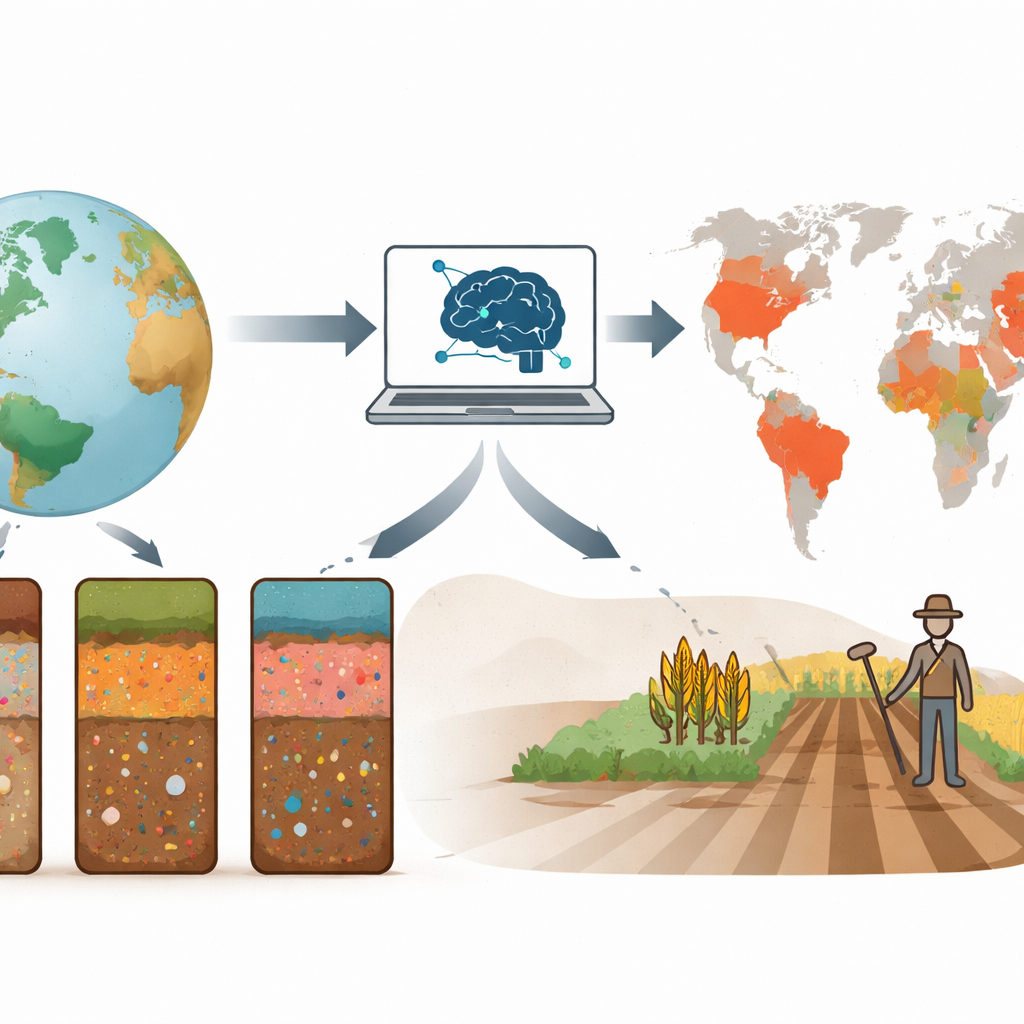
Hidden forms of harmful metals
Metals such as mercury, cadmium, and lead reach soils from both natural rock and human activities like mining, smelting, and burning coal. In soil, they do not exist in a single state. Instead, they are divided among several “fractions”: some are loosely attached to particles or dissolved in water, others are locked inside mineral structures. The loosely held fractions move more easily into waterways and plant roots, while the tightly bound fraction is comparatively stable. Most global studies have focused on total metal amounts, but the authors argue that the balance among these fractions, especially the dominant one in each soil, is what really controls risk to food and health.
Teaching a digital model to read the soil
To capture this balance on a global scale, the researchers assembled 9,489 measurements of metal fractions in topsoils from 56 countries, covering 52 different metals and a wide range of land types. For each sample, they recorded total metal levels, basic soil traits such as acidity (pH), organic carbon, clay content, and cation exchange capacity, as well as numerical descriptors of the metal’s own properties. They then trained a machine learning model, known as eXtreme Gradient Boosting, to learn which fraction tends to dominate under which conditions. After careful feature selection and tuning, the model correctly classified dominant fractions with high accuracy, even though the dataset was skewed toward the stable, low-mobility fraction.
Soil ingredients that set metals in motion
Using interpretation tools, the team examined which factors most strongly shaped the model’s decisions. Total metal concentration emerged as a major driver: as soils become more contaminated, the “storage capacity” of minerals and particles can be overwhelmed, pushing more metal into the mobile fractions. Just as important were the soil’s organic carbon and pH. Higher pH and more organic matter favored the more mobile forms, because dissolved organic pieces tend to bind metals into complexes that stay in the soil water instead of precipitating out. This interplay is not simple—other soil ions and minerals compete for the same binding sites—but the analysis clearly highlighted organic carbon and pH as global levers controlling how easily metals can move.
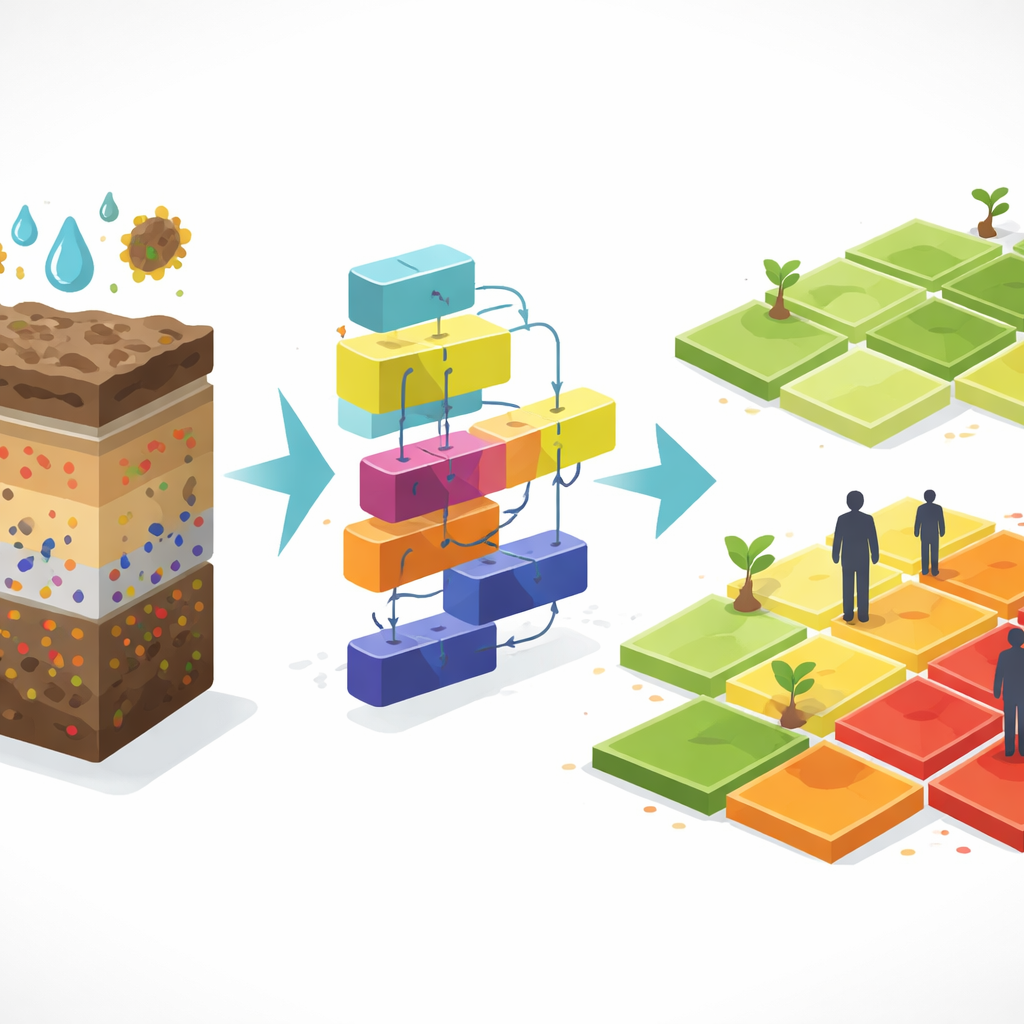
Mapping mercury’s risky hot spots
To show what their tool can do in practice, the scientists focused on mercury, a toxic metal of worldwide concern with relatively good global data. They combined their model with maps of soil mercury, soil properties, population, and cropland at five‑kilometer resolution. Regions where the model judged mobile forms of mercury to be more likely than the stable fraction were marked as high-mobility hot spots. About 17.85% of global land fell into this category. Large stretches of Africa and South America, parts of North America, and Southeast Asia stood out, while much of Europe and some high‑latitude regions showed lower mobility, in part because more acidic soils there tend to hold mercury more tightly.
People and farms in the danger zones
Overlaying the hot spot map with where people live and crops are grown revealed who is most at risk. The authors estimate that around 15.1 million people and 100.9 million hectares of cropland lie in areas where mercury is likely to exist in more mobile forms. Asia, despite having a smaller share of the affected land, hosts the largest number of exposed people and fields because of its dense populations and intensive agriculture—especially in northern India, Bangladesh, and eastern China. These findings suggest that, beyond global treaties aimed at cutting mercury emissions, many countries urgently need soil testing and targeted clean‑up in specific regions.
A faster way to spot trouble in the soil
Laboratory methods that directly measure metal fractions are slow, technically demanding, and expensive, limiting how many sites can be checked. By contrast, the new framework can be trained once on carefully measured samples and then used to rapidly estimate dominant fractions anywhere that basic soil and metal data are available. While the approach still depends on improving global maps of soil contamination and collecting more field data, it already offers a powerful shortcut: a way to pinpoint likely hot spots of mobile, harmful metals in advance, helping governments and communities focus testing and clean‑up where they matter most for food security and public health.
Citation: Hu, T., Wu, M., Chen, Q. et al. Machine learning uncovers dominant fractions of heavy metal(loid)s in global soils. Commun Earth Environ 7, 214 (2026). https://doi.org/10.1038/s43247-026-03221-8
Keywords: soil pollution, heavy metals, mercury, machine learning, environmental health