Clear Sky Science · en
Changes in terrestrial weathering following glacial retreat reveal processes altering North Atlantic neodymium isotopes
Why this icy story matters
When ice sheets melt, they don’t just raise sea levels—they also change the chemistry of the oceans in ways that can alter climate. This study looks at how retreating glaciers in southwest Greenland grind up ancient rocks and release the element neodymium into rivers and, ultimately, the North Atlantic. Because different rocks carry distinct "fingerprints" of neodymium, tracking these fingerprints helps scientists read past changes in ocean circulation and ice sheet behavior—key pieces of the climate puzzle.
From melting ice to ocean clues
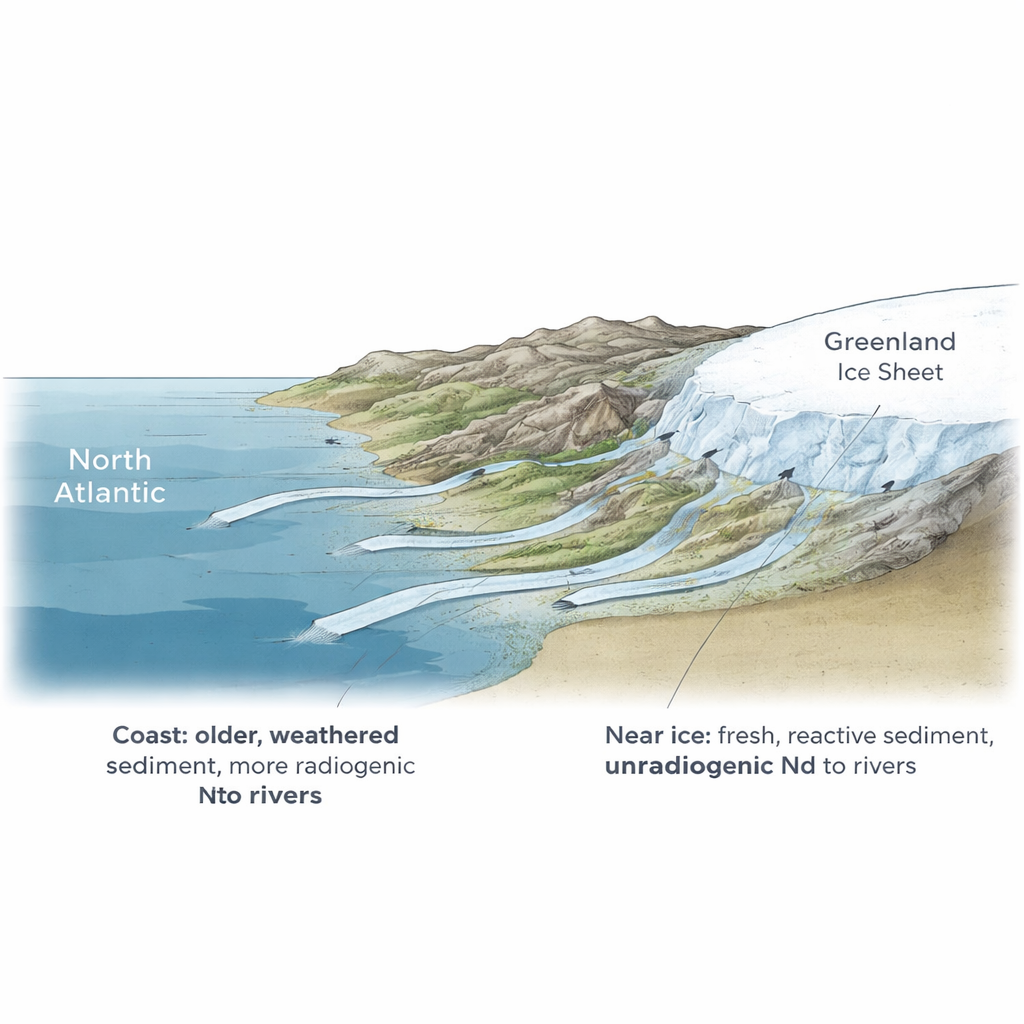
The researchers focused on a 170-kilometer stretch of land in southwest Greenland that runs from the edge of the Greenland Ice Sheet to the coast. As the ice has pulled back since the last Ice Age, it has exposed landscapes of different ages—from freshly uncovered ground near the ice to surfaces that have been ice-free for about 12,000 years near the sea. The team sampled stream water and riverbed sediment across this gradient to see how the neodymium "signature" changed as landscapes aged and weathered. Because neodymium in nearby rocks is controlled by their great age and type, any differences between dissolved neodymium in water and neodymium in sediments reveal how weathering and transport are modifying that original signal.
Fine glacial dust with a powerful signal
Near the ice sheet, rivers carry large amounts of fine, freshly ground glacial sediment—what geologists often call “glacial flour.” In these young watersheds, dissolved neodymium in the stream water is much less radiogenic (that is, it has a lower isotope value) than the neodymium locked in the coarse bedload sediment on the river bottom, with a typical difference of about eight epsilon units. By separating the sediments into clay, silt, and sand, the authors found that the finest grains, especially silt, were both rich in neodymium and carried the least radiogenic signature. These fine particles are packed with easily weathered minerals, such as allanite, that release strongly unradiogenic neodymium when they first break down.
How landscapes mellow with time
Further toward the coast, in older landscapes that have been exposed for thousands of years, the picture changes. There, rivers contain far less fine material: the silt and clay fractions shrink to a tiny portion of the bedload, and the sand-sized grains dominate. As the most reactive, neodymium‑rich minerals dissolve away or are flushed out over time, the remaining sediment is made up mostly of tougher rock-forming minerals like amphiboles and pyroxenes. In these mature watersheds, the neodymium in dissolved form and in sediment become much more similar, differing by only about one epsilon unit. Overall, both water and sediment show more radiogenic values than in the ice-proximal streams, indicating that weathering has shifted from targeting exotic trace minerals to slowly dissolving the bulk rock.
Connecting Greenland rivers to the deep Atlantic
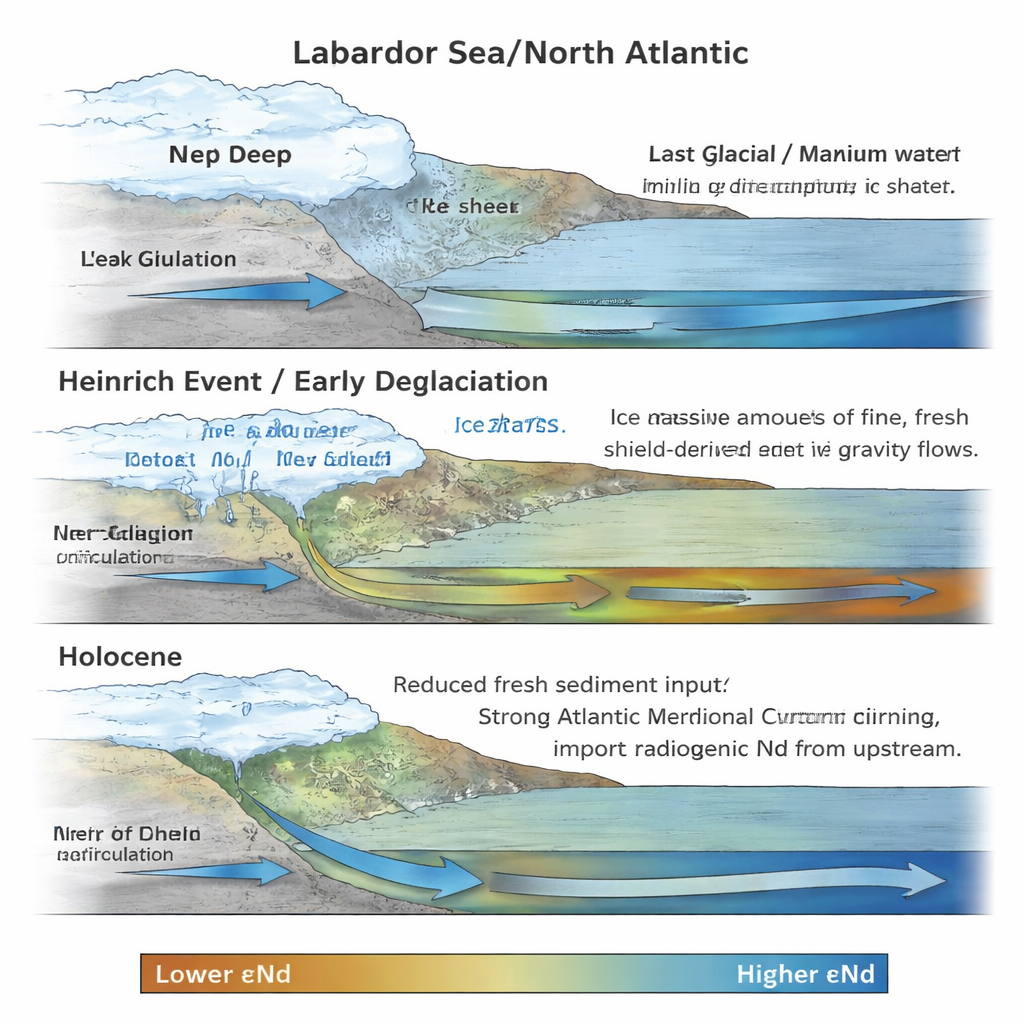
These local changes in Greenland’s rivers matter because similar ancient, hard-rock terrains ring much of the North Atlantic. During times of rapid ice retreat, such as at the end of the last Ice Age, huge amounts of freshly ground shield rock were delivered to the ocean through meltwater streams, icebergs, and underwater flows. The study’s results support the idea that this influx of highly reactive, fine sediment released pulses of unradiogenic neodymium to deep waters in the Labrador Sea and broader North Atlantic. Those pulses are now recorded in seafloor minerals and have long been used to reconstruct changes in deep ocean circulation, especially the strength of the Atlantic Meridional Overturning Circulation. The new work shows that part of this signal reflects changing sediment weathering, not just shifting water masses.
Rethinking ocean “fingerprints” of past climate
In plain terms, the study concludes that when glaciers grind and dump fresh, fine rock into the ocean, they temporarily tilt the neodymium fingerprint of deep waters toward values that look like a stronger contribution from ancient continental rocks. As landscapes and seafloor sediments continue to weather, that extra push fades and the fingerprint drifts back toward more radiogenic values. This means that scientists using neodymium isotopes to read past ocean circulation must also account for how much fresh sediment was being supplied and how far its weathering had progressed. By tying detailed river measurements in Greenland to records from the deep Atlantic, the authors show that the chemistry of tiny mineral grains is a crucial, and previously underappreciated, player in the climate stories written in the seafloor.
Citation: Salinas-Reyes, J.T., Martin, E.E., Martin, J.B. et al. Changes in terrestrial weathering following glacial retreat reveal processes altering North Atlantic neodymium isotopes. Commun Earth Environ 7, 188 (2026). https://doi.org/10.1038/s43247-026-03220-9
Keywords: glacial retreat, neodymium isotopes, Greenland rivers, ocean circulation, chemical weathering