Clear Sky Science · en
Rainfall amplified sea-level control on silicate weathering in the Indo-Pacific Convergence Zone during Quaternary glacials
Why ancient tropical rains matter today
The Indo-Pacific region around Southeast Asia is sometimes called Earth’s “heat engine” because its warm oceans and heavy rains drive weather patterns worldwide. This study looks back 700,000 years to ask a modern question: how did changing sea level and monsoon rains in this region affect the amount of carbon dioxide (CO2) in the atmosphere? By examining how rocks broke down and reacted with CO2 in the past, the authors uncover a hidden natural brake on climate change that could help us better understand the pace of future warming.
Rock weathering as a slow-motion climate lever
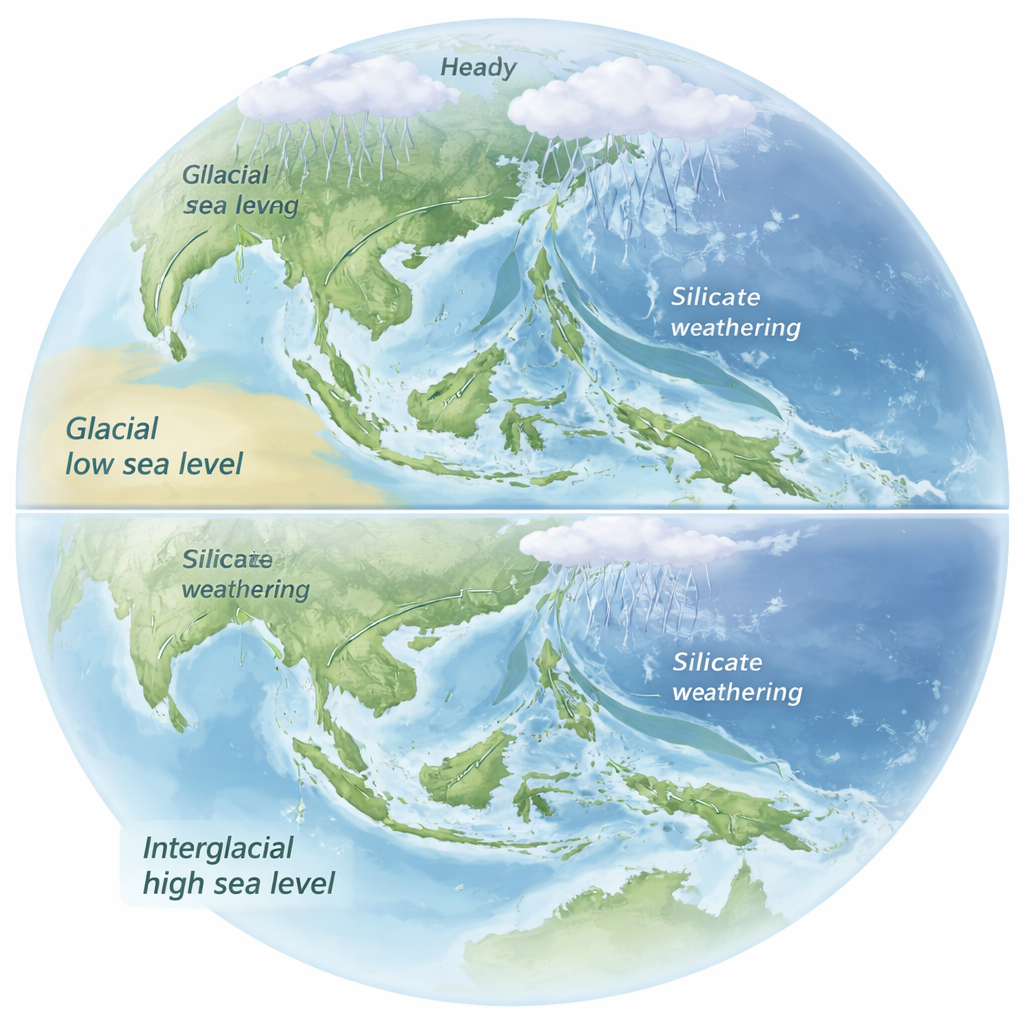
When rainwater flows over land and through soils, it slowly dissolves certain minerals in rocks, especially silicate minerals. In this chemical weathering process, CO2 from the air is converted into dissolved substances that are carried by rivers to the ocean, where they can eventually become carbonate sediments on the seafloor. This acts as a long-term CO2 sink, operating over tens of thousands of years. The Indo-Pacific Convergence Zone (IPCZ) – a belt of intense rainfall and warm temperatures stretching from the South China Sea to the western Pacific – is particularly important because its loose sediments and silicate-rich rocks make it one of the most active regions on Earth for this kind of CO2-consuming weathering.
Sea-level change exposes a hidden landscape
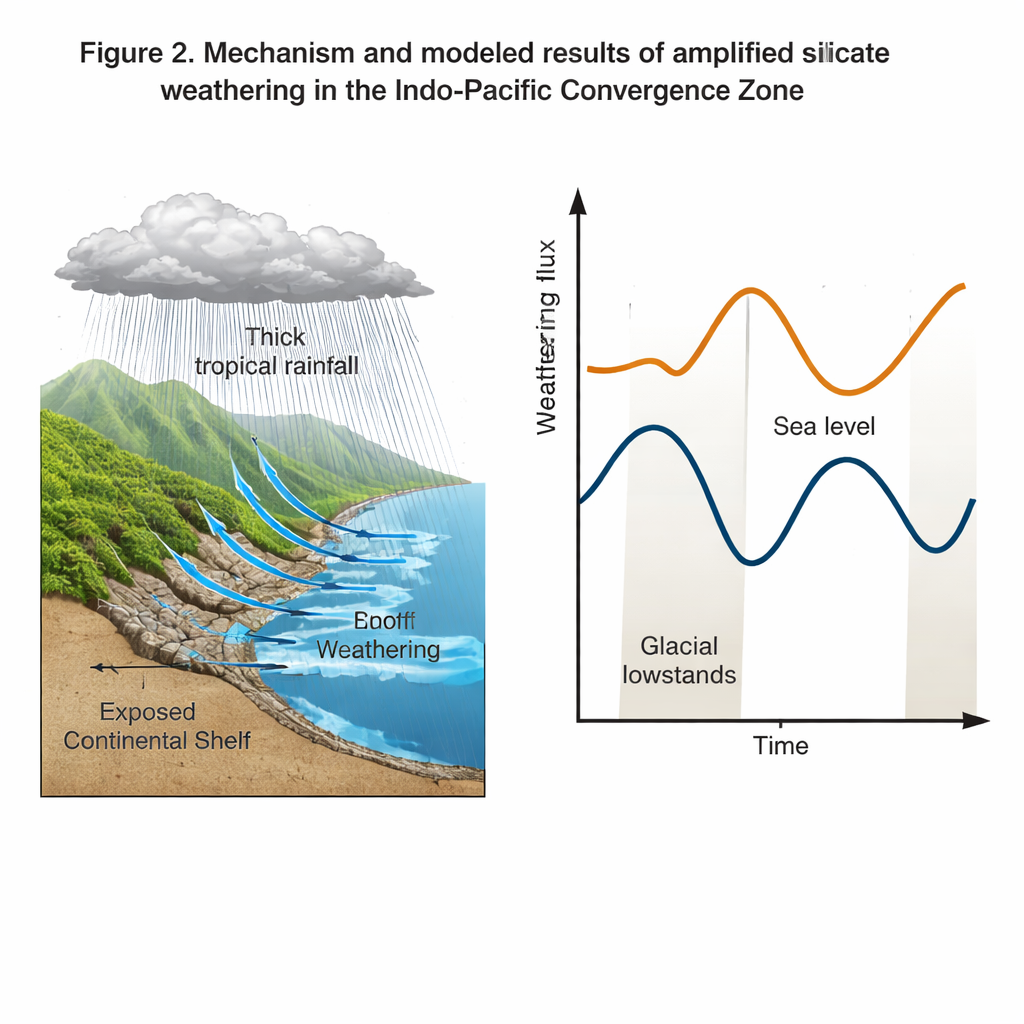
During ice ages, huge ice sheets locked up water, causing global sea level to fall by more than 100 meters. Around Southeast Asia, that drop exposed vast continental shelves – flat, shallow seafloors that became new land surfaces. Using a global geochemical model called GEOCLIM, the researchers simulated how this extra land area affected chemical weathering in the IPCZ over the last 120,000 years, then extended the results back to 700,000 years using statistical tools. They found that simply exposing these shelves during glacial periods increased silicate weathering flux by about one-third compared with warmer, higher-sea-level times. That extra weathering alone was enough to remove the equivalent of roughly 9 parts per million by volume (ppmv) of CO2 from the atmosphere.
When extreme rains supercharge weathering
Sea level was not the only player. The team also examined how variations in rainfall, driven by shifts in Earth’s orbit and monsoon systems, altered weathering. They combined climate simulations, sea-level records, temperature reconstructions, and a weathering-sensitive sediment record from a seafloor drilling site with several machine learning and deep learning models. A Random Forest model, along with a custom neural network, proved especially good at capturing the complex links between temperature, CO2, sea level, and weathering over time. By building a weighted average of all the models, they reconstructed how the IPCZ’s weathering flux rose and fell during many glacial–interglacial cycles.
Rainfall swings amplify the carbon sink
On the longest, roughly 100,000-year cycles, the results showed a tight connection: lower sea level went hand in hand with stronger chemical weathering. But at shorter, precession-related timescales of about 20,000 years, rainfall emerged as a key amplifier. During some glacial periods, especially around 58,000 years ago, tropical rains in the IPCZ appear to have become unusually intense. These high-rainfall episodes, coinciding with already exposed continental shelves, could boost weathering fluxes by more than half – and in some localized cases, by more than double. The authors estimate that this combination of low sea level and strong rainfall increased CO2 removal to about 9.2–13.7 ppmv, a substantial share of the roughly 80 ppmv CO2 difference between ice ages and warm periods.
What this means for understanding climate change
To a non-specialist, the changes in CO2 found here may sound small, but over hundreds of thousands of years they represent an important piece of the climate puzzle. The study shows that the Indo-Pacific’s tropical shelves acted as a powerful, rain-driven “scrubber” of atmospheric CO2 during ice ages, helping to keep the planet cooler. It also highlights how different parts of the Earth system – sea level, rainfall, rock type, and landscape shape – work together to regulate climate on long timescales. While this natural weathering feedback is far too slow to counteract today’s rapid human-driven emissions, understanding its strength and behavior helps scientists build more realistic models of future climate and better interpret how the Earth has responded to past upheavals.
Citation: Yang, Y., Xu, Z., Zhao, D. et al. Rainfall amplified sea-level control on silicate weathering in the Indo-Pacific Convergence Zone during Quaternary glacials. Commun Earth Environ 7, 195 (2026). https://doi.org/10.1038/s43247-026-03219-2
Keywords: silicate weathering, Indo-Pacific Convergence Zone, glacial cycles, sea-level change, carbon dioxide sink