Clear Sky Science · en
Rethinking and comprehensive planning of the floating city concept
A New Way to Live with Rising Seas
As sea levels rise and crowded coasts run out of space, many of the world’s great cities face a stark choice: retreat inland, build ever-higher walls, or rethink what a city can be. This paper explores that last option. The authors lay out a detailed vision for a self-contained floating city, designed not as a science-fiction fantasy but as a practical response to climate change, land scarcity, and the desire for healthier, more community-oriented urban life.
Why Cities May Need to Leave the Shore
Billions of people already live near the coast, and that number is growing. At the same time, scientific projections show that global sea levels are likely to rise several tens of centimeters by mid-century and could approach a meter by 2100, depending on how much we curb greenhouse gas emissions. Combined with land subsidence and more extreme storms, this will expose hundreds of millions of people to regular flooding. Traditional defenses—such as sea walls, beach nourishment, and moving people inland—are costly, patchwork solutions that often shift problems rather than solve them. Floating cities offer a different approach: instead of fighting the water, accept it and build directly on top of it.
From Utopian Sketches to a Concrete Plan
Floating settlements are not new—small water-based communities exist in many parts of the world, and ambitious marine city proposals have appeared since the mid-20th century. Most, however, stayed on paper or were limited to small showpieces tethered close to shore. The authors argue that what is missing is a comprehensive, open, and scientifically grounded plan that treats a floating city as a fully fledged urban system. Their concept is a satellite city, moored offshore yet connected to a nearby coast, and built around three simple pillars: resilience (dealing safely with hazards), sustainability (limiting environmental harm while using local resources), and urban welfare (making everyday life pleasant and fair for residents). They choose a 50,000-person settlement as a test case, but design it to be modular and scalable.
How a Floating City Would Be Built
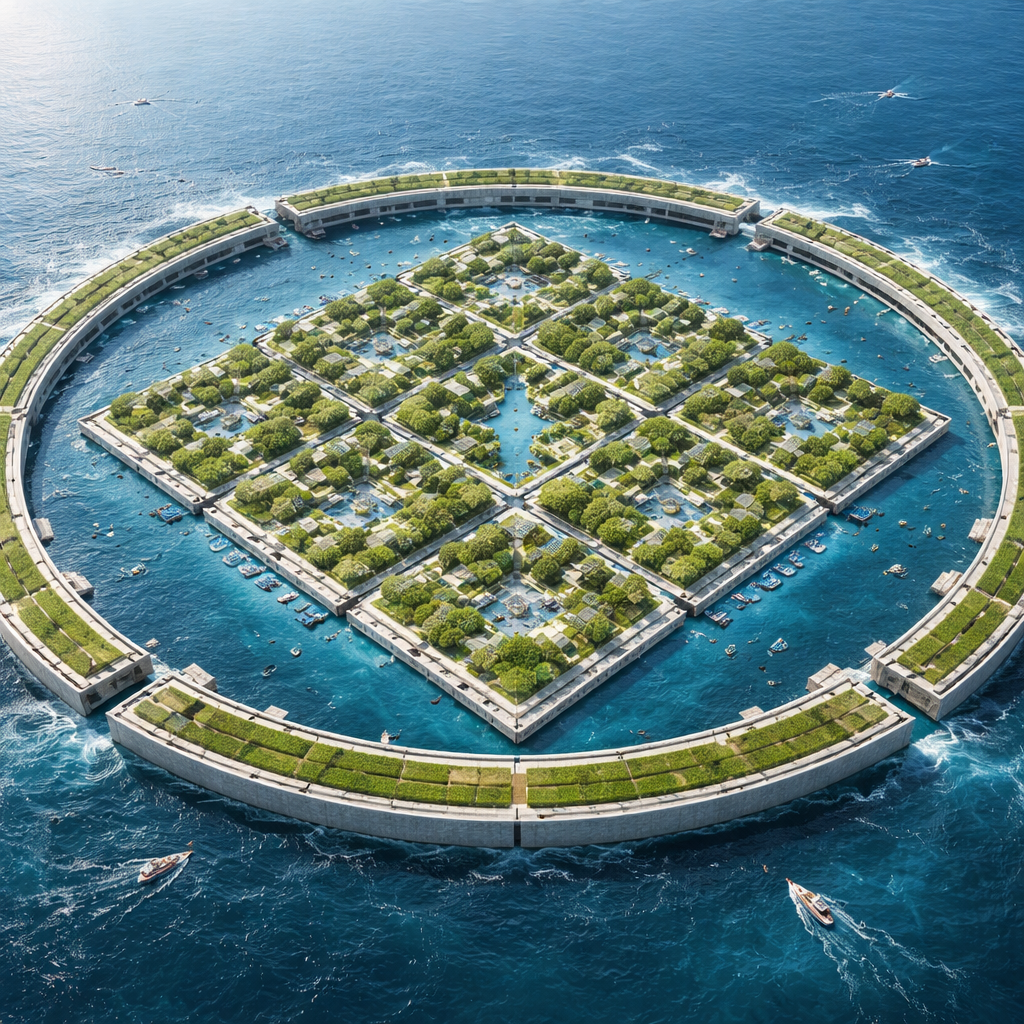
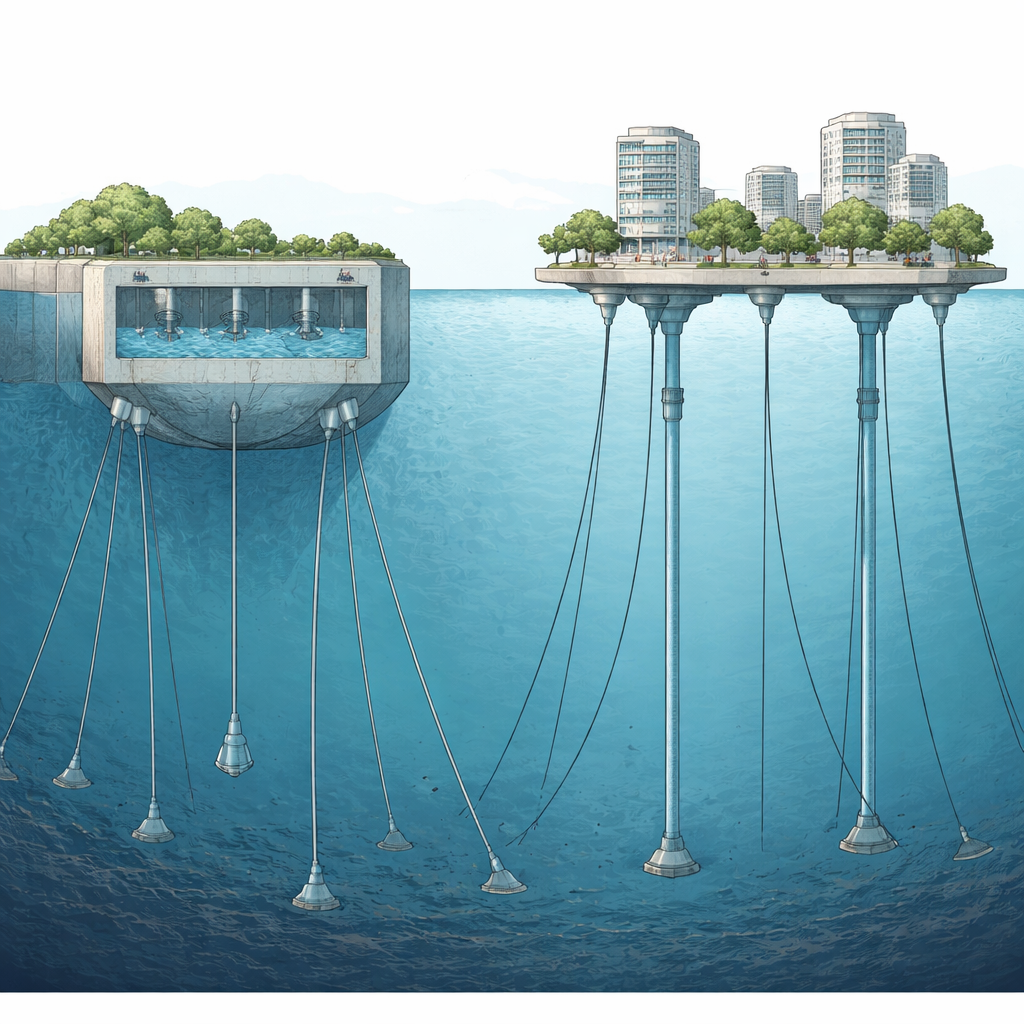
The proposed city is made of two main pieces: an outer protection ring and an inner cluster of neighborhoods. The outer ring is a floating concrete barrier anchored to the seabed with strong vertical tendons. It acts like an artificial reef, calming incoming waves so the water inside remains relatively sheltered. Cleverly, its seaward face includes built-in chambers that make use of the rise and fall of waves to generate electricity, turning the shield into a power plant as well. The interior is a grid of square modules, each roughly 300 meters on a side, resting on semi-submersible platforms supported by slender columns. These modules house homes, schools, clinics, shops, parks, and public squares—everything needed for daily life—while open water channels weave between them for small electric boats and recreation.
Life on the Water: Community, Nature, and Energy
Inside each neighborhood, the authors favor shared spaces over oversized private apartments. Two main building types—courtyard blocks and long "slab" buildings—provide homes with abundant natural light and views of the sea, while communal kitchens, laundry rooms, play areas, and fitness spaces are designed to encourage residents to meet and support one another. Generous green roofs, gardens, and small urban farms bring nature into the city, while blue areas—swimming pools open to the sea, direct stairways into the water, and canals—make daily contact with the ocean a normal part of life. Movement is mostly by foot, bicycle, and short electric-boat trips, with layered paths at water level, deck level, and on elevated walkways linking rooftop parks. The city aims to be largely self-sufficient in key resources: local renewable energy (mostly offshore wind, supplemented by waves and solar panels), desalinated and recycled water, and a mix of agriculture, aquaculture, and high-efficiency systems like hydroponics for food.
Built to Bend, Not Break
Because everything floats, the city naturally follows the average sea level, removing one of the biggest threats coastal cities face. But the designers go further, analyzing how to withstand storms and long-term wear. The outer barrier is tuned to reflect or absorb wave energy while its moorings limit motion; under strong waves it sits slightly deeper, improving protection. The inner platforms are smaller and flexibly linked so they move gently rather than snap under stress, and shared, forgiving mooring systems and backup propellers help keep safe distances between modules. Materials are chosen with durability in mind, especially reinforced concrete that can last for many decades in marine conditions. The city’s infrastructure—energy, water, food, and waste treatment—is deliberately redundant and diverse, so that failures in one part do not cripple the whole system, and the authors highlight the importance of social resilience as well: strong community ties, inclusive design, and local participation in decision-making.
What This Vision Means for the Rest of Us
In simple terms, the study shows that a medium-sized, largely self-sufficient floating city for 50,000 people is technically and energetically feasible using known technologies, at least on paper. The authors do not claim to solve every engineering, legal, or political challenge, but they provide a concrete blueprint and numbers for space, food, and energy that others can refine. For non-specialists, the key message is that floating cities are no longer just dreamy illustrations; with careful planning they could become a real option for countries seeking safe, sustainable space for future generations while rebuilding their relationship with the sea.
Citation: Ruzzo, C., Cacurri, M.L. & Arena, F. Rethinking and comprehensive planning of the floating city concept. Commun Earth Environ 7, 196 (2026). https://doi.org/10.1038/s43247-026-03218-3
Keywords: floating cities, sea level rise, climate adaptation, offshore urbanism, renewable energy