Clear Sky Science · en
Short-term Antarctic ice-sheet dynamics during the late Oligocene
Why ancient ice matters for our future
Scientists are hungry for natural experiments that show how Earth’s great ice sheets behave in a warmer world. This study looks back some 26 million years, to a time when carbon dioxide levels were similar to those expected later this century, to find out how the Antarctic ice sheet responded. By drilling into ancient seafloor mud and analyzing tiny fossil shells and chemical fingerprints, the authors reveal that Antarctica’s ice grew and shrank far more dramatically, and more often, than once thought—offering clues about how quickly ice, and sea level, might change in the future.
A warm world that looks a lot like tomorrow
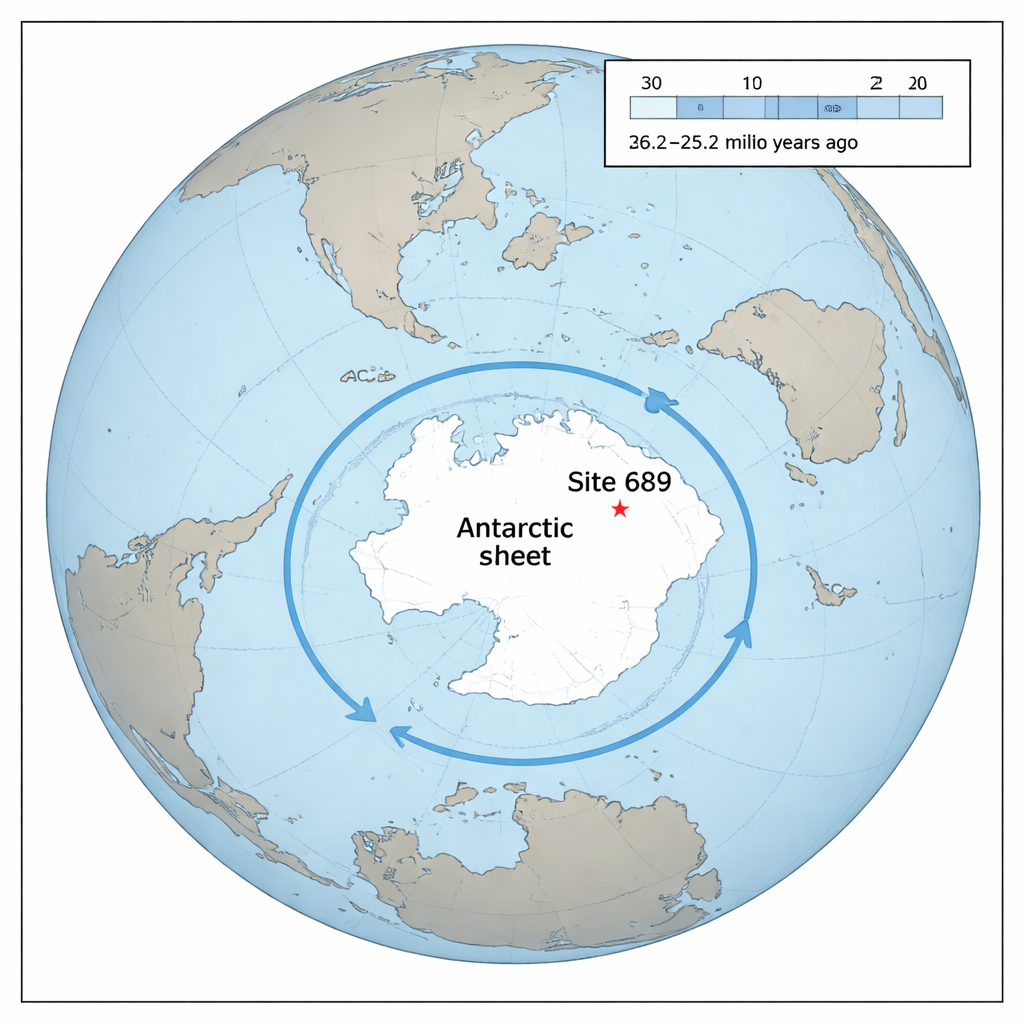
The late Oligocene period, between about 26.2 and 25.2 million years ago, was warmer than today, yet Antarctica was already capped by a large ice sheet. Atmospheric carbon dioxide is estimated to have hovered around 500–570 parts per million, close to projections for the end of this century. At the same time, the continents sat in slightly different positions and ocean gateways around Antarctica were still shifting, helping establish the powerful ring-shaped Antarctic Circumpolar Current. This combination of high greenhouse gases, altered ocean circulation, and a major southern ice sheet makes the late Oligocene a valuable deep-time analogue for our coming climate.
Reading climate history from tiny shells
The team focused on Ocean Drilling Program Site 689, on Maud Rise in the Southern Ocean, where sediments piled up steadily on the deep seafloor. Within these mud layers they picked out single-celled organisms called benthic foraminifera, whose calcium carbonate shells preserve the chemistry and temperature of ancient seawater. By measuring oxygen isotopes and magnesium-to-calcium ratios in the shells, the researchers separated changes in bottom-water temperature from changes in global ice volume. They then compared this ice-volume record with isotopes of two metals, neodymium and lead, locked into the surrounding sediment. These metal isotopes act like barcodes for the types of rocks eroded on the Antarctic continent and for how intensely those rocks were ground up and weathered.
An ice sheet that surged with Earth’s wobble
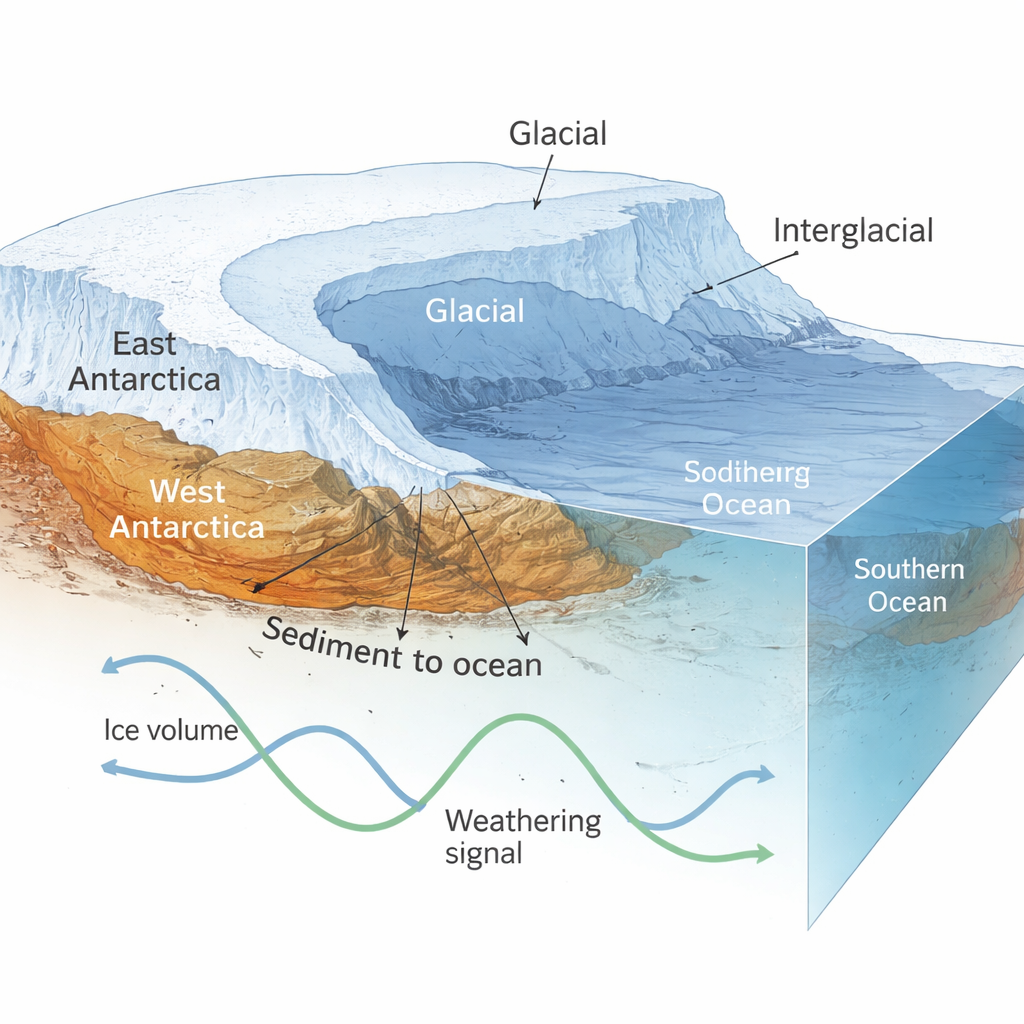
The oxygen-based record shows that the Antarctic ice sheet during this million-year window was anything but static. Ice volume swung between states comparable to, or larger than, today’s Antarctic ice mass and much smaller configurations, but it never vanished entirely. These swings lined up not only with long, slow changes in Earth’s orbit, known as eccentricity cycles, but also with the roughly 41,000-year tilt, or obliquity, cycle. That means the angle of Earth’s axis—controlling how much sunlight reaches high southern latitudes—strongly paced the growth and retreat of Antarctic ice, even under high carbon dioxide. In some intervals the reconstructed changes in ice volume rival those inferred for the more recent ice ages of the Pliocene and Pleistocene.
Rock fingerprints reveal shifting erosion
As the ice sheet expanded and contracted, it scraped different suites of rocks and delivered their fragments and dissolved products into the ocean. This is recorded in the changing neodymium and lead isotope signatures at Site 689. During colder, more heavily glaciated times, the sediment shows pulses of isotopic values that point to stronger erosion of old East Antarctic rocks near the margin, likely as thicker ice advanced and icebergs exported debris. In warmer phases, the signal relaxes toward an “open-ocean” background dominated by material circulating within the Weddell Gyre, the great whirl of water off Antarctica. For most of the record, the metal-isotope shifts track the ice-volume changes, tying continental erosion and regional ocean circulation directly to the waxing and waning of the ice sheet.
Proof of a long‑lived East Antarctic giant
One of the most telling results comes from how the lead isotopes in seawater-derived coatings differ from those in the solid rock fragments. This persistent mismatch indicates a style of intense, uneven chemical weathering that is typical of rock ground beneath a major ice sheet. The authors show that this “incongruent” weathering signal was already firmly in place by the late Oligocene and remained stable over the entire million years they studied. Combined with the large but incomplete ice-volume swings, this points to a substantial, long‑lived East Antarctic ice sheet that never disappeared, even in the warmest intervals. For today, the message is that a big, mostly land‑based Antarctic ice sheet can endure high carbon dioxide, but it can still change dramatically in size on timescales of tens of thousands of years—changes that would translate into major, repeated swings in global sea level.
Citation: Creac’h, L., Brzelinski, S., Lippold, J. et al. Short-term Antarctic ice-sheet dynamics during the late Oligocene. Commun Earth Environ 7, 189 (2026). https://doi.org/10.1038/s43247-026-03217-4
Keywords: Antarctic ice sheet, paleoclimate, Oligocene, sea-level change, Southern Ocean