Clear Sky Science · en
Residence time of Hunga stratospheric water vapour perturbation quantified at 9 years
When a Volcano Changes the Air Above Our Heads
In January 2022, an underwater volcano in the South Pacific, known as Hunga, blasted an extraordinary amount of water high into the sky. That one event increased the planet’s stratospheric water supply by about 10%, the largest such jump seen in more than three decades of satellite measurements. Because water vapour is a powerful greenhouse gas when it reaches the stratosphere, scientists have been racing to answer a simple but crucial question: how long will this extra water stay there, and how long will its climate influence last? 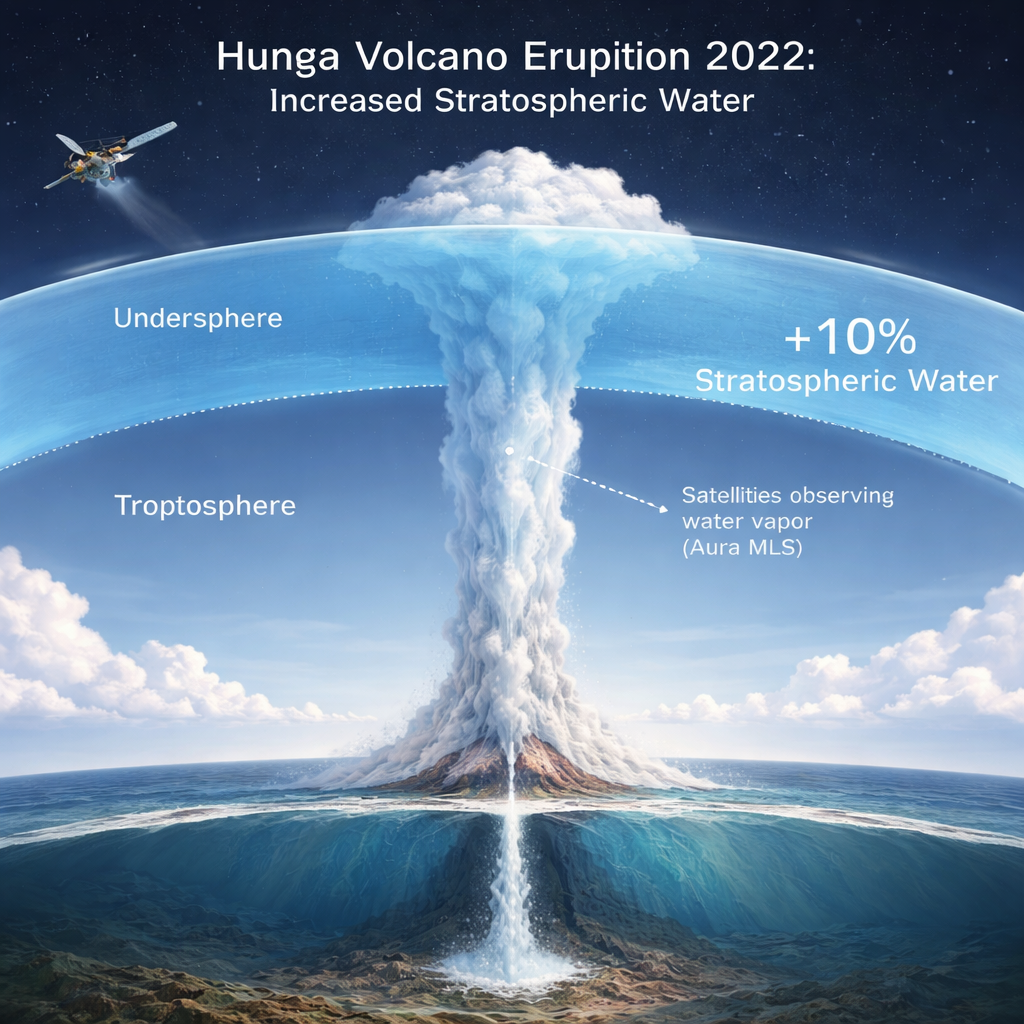
A Giant Splash into the Upper Atmosphere
The eruption injected roughly 150 billion tonnes of water into the middle atmosphere, far more than typical volcanic eruptions, which mostly add ash and sulfur. This sudden “hydration” of the stratosphere altered chemistry, winds, and temperatures high above the Earth. Early measurements showed that, for nearly two years, the added water barely declined, leaving experts unsure whether its effects would fade in just a few years or linger for a decade or more. Estimates of the return to normal ranged widely, from around 2025 to well into the 2030s, making it hard to judge how much the Hunga event might temporarily boost global warming.
Satellites Track a Sudden Turn in 2024
To pin down what was happening, researchers used detailed measurements from NASA’s Microwave Limb Sounder (MLS) instrument on the Aura satellite. MLS has been scanning the atmosphere since 2004, providing daily, near-global profiles of water vapour. These observations reveal that in 2024 the story changed dramatically: the amount of Hunga-added water in the stratosphere fell by about 55 billion tonnes in a single year, the largest and fastest drop in the satellite record. Earlier, in the winter of 2023, very cold conditions over Antarctica had already allowed special ice clouds to form and remove a first large portion of the excess water. But the 2024 decline was broader, persistent through the year, and called for a different explanation.
How the Sky Slowly Drains
To understand the underlying mechanisms, the team turned to a sophisticated computer model of atmospheric chemistry and motion called TOMCAT. They ran simulations with and without the Hunga water injection, and with and without polar ice cloud “dehydration,” to separate the different loss processes. The model, which closely matches the satellite record, shows that after 2023 the extra water spread globally and began to sink from higher layers down toward the lower stratosphere. There, it could finally leak into the weather-filled troposphere below, carried by large-scale circulation at high latitudes and by vigorous intrusions of stratospheric air into the regions where we live. By late 2024, this stratosphere-to-troposphere exchange had become more important than Antarctic ice clouds in removing Hunga’s water. 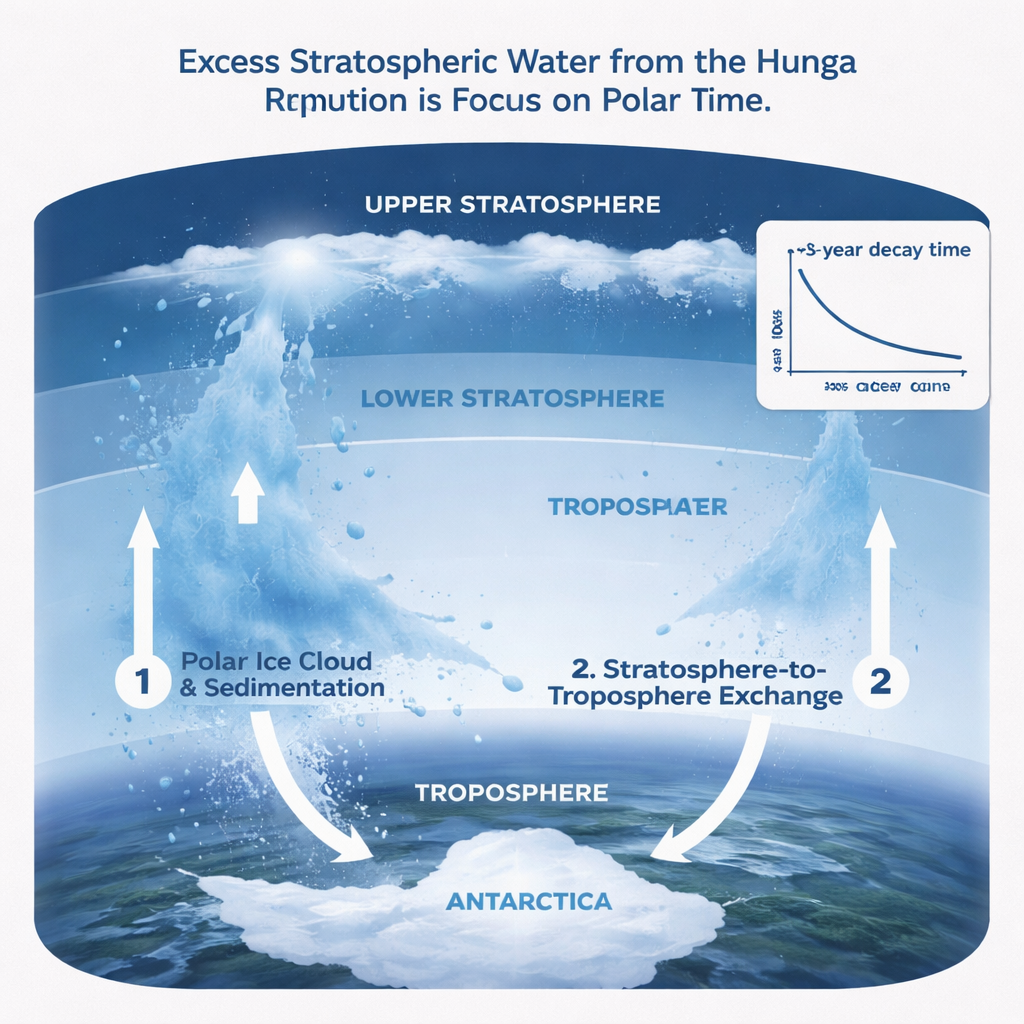
Counting Down the Extra Water
With several years of measurements now in hand, and a model that reproduces both polar cloud losses and transport into the lower atmosphere, the authors were able to calculate how fast the remaining excess water is fading. They find that, from the onset of strong removal in mid-2023, the added stratospheric water is now decaying with an e-folding time of about three years. Put simply, the amount left shrinks by roughly one third every three years, and the total “lifetime” of this perturbation—including the initial waiting period before the decline began—is about four and a half years. Their calculations indicate that roughly half the injected water has already gone and that about three-quarters has left the stratosphere by early 2025.
What This Means for Climate and the Future
For non-specialists, the takeaway is that the Hunga eruption gave the climate system a powerful but temporary nudge. The extra water in the stratosphere does act like an added blanket, trapping a bit more heat, but it will not stay there indefinitely. Based on the latest satellite data and modelling, the authors conclude that stratospheric water levels should return to their usual range of year-to-year variability around 2030. This tighter estimate of a roughly nine-year total disturbance (from the 2022 eruption to full recovery) greatly narrows earlier guesses and helps climate scientists more accurately factor this unusual natural event into near-term projections of global temperature.
Citation: Zhou, X., Chen, Q., Feng, W. et al. Residence time of Hunga stratospheric water vapour perturbation quantified at 9 years. Commun Earth Environ 7, 198 (2026). https://doi.org/10.1038/s43247-026-03216-5
Keywords: Hunga volcano, stratospheric water vapour, volcanic eruption climate impact, Brewer-Dobson circulation, satellite atmospheric observations