Clear Sky Science · en
Zinc isotopes record lunar magmatic outgassing and surface processes in different Chang’e-5 samples
A New Look at How the Moon Lost Its “Breath”
The Moon holds clues to how rocky worlds like Earth gain and lose their most delicate ingredients: volatile elements that can evaporate away as gas. This study uses subtle differences in the element zinc, measured in rocks and soils brought back by China’s Chang’e‑5 mission, to reconstruct both the Moon’s fiery birth and its surprisingly gentle late‑stage volcanic activity. For anyone curious about how our nearest neighbor evolved from a molten ball to the quiet world we see today, these samples offer a rare time capsule.
Reading the Moon’s Past from a Handful of Rocks
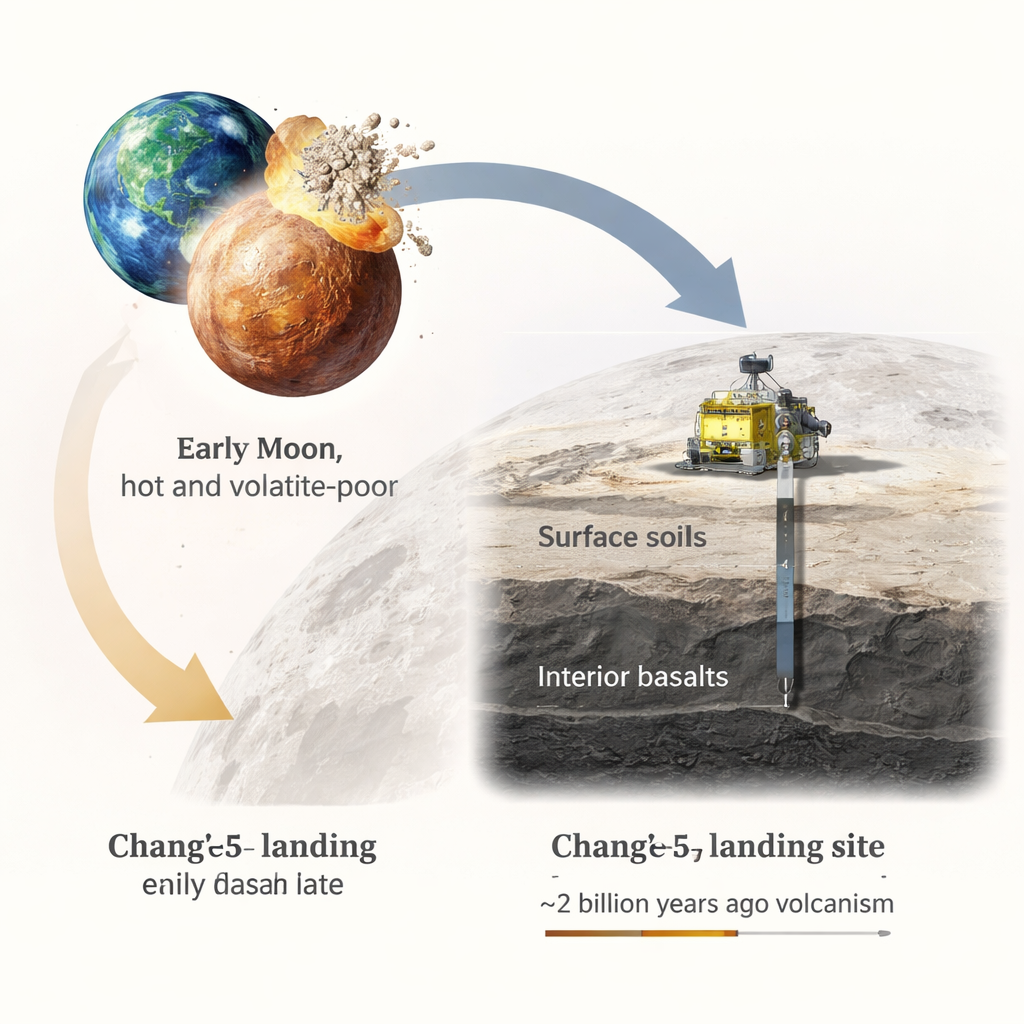
Chang’e‑5 landed in a relatively young lava plain in Oceanus Procellarum and returned 1.7 kilograms of lunar material, including solid volcanic rocks (basalts) and loose surface soil (regolith). The basalts there are about two billion years old—roughly a billion years younger than any lavas brought back by the Apollo missions—so they extend the record of lunar volcanism far into the Moon’s later history. Chemically, these basalts are still very dry and poor in volatile elements, despite their youth, showing that the deep lunar interior remained depleted in easily lost ingredients long after the Moon formed.
A Heavy Signature from a Violent Beginning
The researchers focused on zinc isotopes, which can be thought of as slightly heavier or lighter versions of the same element. When material is strongly heated, lighter isotopes tend to escape more easily into vapor, leaving the remaining rock enriched in heavier isotopes. The Chang’e‑5 basalts show zinc isotope values that closely match those of Apollo mare basalts and lunar meteorites: they are consistently “heavy” compared with Earth’s mantle. Modeling of these measurements indicates that early lunar material experienced intense evaporation under conditions close to vapor saturation, most likely during the giant impact that formed the Moon and the subsequent global magma ocean. Crucially, the younger Chang’e‑5 lavas did not significantly alter this inherited signature, suggesting that the Moon’s interior had already been globally stripped of volatiles and then remained fairly uniform for billions of years.
Soils That Don’t Behave as Expected
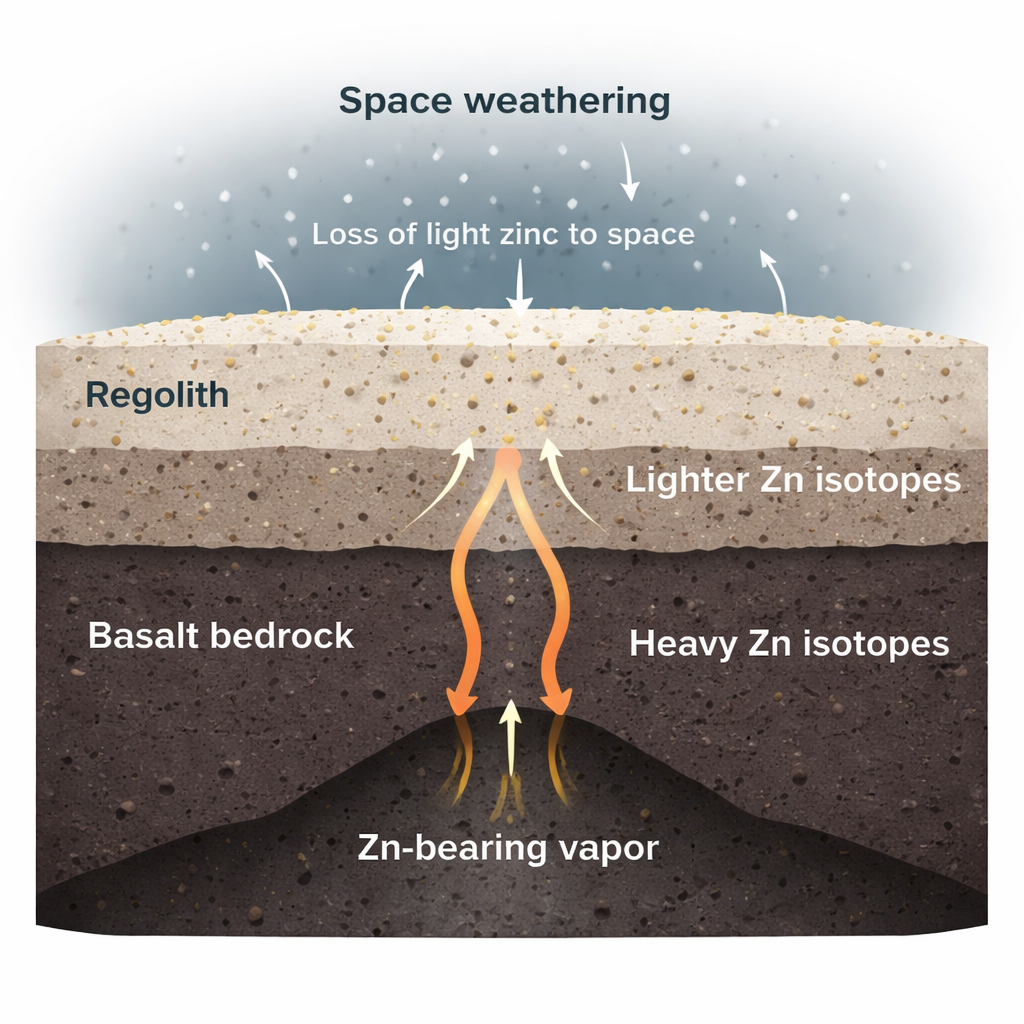
The real surprise lies in the surrounding soil. On older Apollo sites, surface regolith is typically richer in heavy zinc isotopes than the underlying rocks. That pattern is explained by “space weathering”: a slow sandblasting by micrometeorites and the solar wind that tends to knock lighter isotopes off into space over very long timescales. At the Chang’e‑5 site, however, the soils are lighter in zinc isotopes than the basalts, and this lighter signature is found from the surface down to 65 centimeters depth, with almost no change with depth. Other indicators show that this regolith is relatively immature: it is thin, has experienced fewer impacts, and contains less meteoritic contamination than typical Apollo soils. Calculations confirm that micrometeorite bombardment and implanted particles cannot by themselves create the observed combination of higher zinc content and lighter isotopes.
A Gentle Late Breath of Lunar Volcanism
To reconcile these observations, the authors propose that the soils at the Chang’e‑5 site have been overprinted by zinc-rich volcanic vapors. During modest volcanic or fumarolic activity about two billion years ago, zinc-bearing gases escaped from magma at relatively low temperatures compared with impact events. As these vapors rose and cooled, they condensed as particles with light zinc isotopes, settling onto and mixing into the regolith. Simple mixing models show that adding only a few tens of parts per million of such condensates can explain both the elevated zinc contents and the lighter isotopic values in the Chang’e‑5 soils, without erasing the heavy signature in the underlying basalt. Unlike the earlier, more dramatic eruptions that may have briefly wrapped the Moon in a thin atmosphere, these younger events likely released gases into near-vacuum conditions, leading to “excess degassing” where vapor escaped and recondensed locally rather than forming a global envelope.
What This Means for the Moon’s Story
Taken together, the Chang’e‑5 measurements reveal a two-stage tale. First, the Moon’s interior was strongly depleted in volatile elements during its violent birth and early magma ocean phase, leaving a uniformly heavy zinc fingerprint that is still seen in young basalts. Later, relatively gentle volcanic outgassing quietly coated the surface with a thin layer of zinc-rich condensates carrying lighter isotopes, especially in regions that have not been heavily reworked by impacts. For a lay reader, the key message is that even today’s quiet, airless Moon still preserves records of both its catastrophic origin and its fading volcanic “breaths,” written in the tiny isotopic differences of a single element.
Citation: Wang, Z., Tang, H., Zhang, Y. et al. Zinc isotopes record lunar magmatic outgassing and surface processes in different Chang’e-5 samples. Commun Earth Environ 7, 185 (2026). https://doi.org/10.1038/s43247-026-03215-6
Keywords: Moon formation, lunar volcanism, Chang’e-5, zinc isotopes, space weathering