Clear Sky Science · en
Silicic magma reservoir anisotropy persists through protracted crystallization and low strain rates
Why hidden magma matters
Far beneath some of the world’s most dramatic volcanic landscapes, vast bodies of hot, slowly solidifying rock quietly evolve for hundreds of thousands of years. These hidden magma reservoirs influence future eruptions, shape geothermal resources, and store the heat that drives hot springs. This study peers beneath Valles Caldera in New Mexico—today a calm, forested basin—to ask a deceptively simple question: does the underground magma still keep the organized, sheet-like structure seen beneath more restless volcanoes such as Yellowstone?
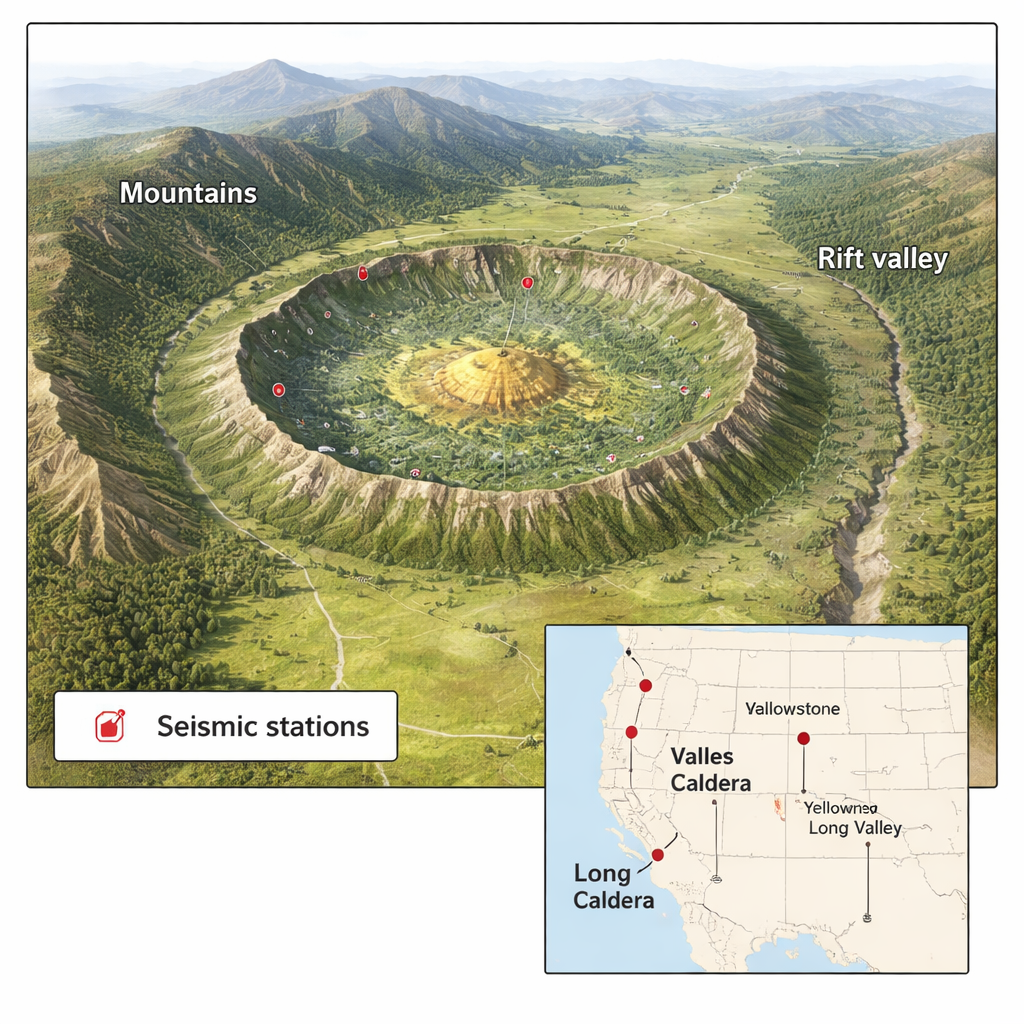
A quiet volcano with a fiery past
Valles Caldera formed through two enormous explosions over a million years ago, each ejecting hundreds of cubic kilometers of ash and lava. Afterward, smaller eruptions built domes of sticky, silica-rich lava around the caldera’s inner ring. Geological drilling and temperature measurements suggest that since about half a million years ago, the underground magma body has been cooling and crystallizing, while surface activity and ground deformation have nearly stopped. Compared with places like Yellowstone and Long Valley, Valles shows very low earthquake activity and almost no measurable crustal stretching today, yet boreholes still encounter unusually high temperatures, hinting that melt remains at depth.
Listening for structure with earthquake “echoes”
Because we cannot see through kilometers of rock, the authors used seismic waves—vibrations that travel through the Earth—to map the subsurface. They deployed nearly 200 temporary, suitcase-sized seismometers across the caldera and combined their recordings with data from permanent stations. By cross-correlating the background seismic “noise” and measuring how different types of surface waves (Rayleigh and Love waves) slow down or speed up beneath various locations, they constructed a three‑dimensional picture of how fast shear waves travel in all directions. In simple terms, slower speeds point to hotter, more melt-rich rock, while differences between horizontal and vertical wave speeds reveal whether material is arranged in layers or other preferred shapes.
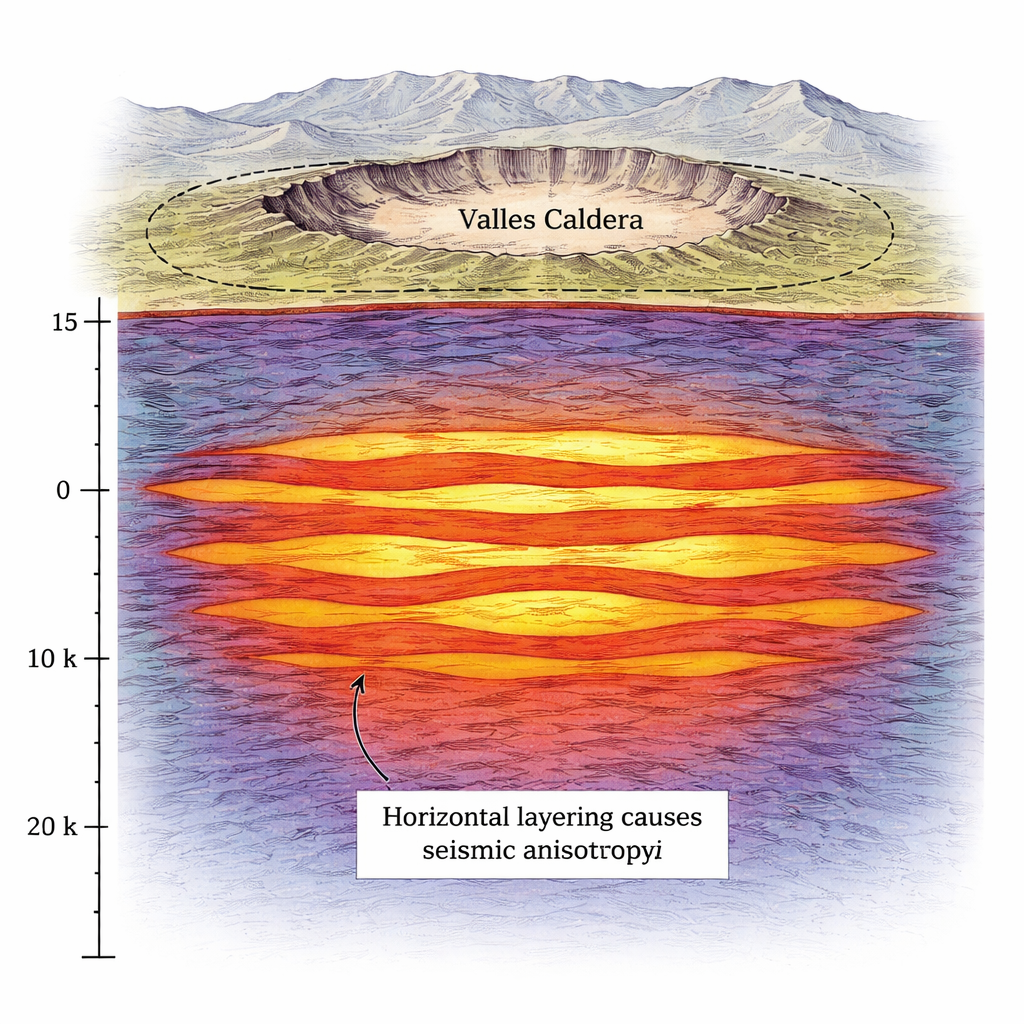
A stacked deck of magma sheets
The seismic images show an especially slow zone directly beneath the caldera from roughly 2 to 15 kilometers depth. Within this zone, shear waves traveling with vertical motion are more strongly slowed than those with horizontal motion, a pattern the authors interpret as “radial anisotropy” produced by many thin, horizontal layers. Modeling indicates that this volume is best explained by a complex of stacked, lens-like magma sheets, or sills, interleaved with more solid rock. The melt-rich layers appear to occupy about half to two‑thirds of the reservoir volume, with individual layers too thin to resolve directly but collectively forming a thick, horizontally banded package. Calculations using rock physics suggest that these melt-rich layers still contain roughly 17–24% liquid magma, even though the overall reservoir has been crystallizing for hundreds of thousands of years.
Long-lived, slow-moving magma
Although the estimated total melt—on the order of one to two hundred cubic kilometers—could exceed the volume of all post-caldera eruptions at Valles, the magma is probably too sluggish to erupt easily. The inferred high viscosity means the remaining melt behaves more like a stiff paste than a flowing liquid, confined within many separate layers at temperatures just above the solidification point. Over time, crystals settle and the crystal-rich framework slowly compacts, squeezing melt into sub-horizontal zones and reinforcing the layered structure. Latent heat released as the last bits of melt crystallize helps keep the reservoir warm for a very long time, even without significant new magma being supplied from below.
A common pattern beneath very different volcanoes
One of the most striking outcomes is that Valles, despite its low present-day strain and quiet seismic behavior, shows a similar layered, sill-like reservoir structure to far more active systems such as Yellowstone and Toba. This suggests that the organization of large, silica-rich magma bodies is governed mainly by internal magmatic processes—like repeated injections of new melt, crystal settling, and slow compaction—rather than by the surrounding tectonic stresses alone. For non-specialists, the takeaway is that a volcano can be outwardly peaceful while still harboring a large, long-lived, but mostly sluggish magma system. Understanding this “quiet organization” helps refine how scientists assess volcanic hazards and the life cycles of giant volcanic systems over hundreds of thousands to millions of years.
Citation: Song, W., Schmandt, B., Wilgus, J. et al. Silicic magma reservoir anisotropy persists through protracted crystallization and low strain rates. Commun Earth Environ 7, 186 (2026). https://doi.org/10.1038/s43247-026-03214-7
Keywords: Valles Caldera, magma reservoir, seismic anisotropy, silicic volcanism, crustal tomography