Clear Sky Science · en
Dislocation creep may control bridgmanite deformation in the Earth’s lower mantle
Why the Deep Earth Behaves Differently
Far beneath our feet, at depths of hundreds to more than a thousand kilometers, rocks in Earth’s mantle slowly flow over millions of years. This deep motion drives plate tectonics, shapes volcanic activity, and influences how earthquakes’ seismic waves travel through the planet. Yet seismic measurements have revealed a puzzle: around sinking tectonic plates, waves behave as if the rock is directionally "stretched," but across most of the lower mantle they travel almost the same in every direction. This study shows that a single key mineral, bridgmanite, can naturally explain both behaviors—depending mainly on temperature.
The Most Common Deep-Earth Mineral
Bridgmanite is thought to be the most abundant mineral in Earth’s lower mantle, making up roughly three-quarters of the rock in this region. It is not evenly strong in all directions at the crystal scale: depending on how its tiny crystals are aligned, seismic waves may move faster one way than another. When many grains share a similar orientation—a pattern called a preferred orientation—the rock as a whole becomes directionally dependent, or anisotropic, to seismic waves. For years, scientists debated whether the nearly isotropic lower mantle meant that bridgmanite there did not deform by the crystal-sliding process known as dislocation creep, which tends to create preferred orientations.
Recreating the Deep Mantle in the Lab
To tackle this problem, the researchers compressed synthetic bridgmanite samples to about 25 gigapascals—pressures similar to those near 700–800 kilometers depth—and heated them to 1700–2100 kelvin. They tested both iron-free and iron-bearing compositions, matching what is expected in real mantle rocks. Using special presses, they squeezed and sheared the samples at controlled rates, then examined how the tiny crystal grains had rotated and recrystallized. High-energy X-ray diffraction, performed at a synchrotron facility, allowed them to map out how the crystal lattices were oriented before and after deformation. 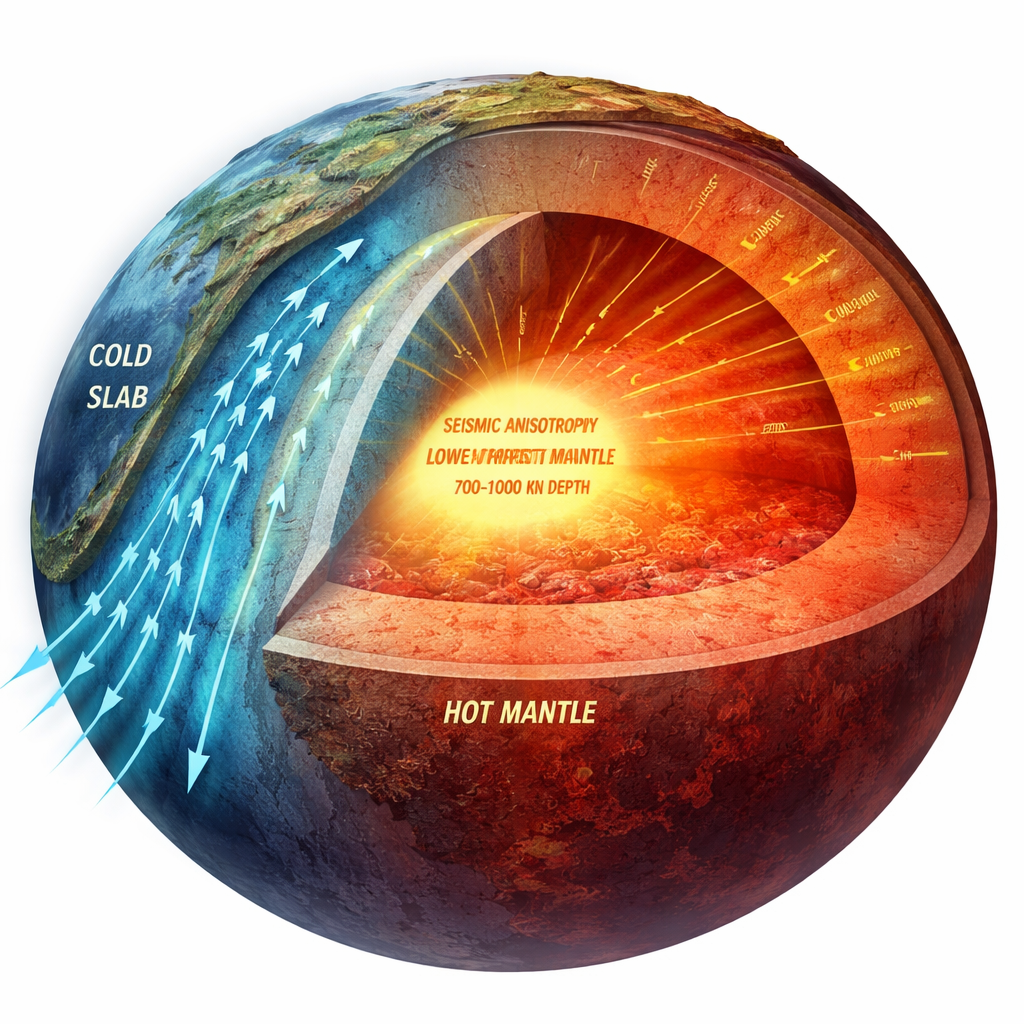
A Temperature Switch in Crystal Alignment
The experiments revealed a clear temperature-driven switch in how bridgmanite crystals line up as they deform. At lower temperatures (below about 1800 kelvin), the crystals develop a strong, organized fabric: particular crystal directions become aligned with the applied stress, creating a pattern that produces strong directional differences in wave speeds. At higher temperatures (around 1900–2100 kelvin), the crystals reorganize into a different alignment pattern that, under horizontal shearing, leads to much weaker seismic anisotropy—almost isotropic behavior—even though the deformation mechanism is still dislocation creep. Importantly, this transition appeared in both iron-poor and more iron-rich samples, suggesting that temperature, not chemistry, is the master control under these conditions.
From Crystal Fabrics to Seismic Waves
Using the measured crystal orientations together with known elastic properties of bridgmanite, the team calculated how seismic P-waves and S-waves would travel through these fabrics. They found that the low-temperature fabric produces noticeable azimuthal anisotropy: waves can travel measurably faster along directions tied to the shear flow, especially in horizontally sheared regions such as those beneath subducting slabs. In contrast, the high-temperature fabric under similar shear produces only very subtle differences in wave speed, yielding nearly isotropic signatures. This provides a natural explanation for why strong seismic anisotropy is seen beneath cold subduction zones, while the surrounding, warmer lower mantle appears almost isotropic, without needing to invoke a completely different style of deformation. 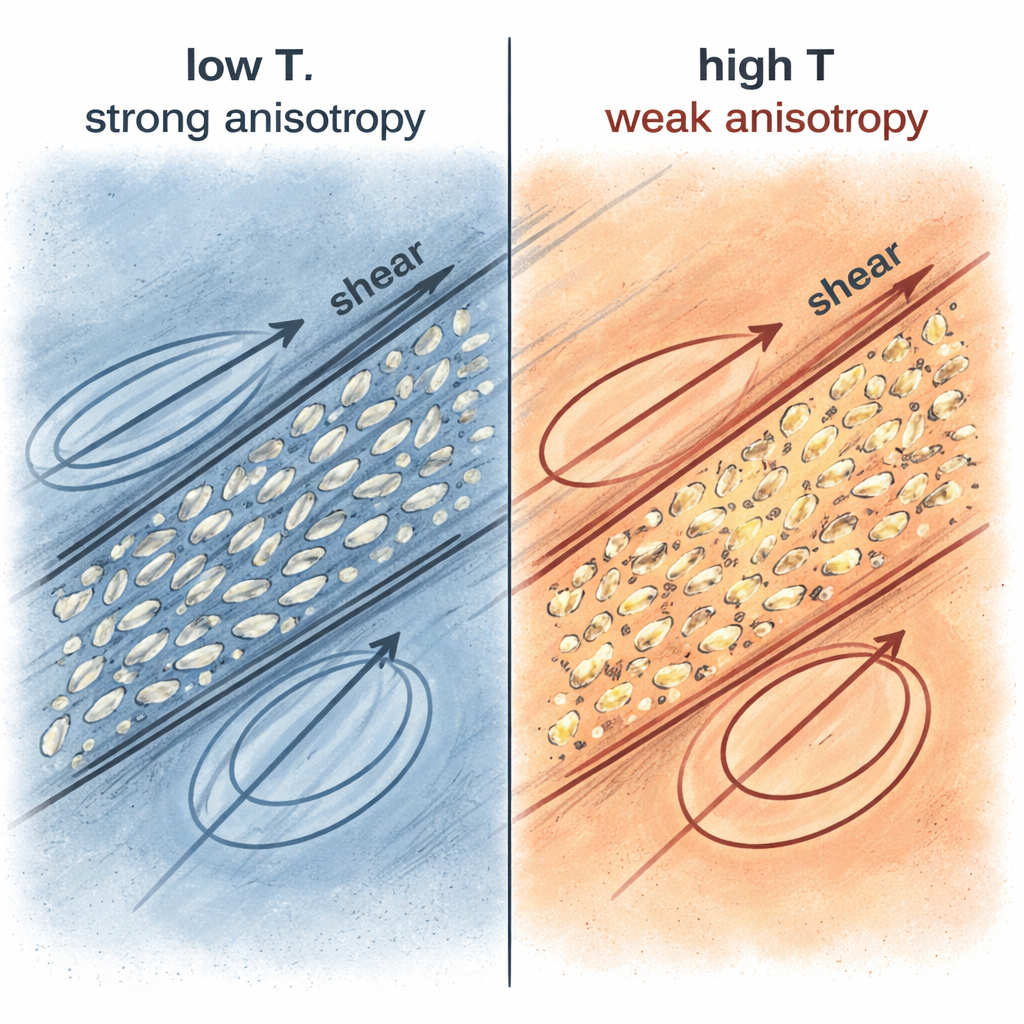
Rethinking the Deep Mantle’s Flow
Putting these results together, the authors propose that dislocation creep in bridgmanite may dominate deformation throughout much of the lower mantle. In cold regions near subducting slabs, the low-temperature crystal fabric leads to strong, observable anisotropy, matching many regional seismic studies. In warmer, deeper, or more distant regions, the high-temperature fabric makes the mantle look nearly isotropic to seismic waves even though the crystals are still aligned and the rock is still flowing. This means that the absence of strong anisotropy does not necessarily mean an absence of crystal alignment or a switch to a different creep process. Instead, a temperature-controlled change in bridgmanite’s microscopic behavior can unify previously conflicting observations and offers a clearer picture of how our planet’s deep interior moves and evolves over geologic time.
Citation: Guan, L., Yamazaki, D., Tsujino, N. et al. Dislocation creep may control bridgmanite deformation in the Earth’s lower mantle. Commun Earth Environ 7, 183 (2026). https://doi.org/10.1038/s43247-026-03212-9
Keywords: Earth lower mantle, bridgmanite, seismic anisotropy, mantle convection, dislocation creep