Clear Sky Science · en
International financial support to achieve the net-zero emissions goal could help resolve equity trade-off between developing and developed countries
Why this global climate money question matters to you
Countries around the world have promised to bring their greenhouse gas emissions down to “net zero” within a few decades. That goal is central to limiting global warming to about 2 °C, but there is a catch: cutting emissions costs money, and it does not cost everyone the same. This paper asks a deceptively simple question with big real‑world consequences: is it fair to expect poorer countries to pay as much, in relative terms, as richer ones to hit global climate targets—and if not, what is the smarter way to share the bill?
The race to net zero and the fairness problem
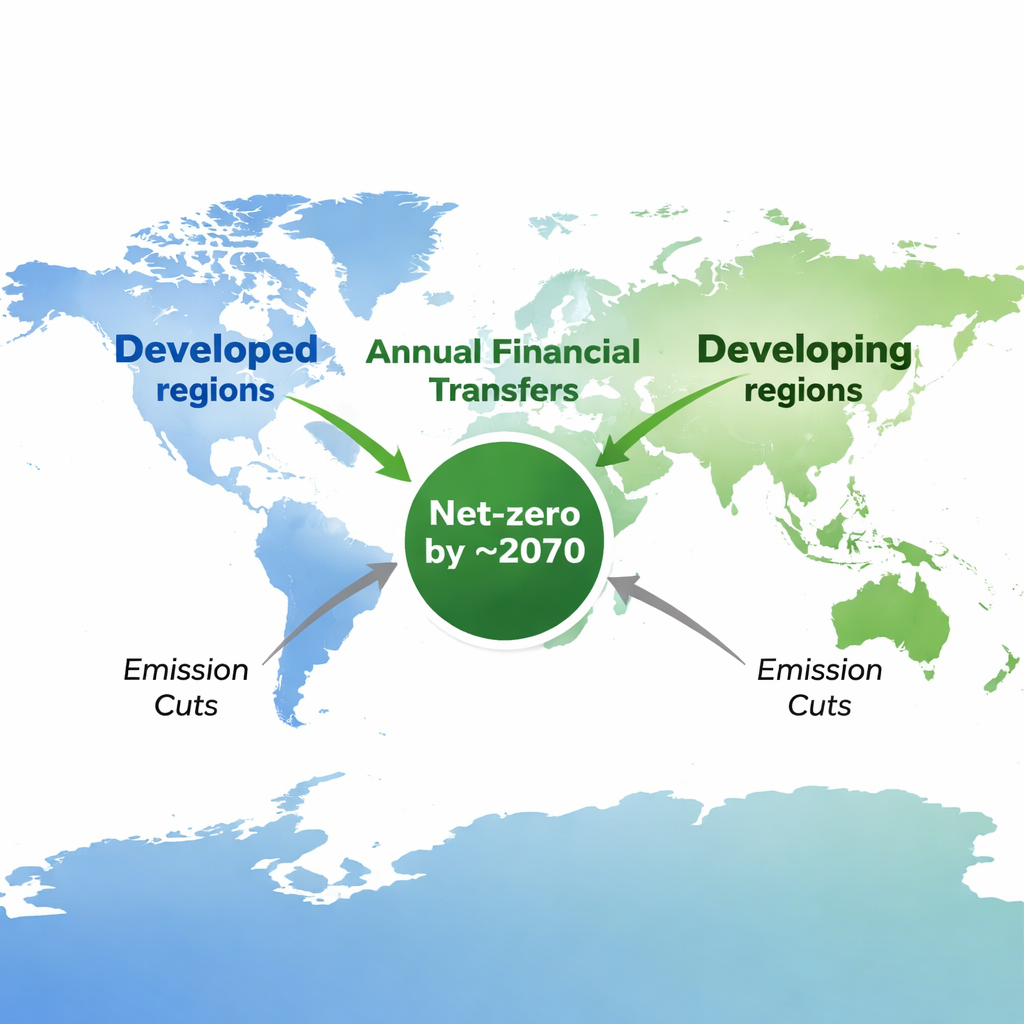
More than 100 countries have now announced net‑zero or carbon‑neutrality goals, covering over 80% of today’s greenhouse gas emissions. These pledges, when combined, are probably strong enough to keep warming near 2 °C, though not the safer 1.5 °C level. Yet the Paris Agreement also says climate action should respect “common but differentiated responsibilities,” meaning rich and poor countries are not starting from the same place. Many existing studies on fairness focused on splitting up a limited global carbon budget in ethical or legal terms. This paper instead looks at equity through a very concrete lens: How much economic damage do different net‑zero strategies cause in developing versus developed regions, and how might we reduce that burden on poorer countries?
Three different roads to the same climate destination
The authors use a global economic–climate model to compare three main scenarios that all keep warming around 2 °C. In the first, every country follows its own announced net‑zero plan and pays its own way, with no extra help crossing borders. In the second, developing countries stop at their existing near‑term pledges, while developed countries go further, creating big “net‑negative” emissions—pulling more carbon dioxide out of the air than they emit—to cancel out the remaining pollution from poorer regions. In the third, all countries still reach net zero, but rich countries send money to poorer ones so that the economic pain in developing regions does not rise beyond what they would face under their current, weaker pledges. The model also compares these options to a more theoretical world with a single global carbon price and no explicit financial support.
Who pays, and how much it hurts
On paper, all of these paths deliver similar total global climate benefits and similar overall economic costs—about a 2–3% loss in global household consumption (a proxy for living standards) over the century. But the distribution of those costs is very different. If each country simply pursues net zero without help, developing regions face the highest burden, losing nearly 5% of consumption by the end of the century. By contrast, if developed countries either send money or take on extra physical cuts, losses in developing regions stay below about 2%. The model finds that around 2.7 trillion US dollars per year in international transfers—roughly 5% of household consumption in rich countries—is enough to protect poorer countries from large extra losses. That is an order of magnitude larger than current climate finance promises, yet still far cheaper for rich countries than trying to offset all remaining emissions elsewhere through extreme carbon removal.
The limits of relying on giant carbon‑sucking machines
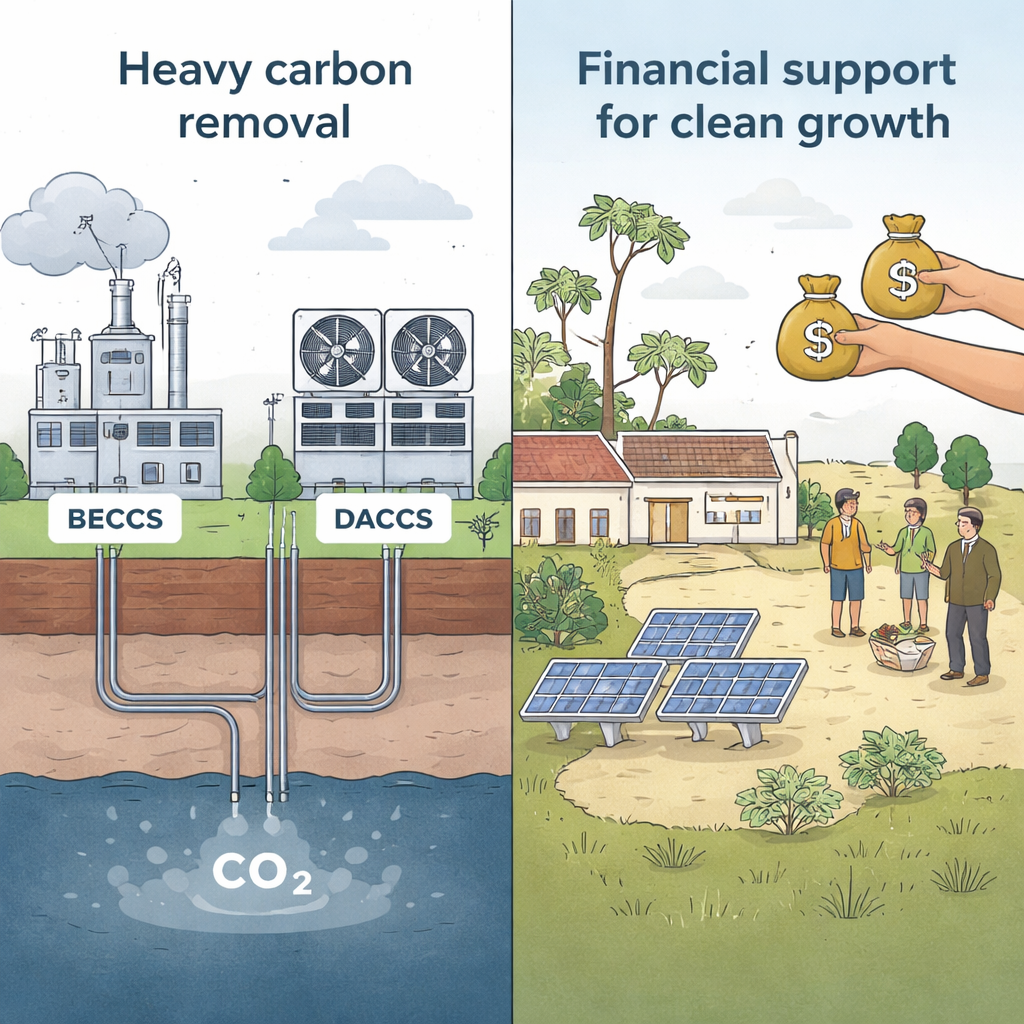
Making wealthy countries responsible for enormous net‑negative emissions sounds appealing from a moral standpoint, but the study shows it quickly becomes technically and economically daunting. In the scenario where rich countries offset developing‑country emissions instead of funding them, carbon dioxide removal in developed regions would need to reach about 26 billion tonnes per year late in the century. That implies vast deployment of technologies such as bioenergy with carbon capture and storage (BECCS) and direct air capture, along with huge underground storage capacity and massive new energy systems. These requirements far exceed typical estimates in other global scenarios and could strain land, water, biodiversity, and power grids. By contrast, the financial‑support scenario reaches similar climate goals with much lower dependence on such large‑scale carbon‑sucking infrastructure.
Human impacts: poverty, hunger, and inequality
Beyond abstract percentages, the authors examine how each option affects poverty, hunger, and income inequality. If every country pushes hard for net zero without support, tens of millions more people in developing regions could be pushed into extreme poverty or face higher risk of hunger by mid‑century, as higher energy and food prices bite. The scenario where rich countries over‑deliver on carbon removal offers the best poverty and hunger outcomes but at the cost of unrealistic technical demands. Financial support lands in the middle: it substantially reduces additional poverty and hunger compared with no support, even though higher carbon prices are still needed in poorer countries to achieve net zero. Overall, the study suggests that focusing only on tonnes of emissions, without looking at who bears the economic and social costs, can give a misleading picture of climate “fairness.”
What this means for climate politics and everyday lives
For a non‑specialist reader, the main message is that how we pay for climate action matters as much as how fast we cut emissions. The authors conclude that very deep net‑negative emissions in rich countries are likely unrealistic and risky as the main tool for correcting global inequities. Instead, a combination of strong domestic cuts everywhere and substantial, sustained financial support from developed to developing regions is a more practical and more just route to net zero. That support—far above today’s pledges—would help poorer countries build cleaner energy systems and protect vulnerable people from higher prices, without demanding impossible levels of carbon removal technology. In short, if the world wants to tackle climate change without sacrificing development in poorer regions, moving money may be wiser than betting on giant machines to clean up the atmosphere later.
Citation: Fujimori, S., Fan, L., Zhao, S. et al. International financial support to achieve the net-zero emissions goal could help resolve equity trade-off between developing and developed countries. Commun Earth Environ 7, 118 (2026). https://doi.org/10.1038/s43247-026-03208-5
Keywords: net-zero emissions, climate finance, developing countries, carbon removal, climate equity