Clear Sky Science · en
Extraordinarily long duration of Eocene geomagnetic polarity reversals
When Earth’s Magnetic Shield Flips
Earth’s magnetic field acts like an invisible shield, steering away much of the high‑energy radiation that streams from the Sun and space. From time to time, this shield flips so that north and south trade places. For decades, scientists thought these flip events were fairly quick, wrapping up in about ten thousand years or less. This study shows that some ancient flips, 40 million years ago during the Eocene, lasted far longer—tens of thousands to over seventy thousand years—raising new questions about how our planet’s magnetic engine works and what such prolonged weak‑field periods might mean for life at the surface.
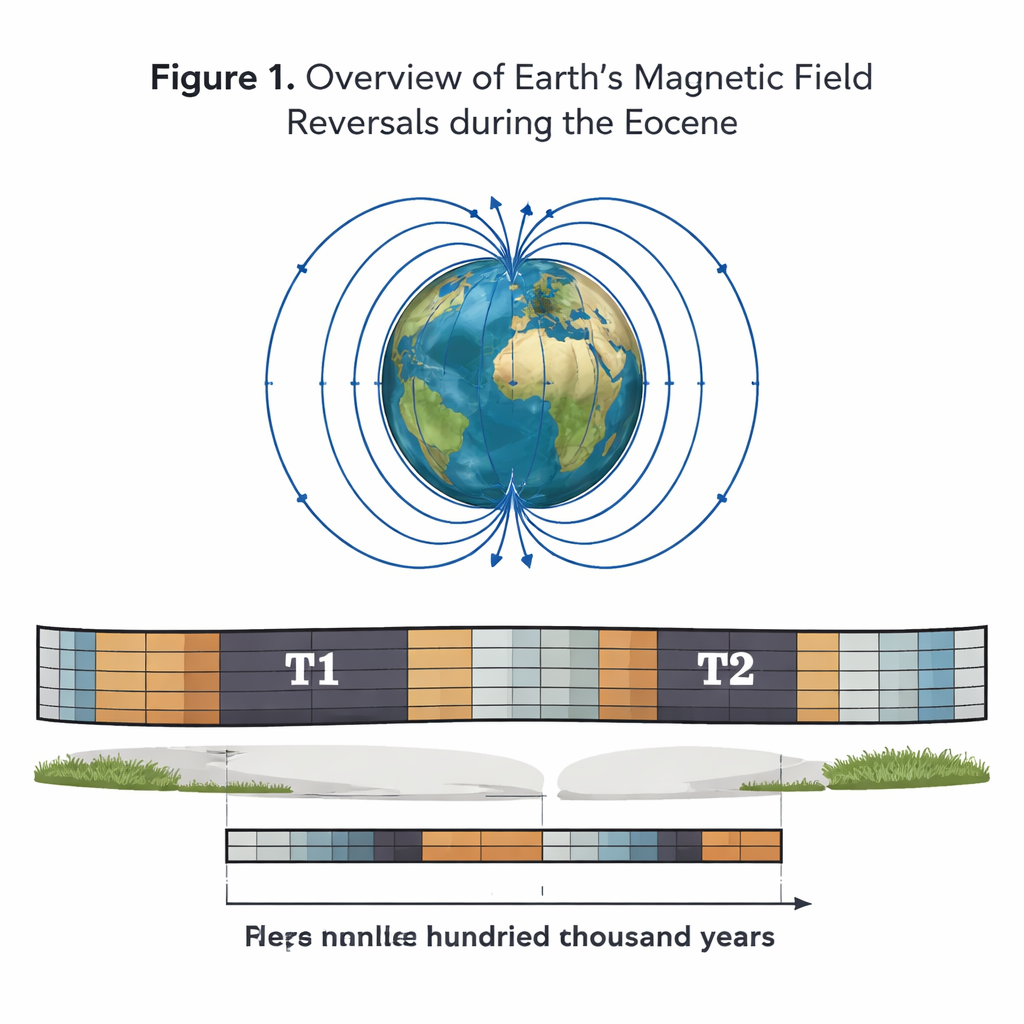
Digging Magnetic History from the Deep Sea Floor
The researchers turned to mud buried deep beneath the North Atlantic, drilled during an ocean‑going expedition. These seafloor sediments slowly piled up, layer by layer, about 2.4 centimeters every thousand years. Tiny crystals of magnetic minerals within each layer lined up with the direction of Earth’s magnetic field as they settled, freezing a record of the field’s behavior through time. By carefully measuring changes in the chemistry and brightness of the sediment, the team built a highly accurate timeline for the middle Eocene, between roughly 38 and 43 million years ago. This allowed them to match subtle shifts in the magnetic record to precise ages, something that is rarely possible so far back in Earth’s history.
Two Flips That Took an Exceptionally Long Time
Within this carefully dated sediment stack, the scientists identified two full magnetic polarity transitions—times when the field shifted from one stable state to the opposite. Each transition is visible as a long stretch during which the apparent magnetic pole wanders away from either geographic pole and the field strength drops. For the first event, the directional flip itself lasted about 18,000 years. For the second, it stretched over a staggering 70,000 years. During these intervals, measurements show that the field remained unusually weak for tens of thousands of years, rather than snapping back quickly. These durations are far longer than the roughly 10,000‑year benchmark inferred from younger, better‑known reversals and demonstrate that Earth’s magnetic behavior in the distant past could be much more drawn out and complicated.
A Chaotic Dance of the Magnetic Poles
Closer inspection reveals that the longer Eocene reversal was not a simple one‑way trip from one polarity to the other. Instead, the magnetic field went through multiple stages: a "precursor" where it first started to depart from its usual state, a main flip, and then several "rebound" episodes in which the field partly recovered and then faltered again before finally settling. This pattern resembles a chaotic dance of the magnetic poles rather than a clean, single crossing of the equator. Such complex behavior has been hinted at in records of more recent reversals, but the Eocene case stands out for how long the field remained in this unstable, weak, and wandering condition.
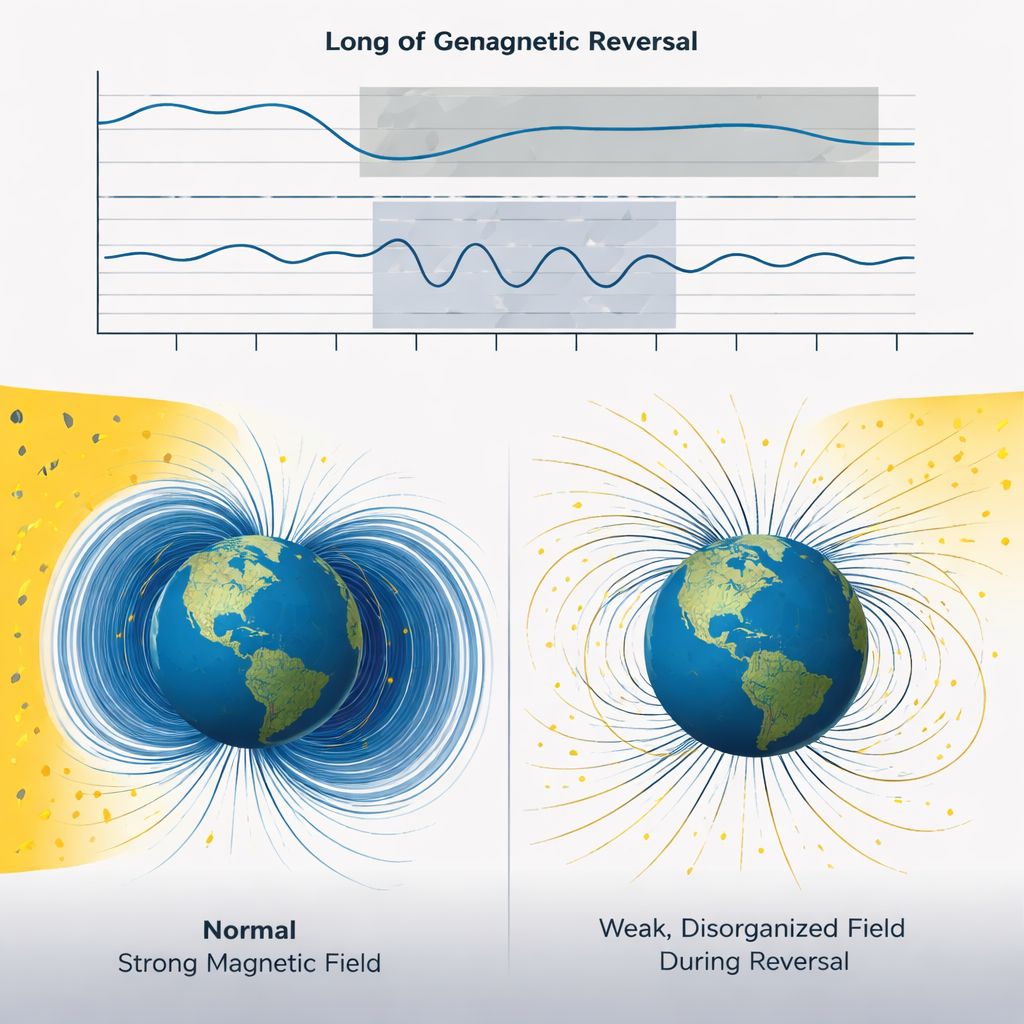
Testing Ideas with Virtual Earths in a Computer
To understand whether these unusually long transitions are odd exceptions or part of normal behavior, the team compared their findings with computer models of Earth’s core. These "geodynamo" simulations mimic how the molten, metal‑rich outer core moves and generates a magnetic field. When run for long periods, the models produce hundreds of polarity flips. The lengths of simulated reversals vary widely and follow a skewed pattern in which most are short but some are very long. When the model times are converted to years using reasonable assumptions, the longest simulated flips last from about 30,000 to more than 100,000 years—squarely in the range of the long Eocene events. This agreement suggests that a wide spread in reversal duration is a built‑in feature of the magnetic engine, not a quirk of the rocks.
What Long Weak Fields Could Mean for Life
For people living on the surface, the magnetic field’s strength matters more than the exact position of magnetic north. During the long Eocene reversals described here, Earth’s shield weakened for tens of thousands of years, allowing more high‑energy particles from the Sun and space to reach the atmosphere. That kind of prolonged exposure could have altered chemical cycles, affected climate‑related processes, or stressed living organisms, much as has been proposed for even older episodes near the dawn of complex animal life. This study shows that slow, drawn‑out magnetic flips have happened before and could happen again, deepening our understanding of the restless heart of our planet and its influence on the environment through geologic time.
Citation: Yamamoto, Y., Boulila, S., Takahashi, F. et al. Extraordinarily long duration of Eocene geomagnetic polarity reversals. Commun Earth Environ 7, 180 (2026). https://doi.org/10.1038/s43247-026-03205-8
Keywords: geomagnetic reversals, Earth magnetic field, Eocene geology, paleomagnetism, geodynamo simulations