Clear Sky Science · en
2023-2024 El Niño amplifies record sea level surges in African marine domains
When Distant Climate Swings Lift African Shores
Sea level is not rising smoothly like water in a bathtub. Around Africa, the ocean is climbing faster than the global average, and powerful climate events are now giving it sudden extra jolts. This study reveals how the 2023–2024 El Niño, combined with decades of ocean warming, pushed sea levels around the continent to record heights, raising the risks of flooding, erosion, and damage to the lives and economies of millions of coastal residents.
Rising Waters Around an Exposed Continent
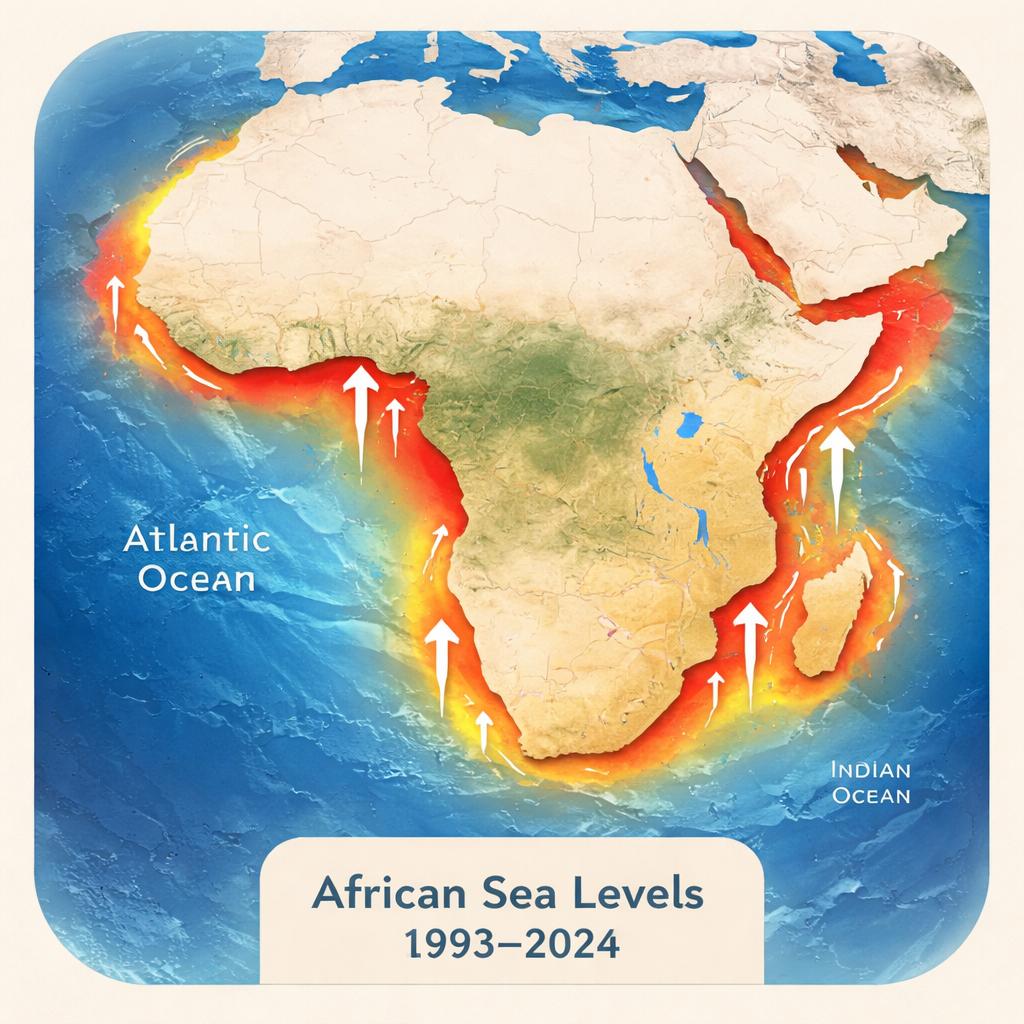
Using three decades of satellite measurements from 1993 to 2024, the authors tracked how sea level has changed across all African marine regions, from the Atlantic and Indian Oceans to the Mediterranean and Red Seas. They found that average sea level around Africa has risen by about 11 centimeters over this period and is now increasing at roughly 3.5 millimeters per year—faster than the global mean. In the Western Indian Ocean and Eastern Central Atlantic, the rise and its acceleration are even stronger, turning low-lying deltas, island nations, and crowded port cities into emerging hot spots of risk. These long-term trends reflect both the warming and expansion of seawater and the addition of water from melting ice sheets and glaciers.
El Niño’s Record-Breaking Push
On top of this background rise came the 2023–2024 El Niño, a natural climate swing born in the tropical Pacific that reverberates around the globe. During this event, the authors detected the largest sea level surge in the African record, even after stripping away the long-term trend. The ocean surface around Africa reached its highest levels ever measured by satellites, with anomalies topping 9 centimeters in 2024 and more than a quarter of the total rise since 1993 occurring in just the last two years. Sea levels during this episode climbed especially high in the Western Indian Ocean, the Gulf of Guinea, the Mediterranean, and the Red Sea, turning storm surges and high tides into unusually destructive events.
A Warmer, Thicker Ocean Surface
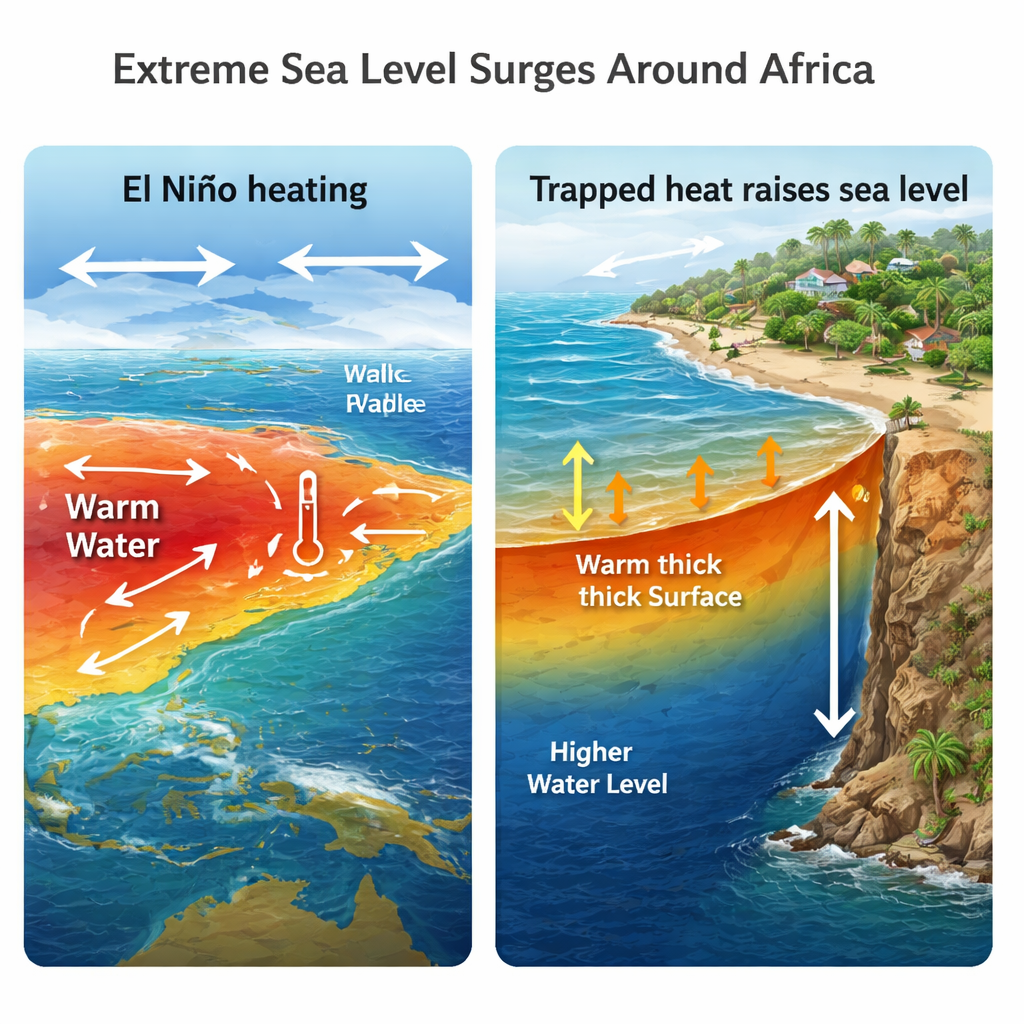
The study shows that this exceptional surge was driven mainly by heat, not just by extra water. As the upper few hundred meters of the ocean warmed to record levels, the water expanded and took up more space—a process known as thermal expansion. During the 2023–2024 El Niño, sea surface temperatures around much of Africa were 1 to 2 degrees Celsius above normal. At the same time, changes in winds suppressed the usual upwelling of cooler, deeper water along several key coasts, trapping warmth near the surface. Measurements of ocean heat content and density structure reveal that the upper ocean became unusually stratified, forming a thick, warm “lid” that stored heat and magnified sea level rise. In some regions, more than 70 to 80 percent of the sea level change during this event came from this thermal swelling alone.
Climate Rhythms Working in Concert
El Niño was not acting alone. The authors examined how several large-scale climate patterns—the Indian Ocean Dipole, Atlantic Niño, and Tropical North Atlantic, among others—combined with El Niño to shape sea levels around Africa. In 2023–2024, many of these patterns lined up in their positive, warming phases at the same time, effectively preconditioning the ocean for an outsized response. Statistical analyses show that while El Niño explains only a modest share of the long-term variance in sea level, it can account for a much larger fraction of the year-to-year swings once the background rise is removed. The study also detects a clear “regime shift” around 2009, after which sea levels began rising much faster, suggesting that even moderate future El Niño events may now produce disproportionate impacts in a warmer world.
Human Stakes on a Narrow Edge
For Africa’s 38 coastal nations, these physical changes are not an abstract concern. Many of the regions where sea level is rising fastest are also home to dense populations, subsiding land, and economies that depend heavily on fisheries and coastal ecosystems. The overlapping pressures of long-term sea level rise, episodic El Niño surges, sinking deltas, and marine heatwaves threaten infrastructure, food security, and livelihoods—from West African cities such as Lagos and Accra to the low-lying islands of the Western Indian Ocean. The authors argue that responding to this new, more hazardous sea level regime will require better monitoring of the ocean and land, early-warning systems that blend scientific and local knowledge, and adaptation plans that anticipate not just a steady rise, but also the sharp pulses delivered by a warming climate system.
Citation: Kemgang Ghomsi, F.E., Stroeve, J., Crawford, A. et al. 2023-2024 El Niño amplifies record sea level surges in African marine domains. Commun Earth Environ 7, 179 (2026). https://doi.org/10.1038/s43247-026-03204-9
Keywords: sea level rise, El Niño, African coasts, ocean warming, climate extremes