Clear Sky Science · en
The growing threat of spatially synchronized dry-hot events to global ecosystem productivity
Why hotter, drier spells are everyone’s problem
From supermarket prices to the stability of global food supplies, what happens to crops in distant fields can shape everyday life. This study looks at a worrying new pattern: not just droughts or heatwaves alone, but weeks when it is both unusually dry and unusually hot in many of the world’s key farming regions at the same time. These “dry–hot” events are becoming more frequent, more connected across continents, and more damaging to plants’ ability to grow and absorb carbon, with particularly strong impacts on staple crops like wheat and maize.
When heat and drought strike together
Plants can cope, up to a point, with either dryness or heat. But when both arrive together, the stress multiplies. To save water, crops tend to close the tiny pores on their leaves, cutting off carbon dioxide needed for growth while their internal machinery still burns energy. At the same time, tissues are directly damaged by high temperatures and lack of moisture. The result is a sharp drop in photosynthesis, poor nutrient uptake, and in many cases lasting harm to yields. The authors focus on weeks when rainfall is unusually low and temperatures unusually high, defining these compound dry–hot events and tracking where and when they occur across the globe from 1979 to 2022 using observation-based datasets.
From local disasters to synchronized shocks
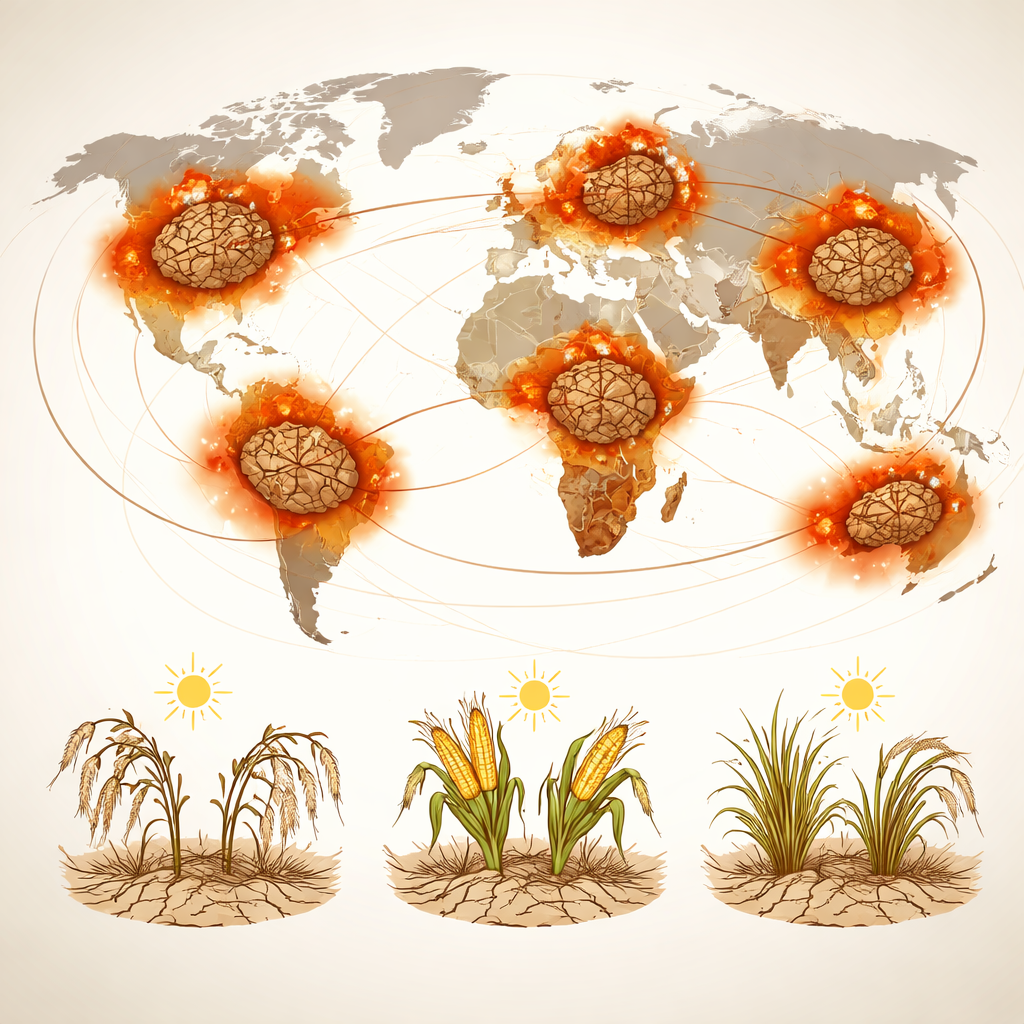
Previous work often examined extreme events one region at a time. Here, the authors ask a broader question: how often do multiple regions suffer dry–hot events in the same week? Using 44 large land regions defined by the Intergovernmental Panel on Climate Change, they treat a week as “regional dry–hot” if a substantial share of that region is affected. They then identify weeks when several regions are hit together, and use a statistical measure to test whether this synchrony is higher than would be expected by chance. The analysis reveals that not only do neighboring regions often share dry–hot extremes, but distant areas—such as South America and central Africa, or European and South Asian breadbaskets—also tend to experience them simultaneously, linked by atmospheric wave patterns and climate modes like El Niño.
A ten-fold rise in widespread events
The most alarming change appears in how these events are distributed. Over the past four decades, weeks with dry–hot conditions confined to just one or two regions have become less common. At the same time, weeks in which five or more regions are hit together have increased nearly ten-fold, from only a couple of weeks per year in the 1980s to nearly half the year in the most recent decade. This shift is driven primarily by the spread of heatwaves, while the overall area in drought has stayed roughly steady. By repeating the analysis with long-term warming removed from the temperature data, the authors estimate that about 80–85% of the increase in synchrony since 2000 can be attributed directly to global warming. In a cooler, detrended world, dry–hot events still occur, but are less coordinated across regions.
What this means for crops and the planet’s carbon balance
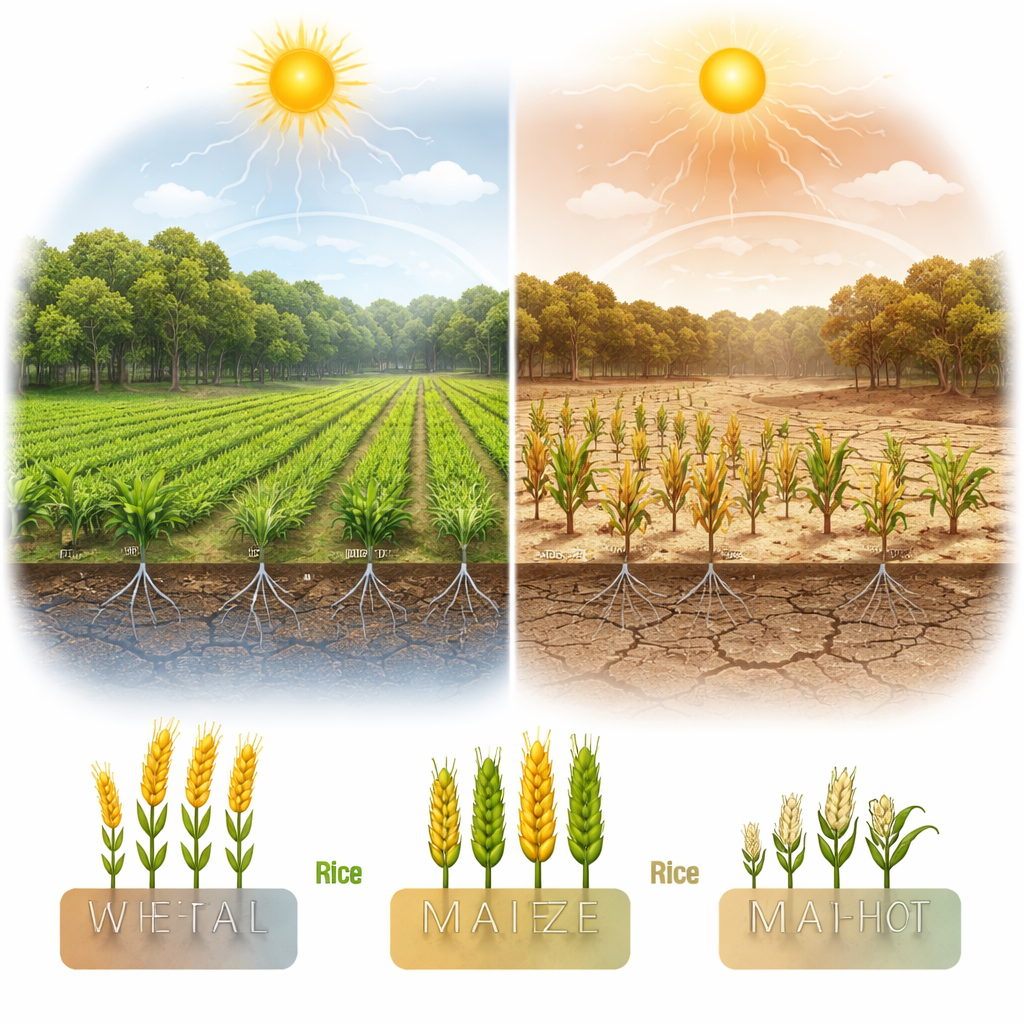
To move beyond counting events, the study links synchronized dry–hot weeks to changes in plant growth. Using satellite-based estimates of gross primary productivity—the rate at which plants convert sunlight and carbon dioxide into biomass—the authors show that dry–hot weeks almost always mean losses, and that losses roughly double when many regions are hit at once compared with when events are confined. On average, a single widespread week trims around three-quarters of a percent off global plant productivity, equivalent to roughly 2 million tonnes of carbon per day. Croplands suffer about 50% more than the global land average, with grasslands especially hard hit and tropical forests somewhat buffered by deeper roots.
Staple crops under growing strain
For agriculture, the picture is even more troubling. By combining maps of where wheat, maize and rice are grown with data on dry–hot weeks, the authors show that wheat is the most vulnerable: for a given increase in affected area or number of regions, wheat’s productivity and yields drop more steeply than those of maize or rice. This reflects, among other factors, an increase in long-lasting dry–hot spells during key stages of wheat’s growing season, especially in Eastern Europe and other major producers. Regional “breadbasket” analyses reveal that European and Australian wheat and maize fields lose productivity at rates up to twice the global average when dry–hot conditions spread. In heavily irrigated yet frequently stressed Asian croplands, losses are also substantial, while some North and South American regions appear partly shielded by better water management.
Why this matters for food security and climate
In isolation, a bad harvest in one region can sometimes be cushioned by imports from elsewhere. But when many breadbaskets suffer at once, trade can no longer fully smooth out shortages, and price spikes and food insecurity become more likely. At the same time, big synchronized drops in plant growth mean less carbon is taken out of the atmosphere, subtly amplifying climate change. This study shows that global warming is not just making hot, dry extremes more common—it is causing them to line up across continents, turning scattered weather disasters into systemic risks for both the food system and the planet’s carbon balance.
Citation: Hassan, W.u., Nayak, M.A., Saharwardi, M.S. et al. The growing threat of spatially synchronized dry-hot events to global ecosystem productivity. Commun Earth Environ 7, 178 (2026). https://doi.org/10.1038/s43247-026-03203-w
Keywords: climate extremes, drought and heatwaves, crop yields, food security, ecosystem productivity