Clear Sky Science · en
Self-organization of mid-ocean ridge segments during oblique oceanisation
Why the Shape of the Seafloor Matters
Deep beneath the oceans, Earth’s crust is constantly being created and pulled apart along long undersea mountain chains called mid‑ocean ridges. At first glance, you might expect these cracks to simply follow the direction in which tectonic plates move. Yet reality is stranger and more orderly: most ridges end up arranged in neat, stair‑step patterns, even when the plates themselves are pulling apart at an angle. This study explains why that happens, and how the seafloor “self‑organizes” into this surprisingly efficient pattern.
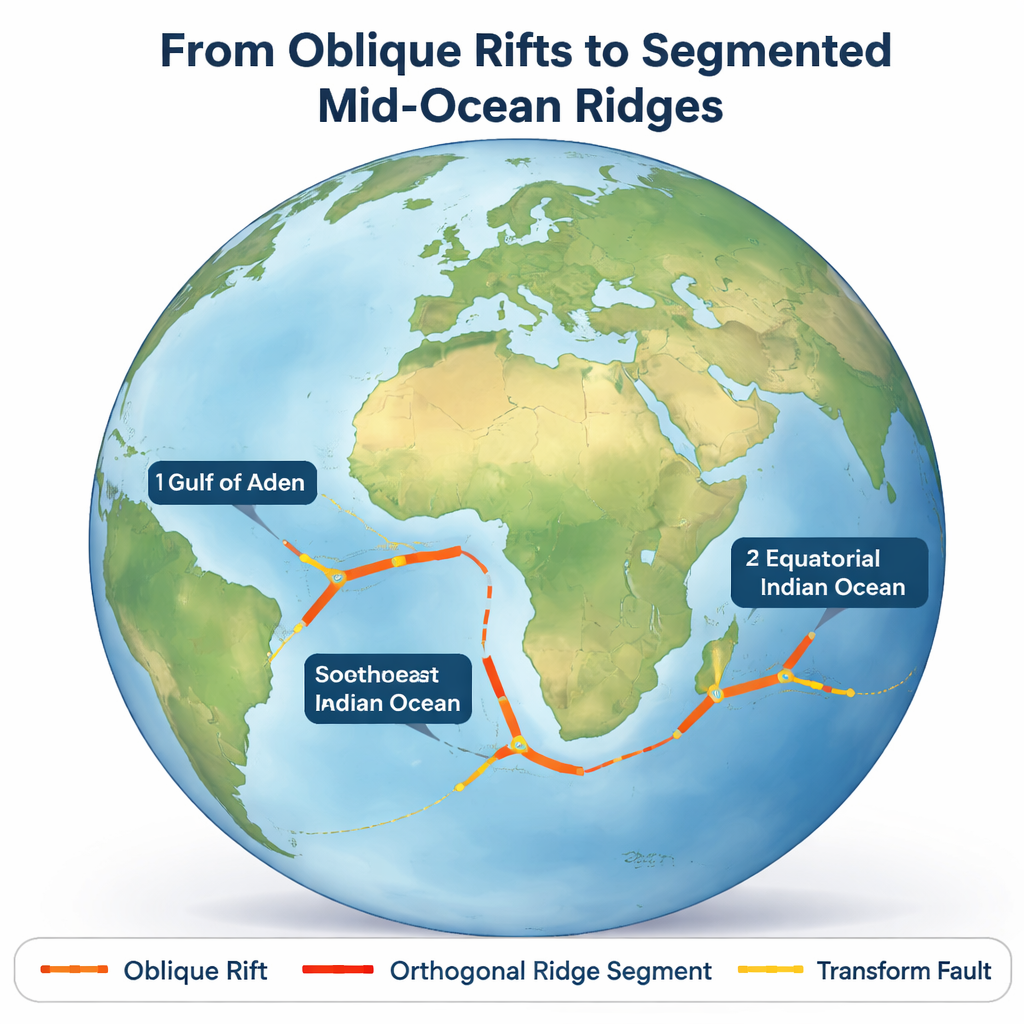
From Slanted Breaks to Straight Steps
When continents first begin to tear apart, the motion of the plates is usually not straight across the rift. Instead, the plates slide away from each other at an angle, a situation known as oblique extension. Earlier models suggested that once the rift opens enough to form new ocean crust, the young mid‑ocean ridge would stay slanted as well. However, real oceans like the southeast Indian Ocean, the central Gulf of Aden, and the Equatorial Atlantic show something different: initially oblique rifts evolve into short, nearly straight ridge segments that are almost at right angles to the plate motion, linked by sideways‑slipping breaks called transform faults. The puzzling question is why the Earth prefers this segmented, stair‑step pattern over a simpler single slanted crack.
Virtual Oceans in a Supercomputer
To answer this, the authors built three‑dimensional computer simulations of the entire life cycle from continental rifting to full‑blown seafloor spreading. Their models included realistic rock behavior, temperature structure, and the way rocks weaken as they accumulate damage. They varied three key ingredients: the angle between the plate motion and the initial rift, the spreading rate, and the temperature of the underlying mantle. Starting from an oblique rift, the model first produced a nearly straight, slanted mid‑ocean ridge, matching what is inferred for early stages of real ocean basins.
How the Ridge Breaks into Segments
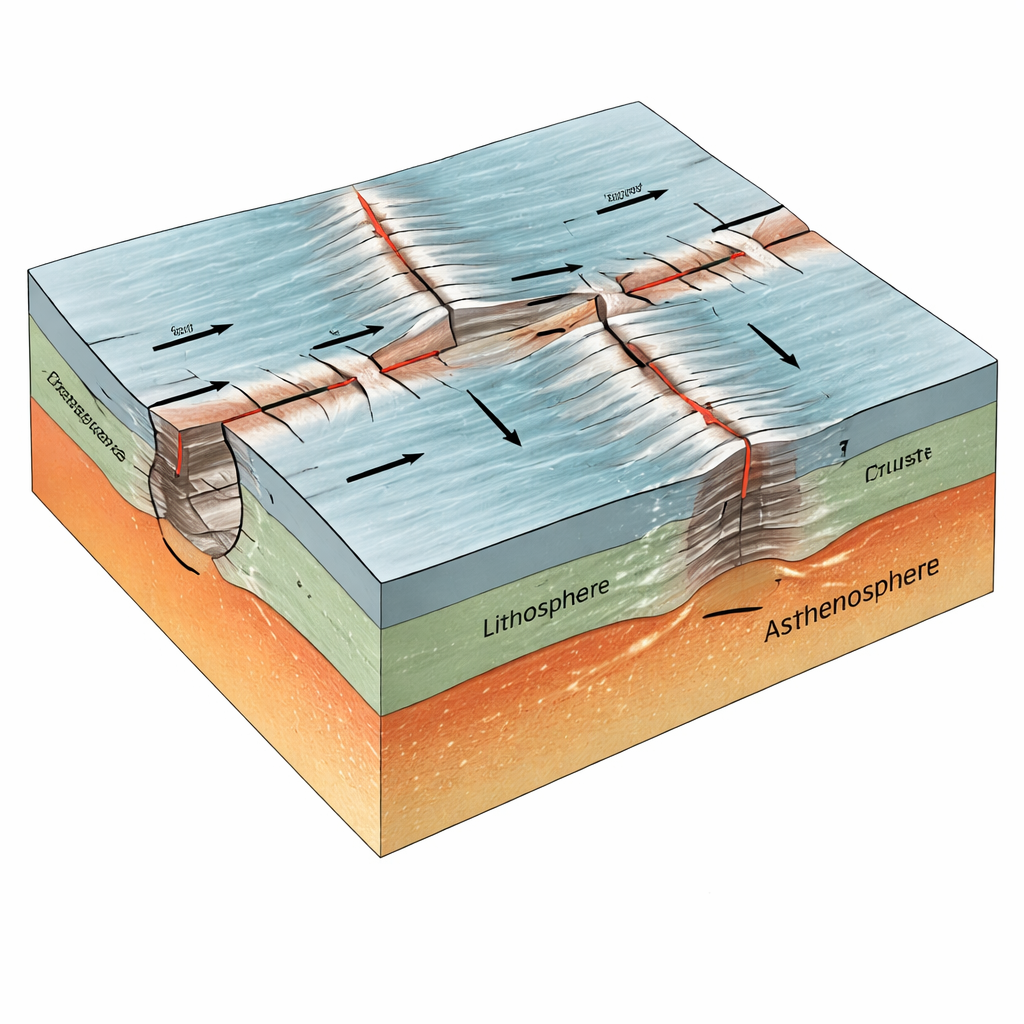
As spreading continued in the models, the ridge did not remain straight. Because one side of the ridge could thin and stretch more easily than the other, the two plates grew asymmetrically, guided by large, gently sloping faults. This unequal growth caused the ridge to curve and kink. With time, sharp offsets developed along narrow zones that cut right through the oceanic crust and upper mantle. These zones behaved like transform faults: they showed strong sideways shearing, low relief at the seafloor, very thin crust, and little magma—features that closely resemble measured properties of real transform faults. Meanwhile, the parts of the ridge between these offsets rotated toward a position that is nearly perpendicular to the direction of plate motion. Within about 8 million years of simulated time, the system settled into a stable pattern of straight segments and connecting transforms.
Nature’s Shortcut to Save Energy
Why is this stepped pattern favored? The simulations reveal a mechanical advantage. Along ridge segments, new rock is continuously formed, so it has not yet accumulated much damage and behaves relatively strongly. In transform zones, by contrast, old rock is repeatedly sheared and progressively weakened. Because it is easier to deform weak rock than strong rock, the system “chooses” to do as much motion as possible along the weaker transforms. By breaking a long slanted ridge into shorter, more orthogonal segments, the total length of strong ridge that must be pulled apart is reduced. This lowers the overall force—or mechanical work—needed to keep plates moving. When the authors reduced the amount of weakening in their models, the ridge no longer split into segments, underscoring how crucial this damage‑and‑weakening process is.
Different Oceans, Different Outcomes
The study also explored how spreading rate and mantle temperature modify this story. Under very slow spreading, the models predicted alternating short magmatic segments (with abundant melt) and oblique amagmatic segments (with little melt), resembling parts of the ultra‑slow Southwest Indian Ridge. When the mantle was made hotter in the simulations, magma became plentiful, filling the gap without needing large faults to bring up deep rock. In these hotter scenarios, long oblique ridges could persist without breaking into many segments, mirroring natural examples influenced by mantle plumes, such as the Reykjanes Ridge near Iceland and the western Gulf of Aden near Afar.
A Simple Takeaway from a Complex Process
For a non‑specialist, the bottom line is that the seafloor is not just passively ripped apart; it actively rearranges itself into patterns that make mechanical sense. When plates pull apart slowly and at an angle, damage builds up along certain zones that become weak, sideways‑slipping faults. The system naturally evolves toward a layout that uses those weak zones as much as possible, breaking a single slanted ridge into short, nearly straight pieces. This self‑organization helps explain why most of the world’s mid‑ocean ridges show a characteristic step‑like geometry, even though the underlying plate motions are often anything but straight.
Citation: Su, H., Liao, J., Brune, S. et al. Self-organization of mid-ocean ridge segments during oblique oceanisation. Commun Earth Environ 7, 176 (2026). https://doi.org/10.1038/s43247-026-03201-y
Keywords: mid-ocean ridges, plate tectonics, seafloor spreading, transform faults, continental rifting