Clear Sky Science · en
Toward a sustainable megalopolis by reconciling power system decarbonization and urban health resilience
Why keeping cool is getting harder
As summers grow hotter, more people depend on air conditioning to stay safe. But the very heatwaves that make cooling essential also strain city power grids, triggering blackouts that leave millions without relief. This study asks a pressing question: as we clean up our electricity systems to fight climate change, could we accidentally make deadly heatwaves even more dangerous for city dwellers—and what can we do about it?
When the power fails during a heatwave
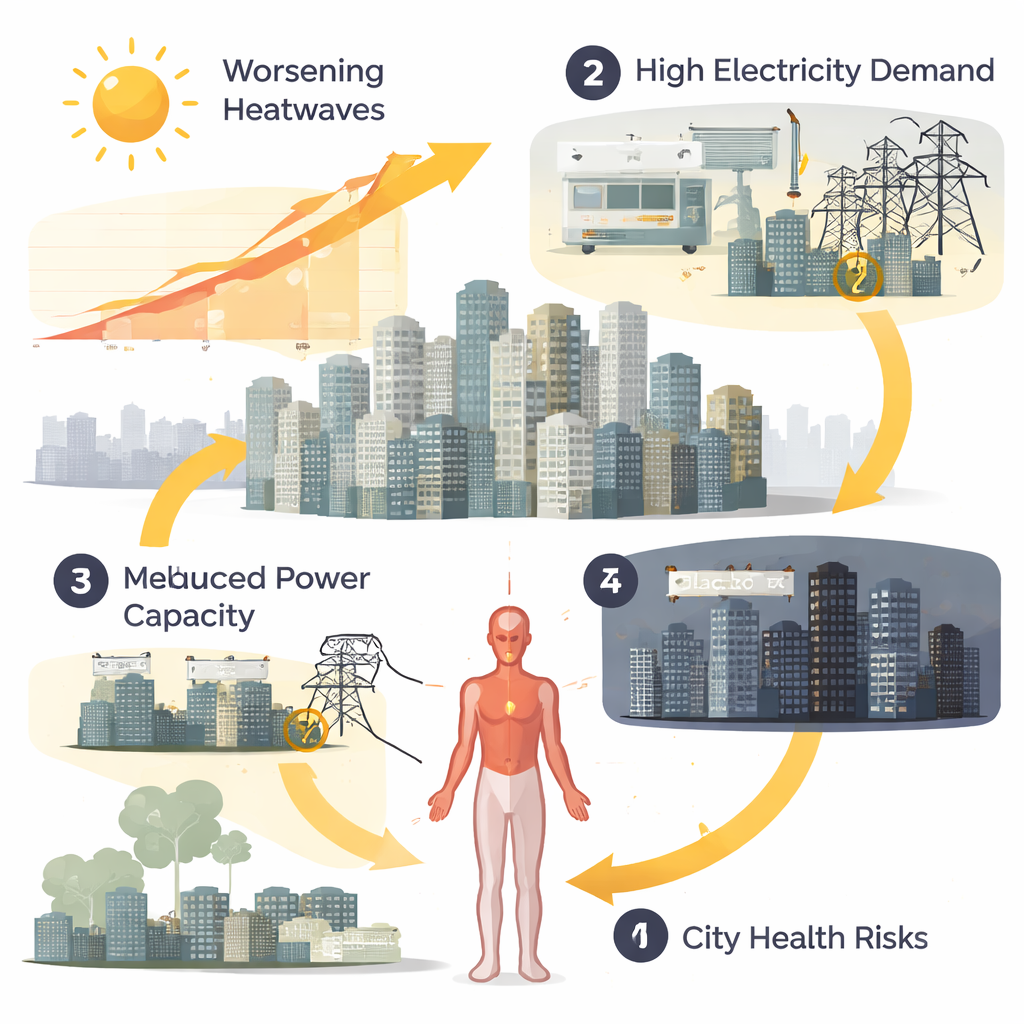
Extreme heat is more than a discomfort; it can overwhelm the body, especially in older adults and people with existing health problems. Heatwaves already kill tens of thousands of people each year worldwide. In big city regions packed with apartments and offices, survival often depends on reliable electricity for air conditioning. Yet heatwaves push power use up by 10–20% for days at a time, just as high temperatures make power lines and power plants less efficient. The result is a double squeeze: more demand and less supply, which can trigger rolling blackouts that expose vulnerable residents to dangerous indoor temperatures for hours or days.
Clean energy and an unexpected health risk
Many regions are rapidly shifting from fossil fuels to cleaner sources like wind and solar to reach carbon neutrality. While this is essential for slowing climate change, the transition has side effects. Traditional coal and gas plants can ramp output up or down quickly, but they are being replaced by weather-dependent renewables that are less flexible without added backup. In the Guangdong–Hong Kong–Macao megacity cluster in southern China, the authors show that as fossil generation declines, electricity shortages during heatwaves become more frequent and longer-lasting. Their simulations suggest that the share of deaths linked to heatwave-related blackouts across this 135-million-person region could rise from about 0.5% of all annual deaths in 2030 to nearly 2.8% by 2050, with many core cities exceeding 3%.
Linking heat, power, and lives saved
To understand and reduce this risk, the researchers built a framework that ties together weather data, power-grid behavior, and public health. First, they created a model of how power systems respond to heatwaves, accounting for surging air-conditioning demand, reduced transmission capacity, and constrained generation. This allowed them to pinpoint when and where blackouts occur. Next, they developed a heat exposure–mortality model that estimates how many extra deaths result when people lose cooling during specific hot hours, taking into account both current and cumulative heat exposure. By combining these pieces, they could trace a clear path: hotter days lead to stressed grids, which lead to outages, which then raise the risk of death for affected populations.
Designing a grid that protects people
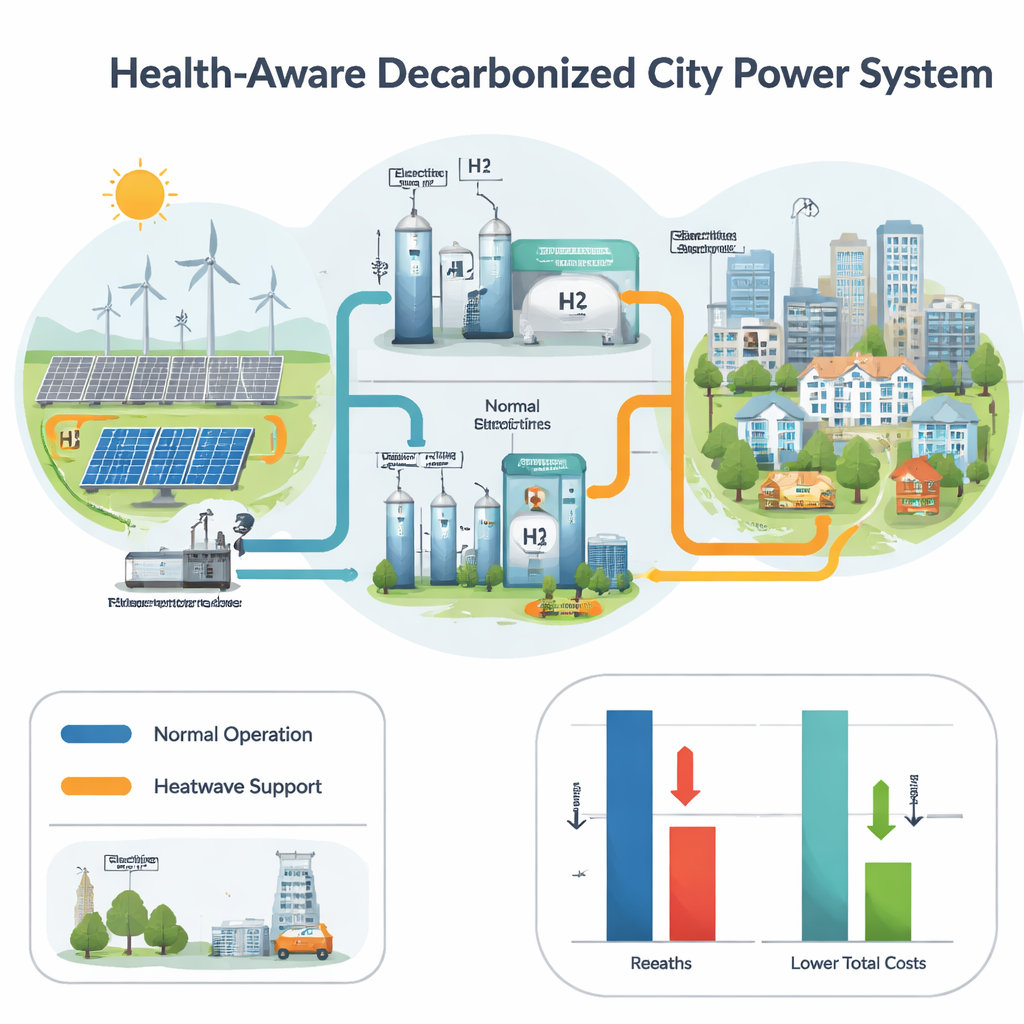
Armed with this coupled model, the team tested different ways to design and operate city power systems. In a detailed case study of Zhuhai, one of the region’s core cities, they compared standard decarbonization plans with “health-aware” strategies that explicitly value preventing heat-related deaths. These strategies add a modest amount of extra generation—especially daytime solar panels—and introduce hydrogen-based energy storage. Surplus renewable power is converted to hydrogen, stored, and later burned in gas turbines when demand peaks or solar power drops. Just as important as how much power is built is when outages, if unavoidable, occur. With more solar in the mix, blackouts can be shifted away from the hottest hours toward the night, sharply reducing harmful heat exposure even without eliminating all interruptions.
Healthier cities at lower long-term cost
The results are striking. In Zhuhai, health-aware planning that slightly increases power capacity and adds hydrogen storage cuts heatwave-related excess deaths by roughly 55–65% compared with conventional decarbonization paths. At the same time, as clean technologies get cheaper and heatwaves more common, these investments pay for themselves: overall annual costs fall by 9–14% by mid-century, thanks to fewer blackouts, lower fuel use, and reduced economic losses from illness and death. The authors conclude that cities do not have to choose between cleaner power and public health. By explicitly planning grids around both carbon and health goals—using tools like targeted solar deployment, flexible backup, and energy storage—megacity regions can become both more sustainable and far safer places to weather the coming heat.
Citation: Yang, Z., Zhang, H., Li, H. et al. Toward a sustainable megalopolis by reconciling power system decarbonization and urban health resilience. Commun Earth Environ 7, 174 (2026). https://doi.org/10.1038/s43247-026-03198-4
Keywords: heatwaves, urban power grids, decarbonization, public health, energy storage