Clear Sky Science · en
Persistent stratospheric cold-season aerosols from the 1783 Laki eruption produced winter warming over Northern Eurasia
A Volcano That Warmed Winter
Most of us think of big volcanic eruptions as planet-coolers: they dim the Sun and lower temperatures for a year or two. This study tells a more surprising story. By revisiting the huge 1783 Laki eruption in Iceland, the authors show that a volcano can chill the globe overall yet still make winters warmer over parts of Northern Eurasia. Understanding this strange pattern helps scientists better predict the climate risks of future eruptions and of proposed geoengineering schemes that would deliberately add particles to the stratosphere.
An Unusual Northern Eruption
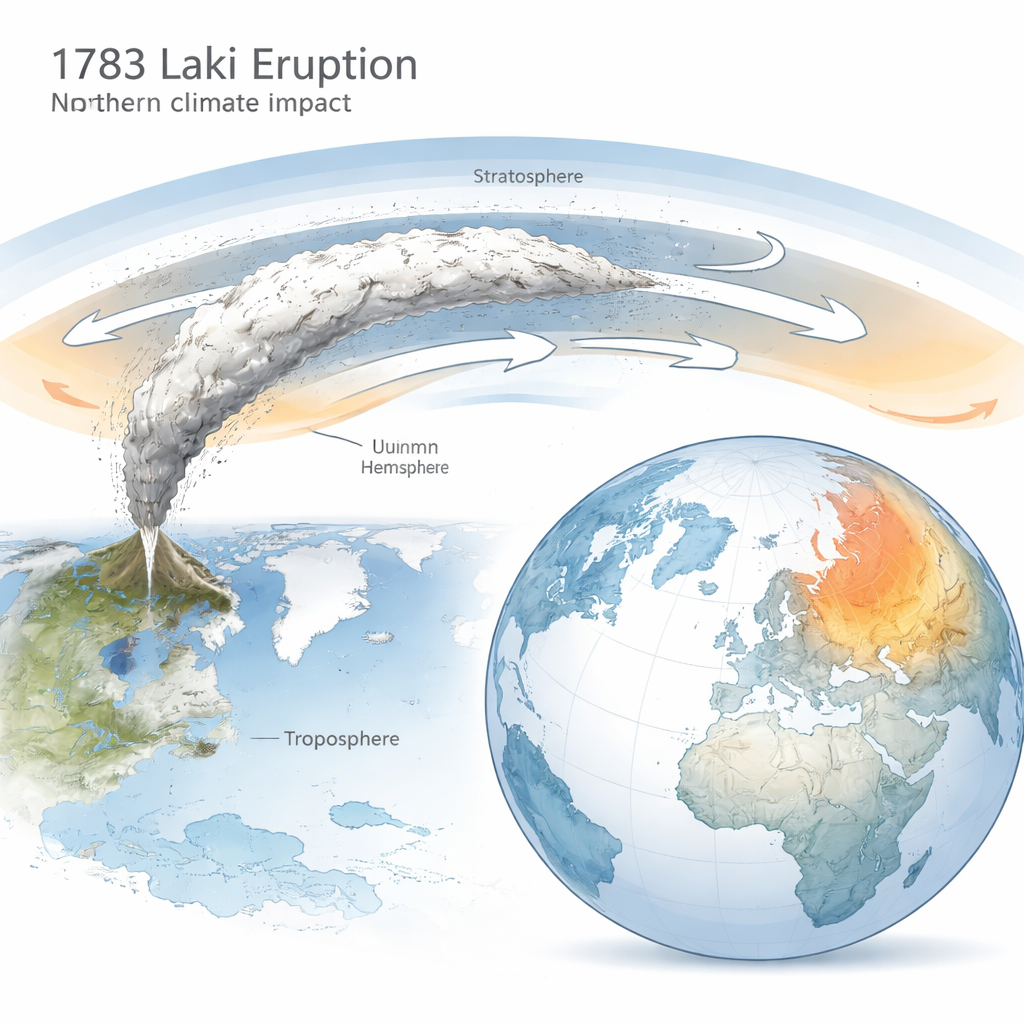
The Laki eruption was one of the most powerful in the last thousand years, releasing far more sulfur gas than the famous 1991 Pinatubo eruption. Unlike many climate-changing eruptions that occur in the tropics and in a single burst, Laki was a high-latitude event that leaked gases over about eight months. The sulfur turned into tiny particles in the upper atmosphere that spread around the Northern Hemisphere. Historical records describe heat waves, harsh cold spells, floods, and famine in the years that followed, but the pattern and causes of these extremes have long been debated.
Replaying 1783 With Better Inputs
Previous climate simulations treated Laki as a one-off summer blast and often placed its aerosol cloud in the wrong latitude band and even the wrong year. In this study, the authors rebuild the eruption’s “forcing” – the pattern of sunlight-blocking particles – to match its real Icelandic location and its multi-stage nature. They base this on modern high-top climate models that track chemistry and aerosol physics in detail, then feed the refined forcing into a widely used Earth system model. They compare the simulated temperatures with two independent reconstructions that blend historical documents, tree rings, ice cores, and early instrumental records.
A Winter Warm Spot in a Cooler World
The model confirms that Laki cooled the Northern Hemisphere overall, especially in the months right after the eruption. Yet by the first winter, something counterintuitive happens: much of Northern Eurasia, especially Russia and Siberia, becomes warmer than usual, in some areas by more than 3 degrees Celsius. The two reconstruction datasets show a similar winter warm patch over Eurasia, even while other regions, like parts of Europe and North America, experienced intense cold. This agreement between model and evidence suggests that the eruption’s aerosol cloud played a key role in shaping the unusual winter pattern, though natural ups and downs in the climate system still mattered and could have produced neutral or cold winters in some realizations.
How Stratospheric Particles Reshaped the Winds
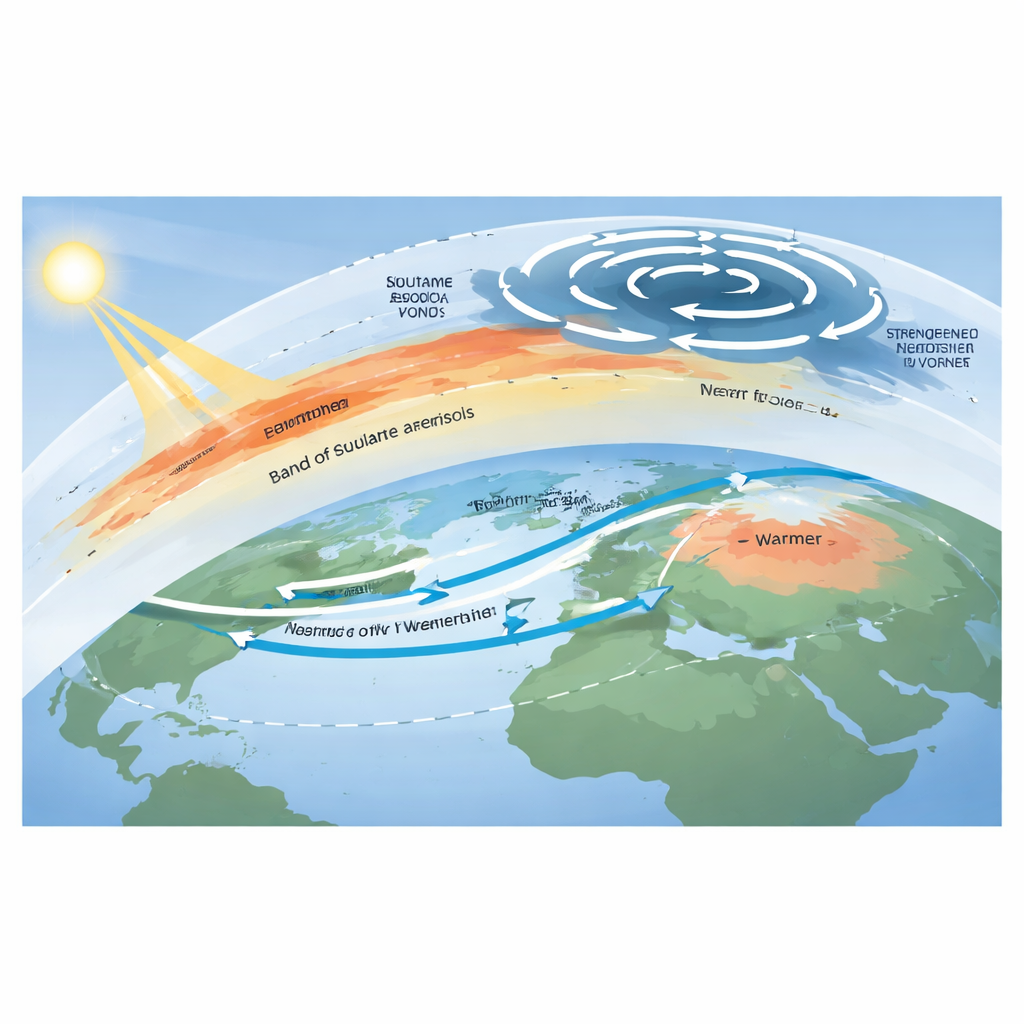
The key lies in when and where the Laki particles lingered. Because the aerosol cloud persisted through autumn and into early winter in the lower stratosphere at mid to high northern latitudes, it absorbed sunlight and warmed that layer of air more strongly in mid-latitudes than over the dark polar night. This sharpened the temperature contrast between mid-latitudes and the Arctic aloft, strengthening the polar vortex – the high-altitude belt of westerly winds around the pole. A stronger vortex favored a pattern known as the positive North Atlantic Oscillation, which deepens the Icelandic Low and boosts westerly winds that carry mild, moist ocean air into Northern Eurasia. The result: regional winter warming on land, even as the planet as a whole cooled.
Why Season and Location Matter
The authors show that this winter-warming response only appears when enough aerosols are present in the stratosphere during the cold season. Other large high-latitude eruptions in the last millennium, whose particles did not persist into winter, fail to generate similar warming in models. Likewise, a separate set of simulations finds that tropical eruptions only produce Eurasian winter warming when they occur in seasons that allow their aerosol clouds to survive into winter. This means the climate impact of a volcano depends not just on how big it is, but also on where it is and when it erupts.
Lessons for Today and Tomorrow
By successfully reproducing the Laki-driven winter warming, this work strengthens the idea that tight coupling between the stratosphere and the lower atmosphere can flip regional climate patterns in the wake of major eruptions. It also sounds a note of caution for proposals to cool the planet by injecting sulfate aerosols into the stratosphere. If a single, naturally occurring high-latitude eruption can cause strong winter warming over Eurasia, engineered aerosol layers might do so too. Any serious assessment of such schemes, the authors argue, must account for how aerosol location, season, and natural climate variability combine to shape regional winners and losers.
Citation: Yang, L., Gao, C., Liu, F. et al. Persistent stratospheric cold-season aerosols from the 1783 Laki eruption produced winter warming over Northern Eurasia. Commun Earth Environ 7, 173 (2026). https://doi.org/10.1038/s43247-026-03197-5
Keywords: Laki eruption, winter warming, stratospheric aerosols, polar vortex, volcano–climate interaction