Clear Sky Science · en
Salt fingers contribute substantially to diapycnal oxygen transport into the oxygen minimum zone of the eastern South Pacific
Why the ocean’s hidden oxygen deserts matter
Far below the ocean’s sunlit surface lie vast "oxygen minimum zones"—layers of water where oxygen is so scarce that many animals struggle to survive. These hidden deserts are expanding as the climate warms, threatening fisheries, marine biodiversity, and the chemistry of the seas. This study explores an overlooked process, known as salt fingering, that quietly helps deliver fresh oxygen into one of the planet’s largest low-oxygen regions off the coasts of Peru and Chile, shedding light on how these fragile environments may change in the future.
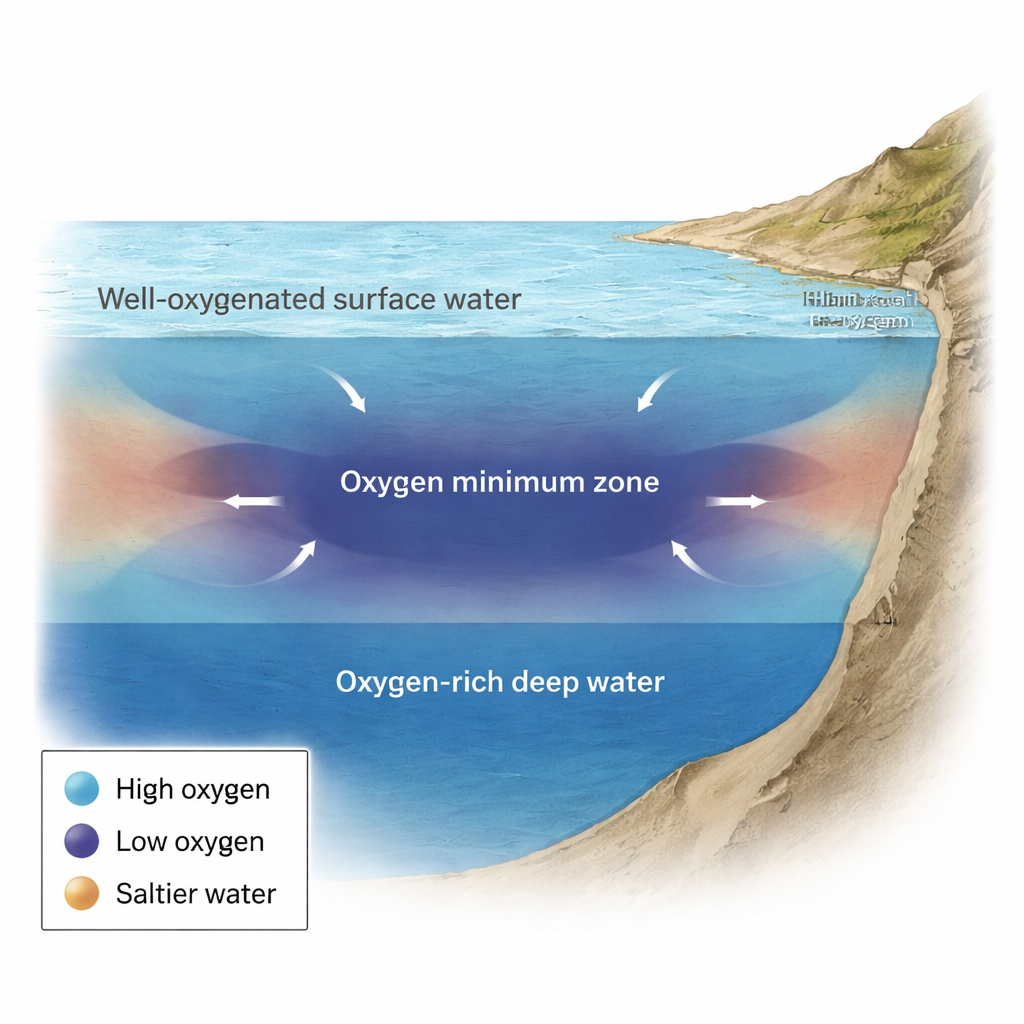
A deep stretch of low-oxygen water
The eastern South Pacific hosts one of the world’s most extensive oxygen minimum zones. Supported by productive coastal upwelling, surface waters teem with life, but when organic matter sinks and decomposes, it consumes oxygen at depth. Between about 100 and 450 meters down, oxygen levels plummet to hypoxic or even functionally zero values, forming a thick, suffocating layer. This zone is sandwiched between well-ventilated waters above and below, so its oxygen content depends on how efficiently mixing moves oxygen across its sharp upper boundary and its more gradual lower boundary.
Layers of different waters set the stage
Off central Chile, three water masses stack up to create strong contrasts in temperature and saltiness. Near the surface lies relatively fresh, well-oxygenated water. Beneath it, an equatorial subsurface water mass is unusually salty and very low in oxygen, forming the core of the oxygen minimum zone. Deeper still flows cooler, fresher Antarctic intermediate water that contains much more oxygen. Where these layers meet, their different heat and salt properties make the water column unstable in subtle ways, priming it for a special type of mixing called double diffusion.
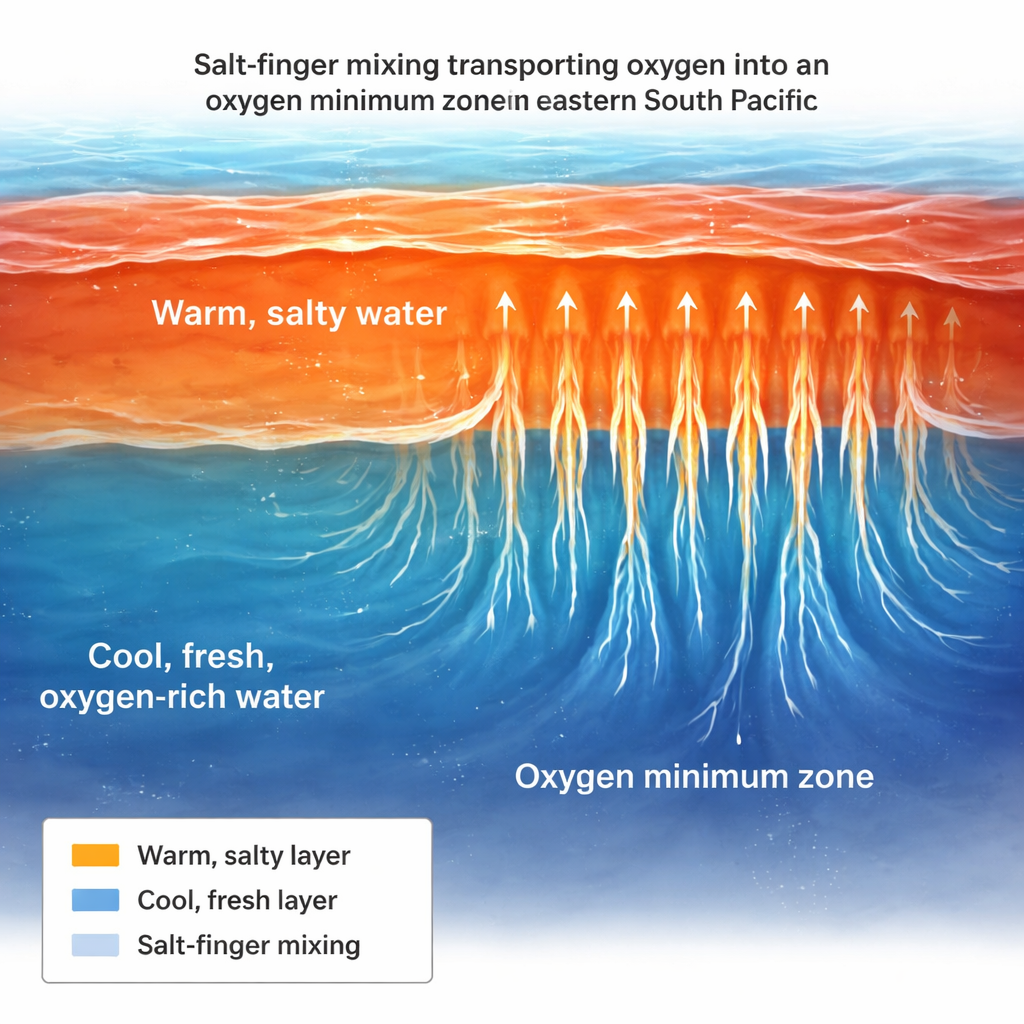
Salt fingers: tiny structures with big impact
Double diffusion arises because heat and salt diffuse at different molecular speeds. When warm, salty water lies above cooler, fresher water, heat escapes downward more quickly than salt. This causes narrow, downward-moving plumes of salty water—"salt fingers"—to form, while cooler, fresher water moves upward between them. Using sensitive microstructure profilers, standard temperature–salt–oxygen casts, and current meters on three cruises between 2020 and 2022, the researchers measured the turbulence and fine-scale structure of the water column near the oxygen minimum zone’s southern edge. They found that just below the low-oxygen core, conditions favor salt-finger activity much of the time, and the resulting mixing can be one to two orders of magnitude stronger than ordinary shear-driven turbulence there.
Comparing top-down and bottom-up oxygen supply
Near the upper boundary of the oxygen minimum zone, strong vertical oxygen gradients make that interface a natural gateway for ventilation from above. However, the water there is highly stratified, which suppresses turbulent mixing and keeps diffusivities low. In contrast, the lower boundary where salt fingers occur has smoother oxygen gradients but much higher effective diffusivities. When the team combined their turbulence measurements with oxygen profiles, they found that the upward oxygen flux from below often matches, and at times even rivals, the downward flux from above. In some periods, salt-finger-driven mixing across the lower boundary contributed more than two-thirds of the total vertical mixing, meaning that this subtle process plays a major role in sustaining what oxygen exists inside the low-oxygen layer.
What this means for a changing ocean
The findings overturn the simple view that oxygen minimum zones are ventilated mainly from the top. Instead, they reveal that persistent salt-finger mixing at depth can provide a steady, bottom-up supply of oxygen that is comparable to, or larger than, the top-down input. Because the temperature and salinity structure that drives salt fingering appears stable over large regions of the eastern South Pacific, this mechanism likely acts over broad areas and long timescales, and similar conditions exist in other upwelling systems worldwide. Accurately predicting how these oxygen-poor zones will expand or contract in a warming, deoxygenating ocean will require climate and ocean models to include salt fingers and other fine-scale mixing processes—not just the more familiar forms of turbulence near the surface.
Citation: Pinto-Juica, M., Pizarro, O., Rodríguez-Santana, Á. et al. Salt fingers contribute substantially to diapycnal oxygen transport into the oxygen minimum zone of the eastern South Pacific. Commun Earth Environ 7, 175 (2026). https://doi.org/10.1038/s43247-026-03194-8
Keywords: oxygen minimum zones, salt fingering, ocean mixing, eastern South Pacific, ocean deoxygenation