Clear Sky Science · en
Spring phenology of the Arctic Ocean shelf production system
Life under the Arctic ice
For many of us, the Arctic Ocean in winter conjures images of silent, frozen seas where little happens until the summer sun returns. This study turns that picture on its head. By combining satellite data, ocean models, and biological knowledge, the authors reveal a hidden, highly organized burst of life that begins months before the ice breaks up—linking microscopic algae, tiny drifting animals, and young fish in ways that may be especially vulnerable to climate warming.
The hidden engine beneath the ice
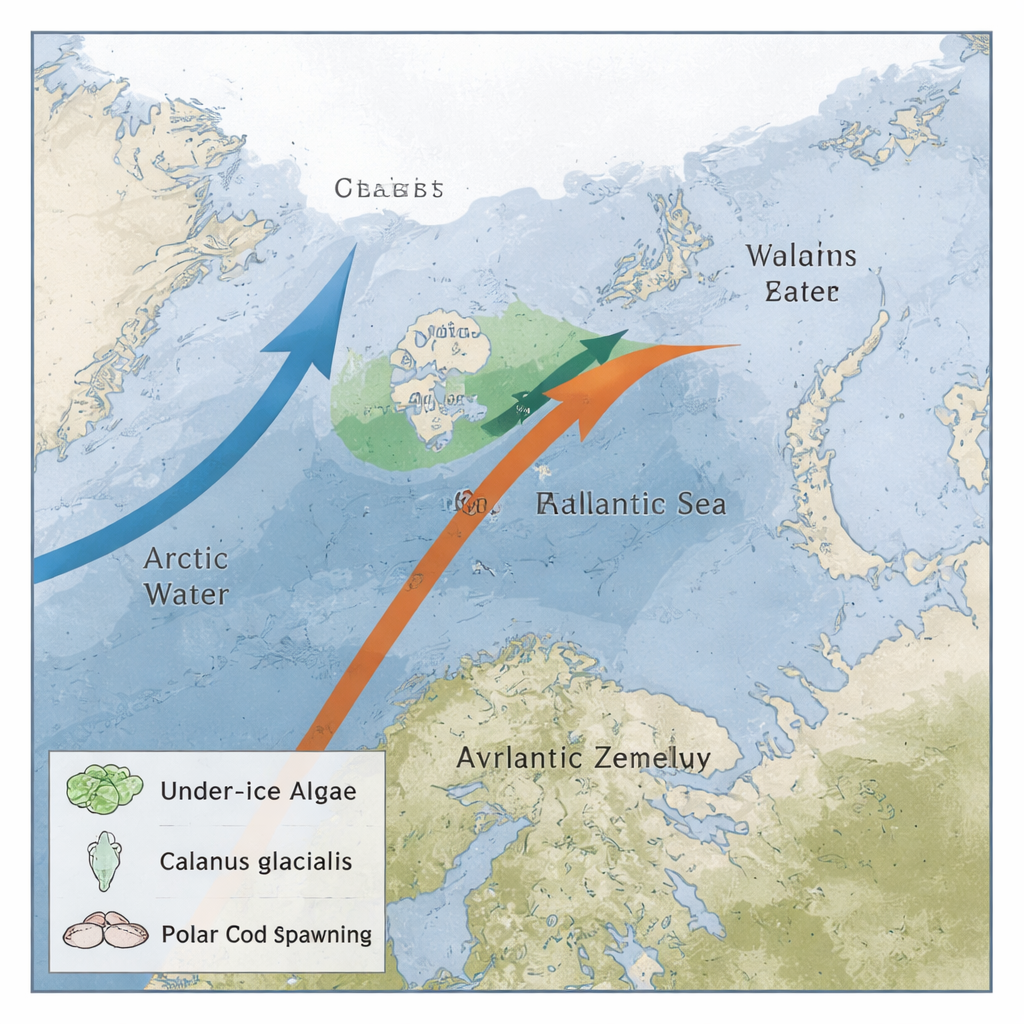
The work focuses on the northern Barents Sea, a broad continental shelf north of Norway and Russia that feeds some of the Arctic’s richest food webs. Instead of assuming life “wakes up” only when the sea ice retreats, the researchers asked what really happens in late winter and early spring, while thick ice still covers the water. They built a data-driven model that couples detailed ocean physics—currents, ice cover, temperature, and light—with three key living components: ice-dwelling algae, the copepod Calanus glacialis (a fat-rich crustacean the size of a grain of rice), and the early life stages of polar cod, a small fish that is central to Arctic food webs.
The early light that starts the season
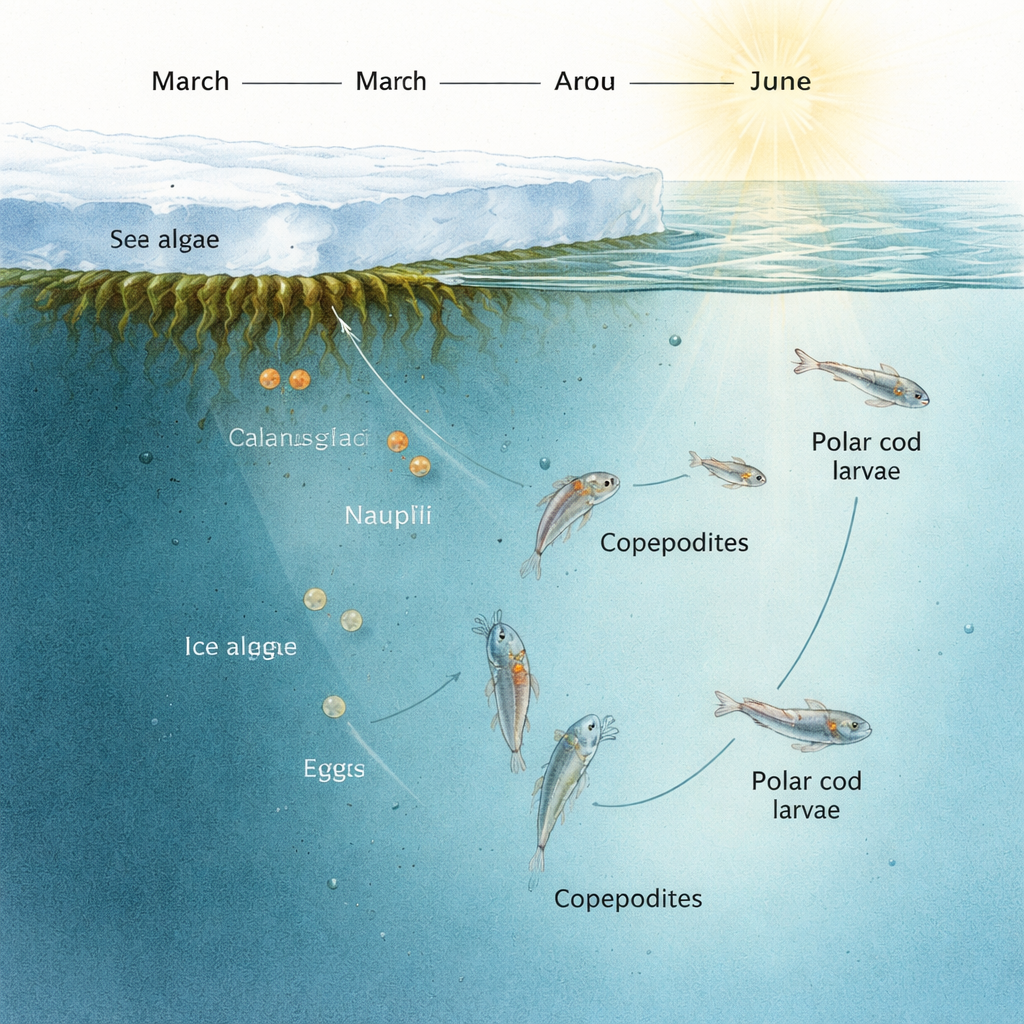
The simulations show that the under-ice “spring” reliably begins around March 1. At that point, sea ice is still about half a meter thick and covers most of the area, but enough sunlight filters through snow and ice to let algae attached to the underside of the ice start to grow. As the sun climbs higher through March, April, and May, algal division rates rise sharply, especially once midday light levels reach a few hundred watts per square meter. By late June, growth under the ice becomes nearly explosive—up to almost one doubling per day—just as the ice breaks up and melts. Far from being dormant, the ice-covered season turns out to be an extended, carefully timed ramp-up in primary production.
Tiny grazers and drifting fish join the pulse
Calanus glacialis has evolved to take advantage of this early light. The model suggests that overwintering adults, carried into the region by Arctic currents, begin releasing eggs as soon as the first weak light appears under the ice in late February. Eggs and non-feeding young stages build up quickly, followed by feeding larvae that graze on the growing ice-algae community through spring. By summer these copepods reach larger stages that store energy-rich fats and form crucial prey for fish, seabirds, and marine mammals. At the same time, polar cod appear to time their spawning—mainly east and north of Svalbard—so that their larvae hatch between March and early summer, just as the smallest, most nutritious copepod stages become abundant. Modelled larvae drift widely across the northern Barents Sea and beyond, in patterns that match where young polar cod are actually found in late-summer surveys.
A finely tuned conveyor belt of life
Taken together, the results reveal a “biological corridor” running along the Arctic continental shelf. Sub-zero Arctic waters, predictable seasonal ice, and early light under the ice combine to create overlapping habitats where ice algae, Calanus copepods, and young polar cod all thrive and are transported over large distances. This corridor exports huge amounts of biological material eastward toward the Kara and Laptev Seas and into the central Arctic. The model also shows that the proportion of Calanus glacialis in the zooplankton community can drop steeply as waters warm, with up to a quarter loss for each degree Celsius increase in temperature in the most sensitive ranges—hinting at how fragile this balance may be.
Why a warming Arctic puts this system at risk
For a non-specialist, the main message is that much of the Arctic’s productivity—and the success of key species like polar cod—depends on a tight schedule: light arriving under ice in March, algae responding quickly, copepods spawning and growing in step, and fish larvae hatching in time to find the right prey. As sea ice retreats and warmer Atlantic waters push farther north, this schedule and the habitats that support it are shifting. The study’s model suggests that the under-ice nursery for algae, copepods, and polar cod will shrink and move, raising the risk that young fish will miss their critical food window. In plain terms, a warming Arctic is not just losing ice; it is threatening the carefully choreographed early-season pulse of life that supports much of its marine food web.
Citation: Huserbråten, M., Vikebø, F.B. Spring phenology of the Arctic Ocean shelf production system. Commun Earth Environ 7, 170 (2026). https://doi.org/10.1038/s43247-026-03192-w
Keywords: Arctic Ocean, sea ice, polar cod, zooplankton, spring bloom