Clear Sky Science · en
Widespread enhancement of ecosystem carbon fluxes during post moisture pulse
Why short rainstorms matter more than you think
As the climate warms, many places are seeing fewer rainy days but more intense downpours. What happens to plants and ecosystems in the days after one of these soaking storms is surprisingly important for how much carbon dioxide land removes from the atmosphere, how much water returns to the air, and how hot the surface feels. This study treats each rainfall event as a natural experiment to reveal how Earth’s ecosystems briefly speed up, then slow down, as the soil dries out again.
A world of soils breathing after rain
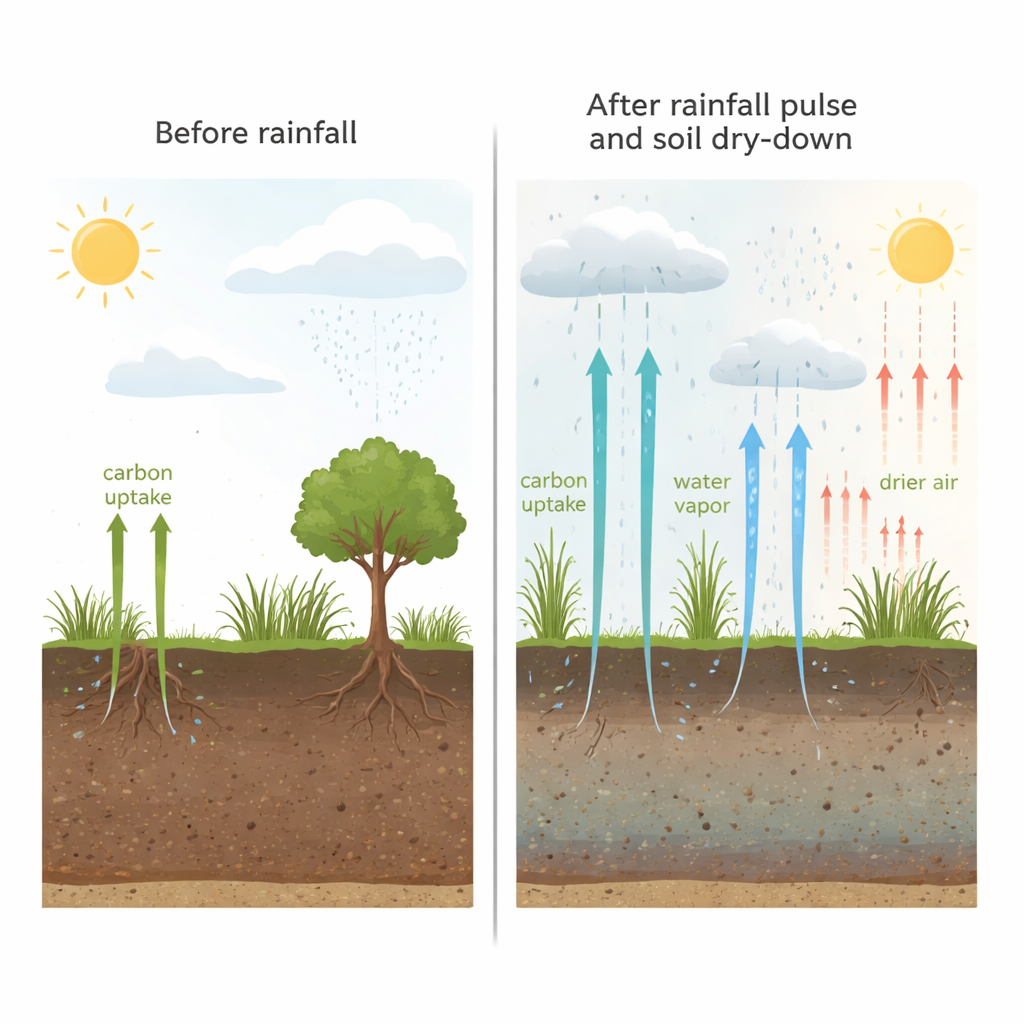
The researchers assembled observations from 215 monitoring towers scattered across the globe, from dry grasslands to lush forests. These towers continuously measure exchanges of carbon, water, and energy between land and air. From these records they identified 6,502 “dry-down” episodes: runs of at least ten days with no rain, during which the top layer of soil steadily lost moisture after a rainfall pulse. For each event, they compared the measured fluxes to the average behavior on the same calendar days in other years when the soil did not dry out this way. This allowed them to isolate the specific effect of a rain pulse followed by drying, separate from normal seasonal changes.
A brief surge in plant activity
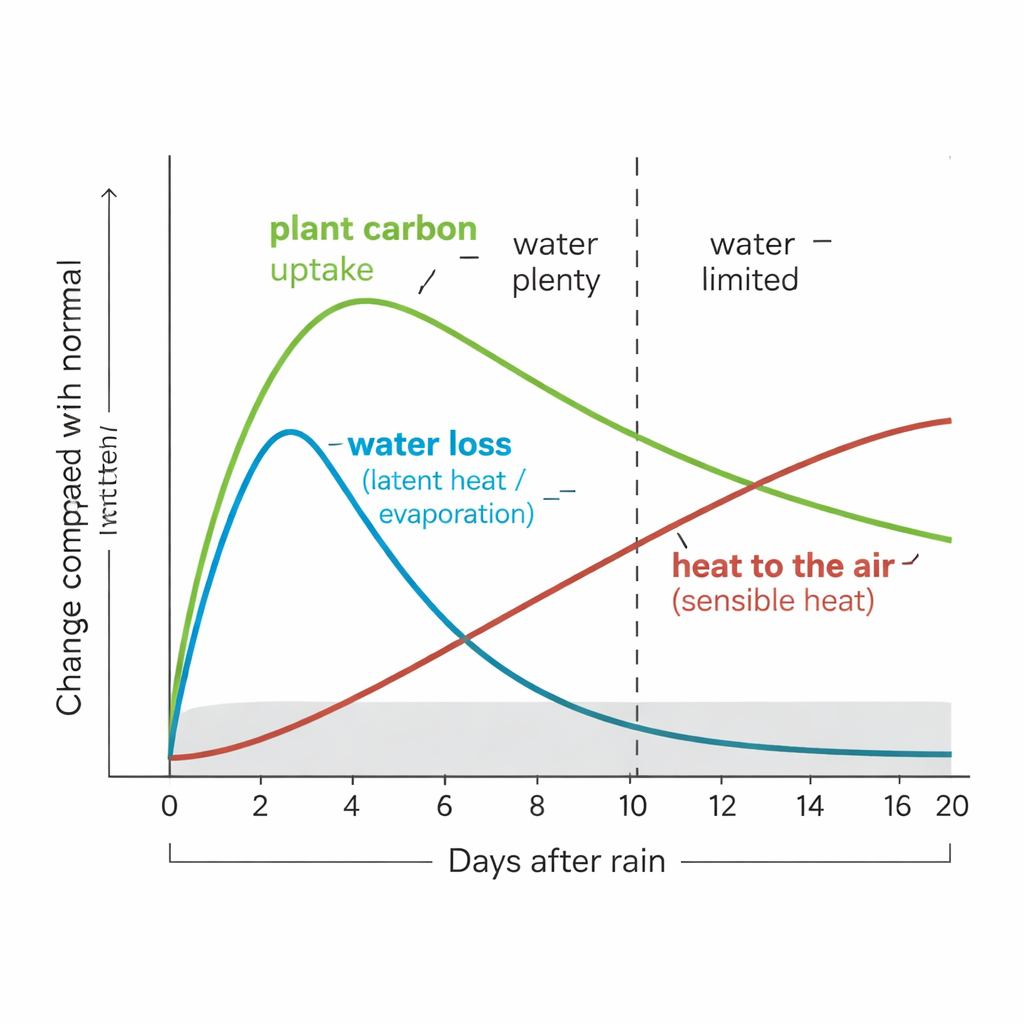
Across nearly all ecosystems, the first days after a rainfall pulse showed a clear pattern: plant growth and soil breathing both sped up compared with typical years. Plants pulled more carbon dioxide from the air while soil microbes respired more carbon back, but the plant gains were larger, so the land temporarily became a stronger carbon sink. At the same time, evaporation and plant transpiration increased, sending more water vapor into the air. This early boost lasted several days, even as the soil began to dry. Eventually, as moisture dropped and the air grew drier, the extra growth faded and in many places turned into a slowdown, with plants taking up less carbon than during ordinary years.
Different landscapes, similar pulses
The team then asked whether this pulse-and-dry pattern was limited to deserts and drylands, where the “pulse–reserve” idea was first developed, or whether it applied more broadly. By grouping sites using a simple dryness index, they found that both drylands and wetter regions showed an early bump in carbon uptake and water loss after rain. Ecosystems with dense foliage, such as many non-dryland forests, showed especially strong initial benefits because they have high capacity for photosynthesis. Yet this lushness came with a cost: thick canopies also used water faster, which hastened the shift to water-limited conditions as the soil dried. The exact timing and strength of these responses varied by vegetation type and local climate, but the basic pattern of a short-lived boost followed by decline was widespread.
What controls the rise and fall
To uncover why some places gained more from these pulses than others, the authors used machine-learning models fed with information about vegetation, climate, and soil conditions. When plant uptake increased, the key ingredients were high photosynthetic capacity (captured by maximum leaf area) and extra sunlight after the storm as clouds cleared. When uptake dropped, factors tied directly to water shortage dominated: how much soil moisture was lost during the dry-down, how dry the air became, and how wet the soil had been right after the rain. The analysis suggests that photosynthesis can stay surprisingly resilient under moderate drought, remaining active even after other signs point to water stress, but that continued drying and hot, thirsty air eventually pull the plug on this resilience.
Global patterns and model blind spots
Using global maps of plant productivity built from satellite data and tower measurements, the study showed that this early positive response after rain appears across most vegetated regions of the world. The gains typically persist for about 9 to 17 days, depending on how long the soil keeps drying, before flipping to net losses in some areas as plants become strongly water-limited. When the team compared these real-world patterns with state-of-the-art Earth system models used for climate projections, they found that the models captured the general shape of the response but seriously underestimated how much extra carbon plants take up after rain pulses. The models also showed weaker soil-moisture changes than observed, pointing to missing or oversimplified processes in how they represent plant water stress and land–atmosphere feedbacks.
What it means for our future climate
For non-specialists, the key message is that short episodes following rainstorms play an outsized role in how land stores carbon and exchanges water and heat with the atmosphere. A soaking rain briefly supercharges plant growth and cooling, but as soils dry and the air grows thirstier, those benefits fade and can reverse. Because climate change is expected to bring more intense but less frequent storms, these boom-and-bust cycles in plant activity are likely to become more important. The study shows that this behavior is not just a quirk of deserts but a global feature of how ecosystems work, and that current climate models still struggle to capture it, which matters for predicting future carbon sinks, drought impacts, and heat extremes.
Citation: Bai, Y., Zhang, F., Ciais, P. et al. Widespread enhancement of ecosystem carbon fluxes during post moisture pulse. Commun Earth Environ 7, 171 (2026). https://doi.org/10.1038/s43247-026-03191-x
Keywords: soil moisture, rainfall pulses, ecosystem carbon uptake, drought impacts, land atmosphere interactions