Clear Sky Science · en
European coastal deformation drives unequal exposure to climate hazards
Why Europe’s Coasts Are Quietly Sinking and Rising
Many of Europe’s favorite coastal places—historic ports, beach towns, wetlands, and farming plains—are changing in ways that most people can’t see. The ground itself is slowly moving up or down, while the oceans rise. This study looks across the entire European coastline to ask a simple but urgent question: who and what will be left most at risk when these subtle shifts meet accelerating climate change?
Shifting Ground Beneath the Waves
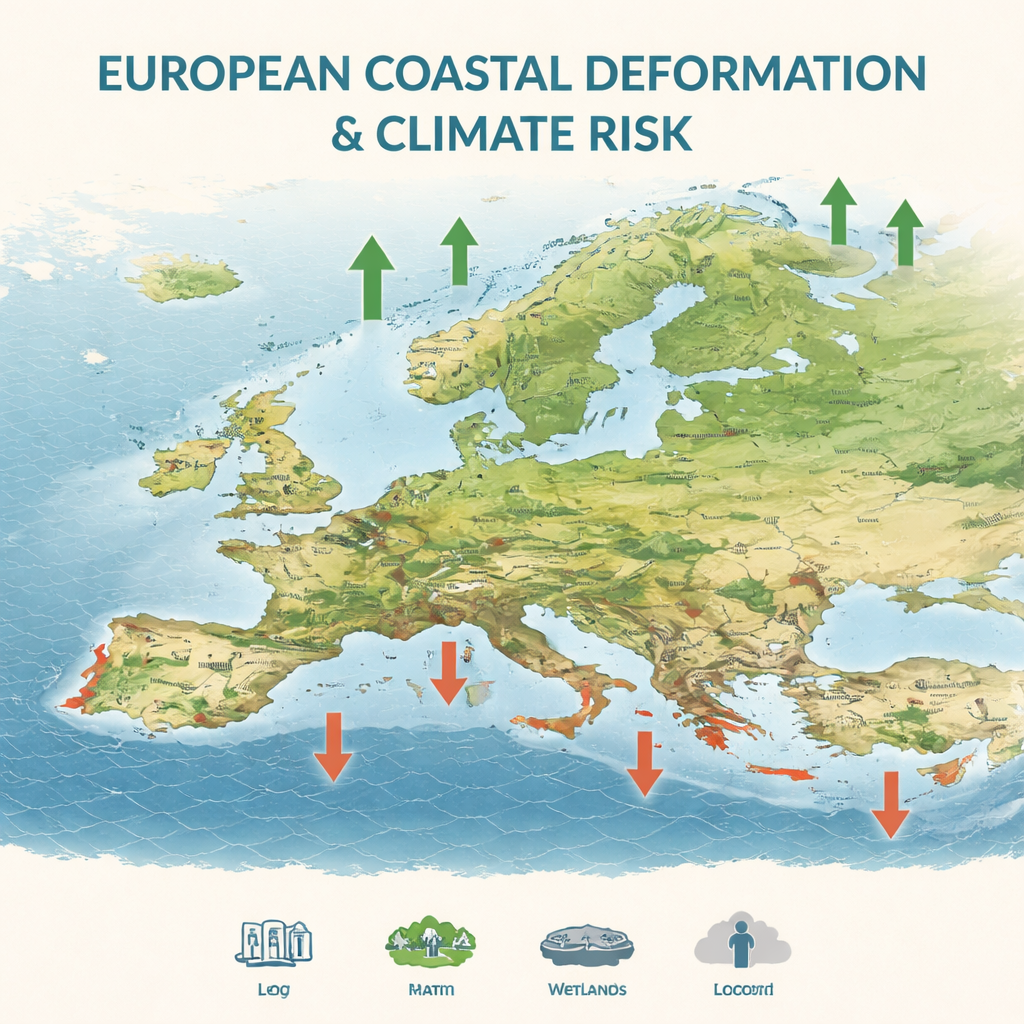
The research team used precise satellite radar measurements, capable of detecting millimeter-scale motion, to map how the land along Europe’s coasts is moving vertically. They found a clear north–south contrast. In Scandinavia—including Sweden and Finland—the ground is still rebounding from the last Ice Age and is lifting by more than 5 millimeters per year in places, effectively offsetting some sea-level rise. In contrast, large parts of central and southern Europe, including the Netherlands, northern Germany, Italy, Greece, and Malta, are sinking. Several “hotspots” of subsidence—where the land sinks more than 1–2 millimeters per year—line up with low-lying coasts that are already vulnerable to flooding.
Landscapes That Sink Faster Than Others
Not all types of land behave the same way. The study combined land-motion data with detailed maps of land cover—cities, farms, forests, and wetlands. Forests and farmland cover most of the European coastal zone and commonly show noticeable sinking, often linked to groundwater pumping and intensive irrigation. Yet it is wetlands that stand out: they occupy only a tiny share of coastal land but are, on average, sinking the fastest. Soft, waterlogged soils compact under their own weight, and when tides and waves disturb sediments, the land surface drops further. As a result, coastal wetlands—which help buffer floods, store carbon, and filter water—are losing elevation just as the sea is rising, putting these natural defenses at special risk.
Flooded Land, Homes, and Lives by 2050
To see what these changes mean on the ground, the authors projected sea levels for 2050 under an intermediate climate scenario and combined this with the measured land-motion patterns and high-resolution elevation data. Assuming no new protective walls or dikes, they estimate that about 94,000 square kilometers of European coastal land could be at risk of regular inundation by mid-century. Within this area live nearly 25 million people and more than 8 million buildings. Some countries emerge as hotspots: Germany, the United Kingdom, France, Italy, and especially the Netherlands, where millions of buildings and trillions of euros in assets lie in zones that could be exposed to flooding if adaptation lags behind.
Unequal Burdens on People and Places
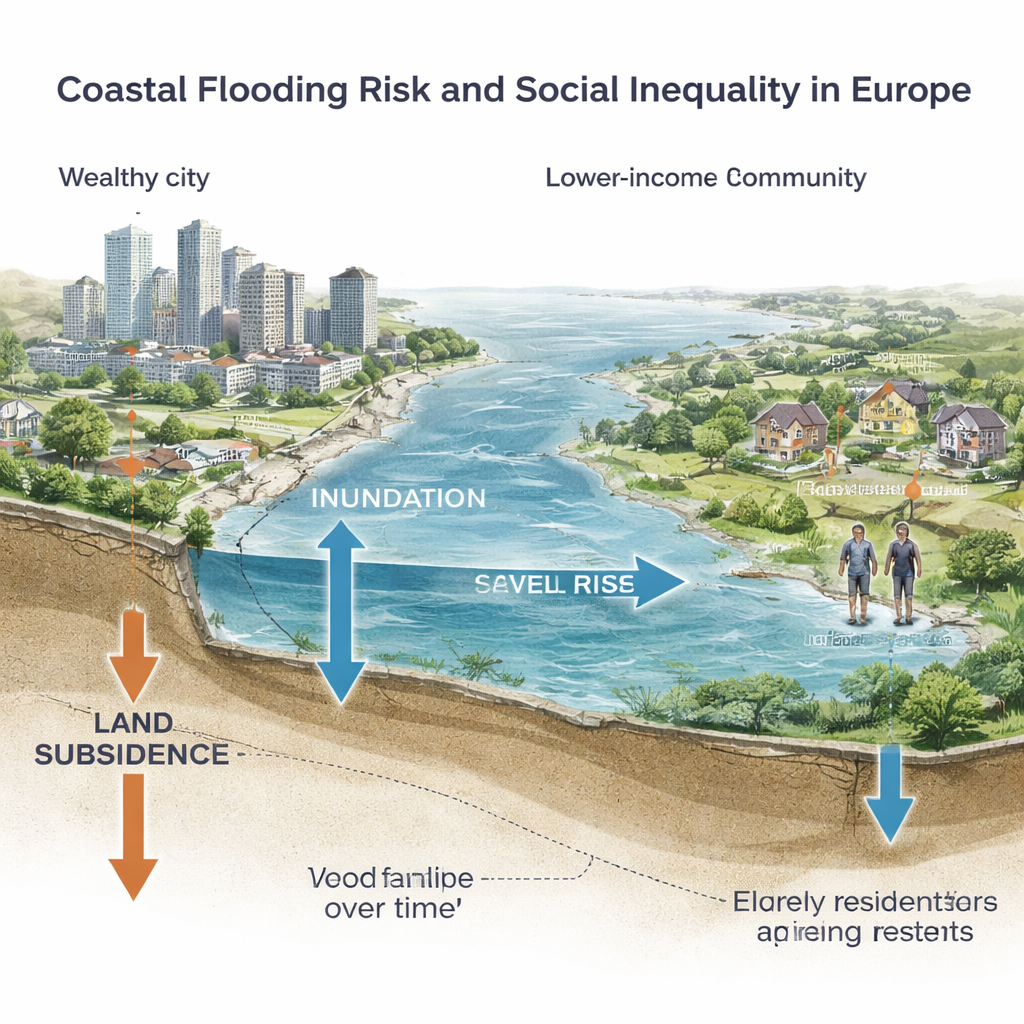
The danger is not only physical but social. The study overlays its flood maps with information on income, age, and marginalized communities. Many high-risk areas have strong economies and advanced defenses—but others do not. Low-income districts often lack robust infrastructure and insurance, making it harder to prepare and recover. Older adults and children already make up about 40% of the population in threatened zones, a share expected to rise to around 60% by 2050 as Europe ages. In parts of southern Europe, especially Spain, Roma communities and other socially excluded groups are concentrated in exposed coastal regions, frequently in poorer-quality housing. This combination of sinking land, rising water, and limited resources creates “triple-risk” zones: high subsidence, high exposure, and high social vulnerability.
Planning Fair and Future-Proof Coasts
The authors conclude that Europe’s coastal risk is not simply a story of higher seas; it is also about where the land is sinking and who lives on it. Northern uplift may offer some natural protection, but many southern and low-lying regions face mounting threats. By weaving together ground motion, land use, and social data, the study provides a continent-scale guide for targeting adaptation funds toward places where physical hazards and social inequality overlap. For everyday readers and decision-makers alike, the message is clear: the sooner Europe invests in both defenses and fairness—protecting wetlands, reinforcing infrastructure, and supporting vulnerable communities—the better prepared it will be for the coming decades of coastal change.
Citation: Chen, H., Wang, C., Fernandez, J. et al. European coastal deformation drives unequal exposure to climate hazards. Commun Earth Environ 7, 168 (2026). https://doi.org/10.1038/s43247-026-03190-y
Keywords: sea-level rise, land subsidence, coastal flooding, climate inequality, European coasts